AIR learning-rate schedule beats cosine in 128B-token MoE pretraining, paper claims
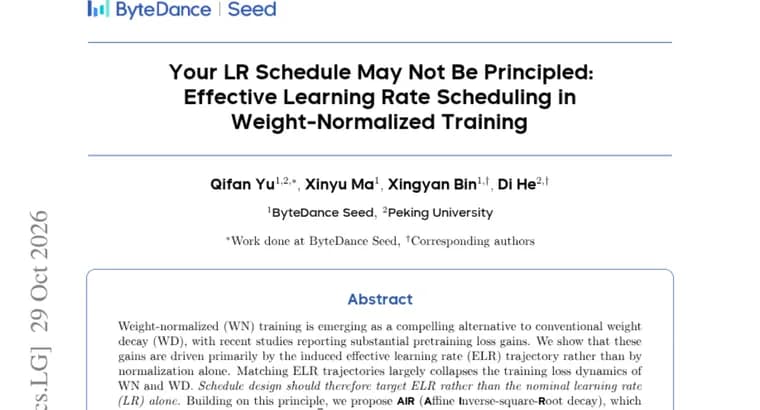
A paper listed on Hugging Face Papers takes on a question in language-model pretraining: why does weight-normalized (WN) training beat conventional weight decay (WD)? The paper's opening premise is that WN is emerging as a compelling alternative to WD, with recent studies reporting substantial pretraining loss gains.
The authors say those gains are driven primarily by the effective learning rate (ELR) trajectory that WN induces, not by normalization alone. When the ELR trajectories of the two methods are matched, the training loss dynamics of WN and WD largely collapse onto each other. The conclusion they draw is that schedule design should target ELR rather than the nominal learning rate (LR) alone.
Building on that principle, they propose AIR (Affine Inverse-square-Root decay). It combines a theoretically derived 1/t decay with an affine adjustment, so that a prescribed peak LR and terminal LR are met over a finite training horizon. The authors also identify late-stage ELR scheduling as a key source of AIR's gains: a shared late schedule attenuates the effect of earlier LR choices.
The empirical test is 128B-token Mixture-of-Experts pretraining. There, the authors report that AIR outperforms cosine and other candidate schedules on training loss, downstream performance and hyperparameter robustness. The one concrete number given is a reduction in terminal training loss of approximately 0.01 relative to cosine at matched cumulative LR. That is an absolute loss difference, not a percentage.
Finally, applying the same ELR trajectory to WD reproduces the corresponding training dynamics. The authors take this to show that the benefits extend beyond fixed-norm training, and they present ELR as the principled scheduling object.
Key facts
- The paper argues that WN training's pretraining loss gains over weight decay come primarily from the effective learning rate (ELR) trajectory, not from normalization alone.
- Matching ELR trajectories largely collapses the loss dynamics of WN and WD; applying the same ELR trajectory to WD reproduces the corresponding dynamics.
- AIR (Affine Inverse-square-Root decay) combines a theoretically derived 1/t decay with an affine adjustment to hit set peak and terminal LRs over a finite horizon.
- In 128B-token MoE pretraining, AIR is reported to beat cosine and other schedules on training loss, downstream performance and hyperparameter robustness.
- The stated loss margin is approximately 0.01 lower terminal training loss than cosine at matched cumulative LR.
Why it matters
Learning-rate schedules are a basic knob in every pretraining run, and cosine decay is the usual baseline. This paper claims the right thing to schedule is the effective learning rate rather than the nominal one. If that holds, it also reframes earlier reports that weight-normalized training beats weight decay: the authors attribute most of that advantage to the ELR trajectory, not to normalization itself.
Who it affects
Mainly people who run large-scale pretraining and tune schedules, particularly for Mixture-of-Experts models, which is where the experiments were run. Researchers comparing weight normalization with weight decay are also addressed, since the paper says matched ELR trajectories largely erase the difference between them.
How to use it
The practical takeaway the authors give is to design schedules around ELR rather than the nominal LR alone. AIR is their concrete proposal: a 1/t-style decay with an affine adjustment so that chosen peak and terminal LRs are satisfied over a fixed training length. They also say that applying the same ELR trajectory to WD reproduces the dynamics, so the idea is not limited to fixed-norm training.
How solid is it
The claims come from the authors' own abstract on a Hugging Face Papers listing. The reported experiments are 128B-token Mixture-of-Experts pretraining, with AIR said to beat cosine and other candidate schedules on training loss, downstream performance and hyperparameter robustness. The only quantified margin is about 0.01 in terminal training loss against cosine at matched cumulative LR. The authors say matching ELR "largely" collapses WN and WD dynamics, not completely.
Risks and caveats
The margin is small in absolute terms, and the source gives no absolute loss values, model sizes or expert counts to judge it against. The downstream benchmarks and the size of downstream gains are not named. The 0.01 figure is stated only against cosine; no figure is given for the other candidate schedules. Results are reported only for 128B-token MoE pretraining, and nothing is said about larger scale or dense models.