EasyProver nearly saturates Lean benchmarks; new Aegis tests Rust code
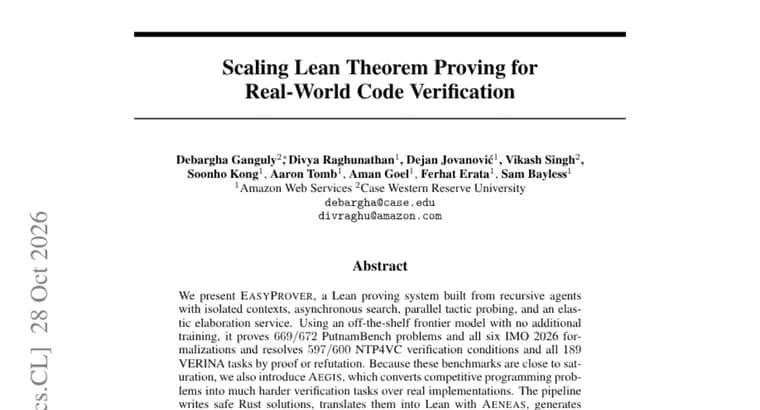
A paper on Hugging Face presents EasyProver, a Lean proving system built from recursive agents with isolated contexts, asynchronous search, parallel tactic probing, and an elastic elaboration service. It runs on an off-the-shelf frontier model with no additional training.
On existing benchmarks it comes close to a clean sweep. It proves 669 of 672 PutnamBench problems and all six IMO 2026 formalizations. It resolves 597 of 600 NTP4VC verification conditions and all 189 VERINA tasks, by proof or refutation.
Because these benchmarks are close to saturation, the authors also introduce Aegis, a pipeline that converts competitive programming problems into much harder verification tasks over real implementations. The pipeline writes safe Rust solutions, translates them into Lean with Aeneas, generates specifications, and labels each frozen statement with a kernel-checked proof or refutation. It produces 2,045 differentially validated Rust-Lean program pairs and 11,533 candidate specifications.
The authors say that, unlike hand-written benchmarks, these tasks carry implementation-level obligations from fixed-width arithmetic, explicit failure, generated loops, casts, and functionalized mutation.
On a stratified sample of 2,000 Aegis statements, EasyProver proves 1,054 (52.7%) within a 30-minute budget per statement. The authors add that the same tasks can be used to benchmark other provers and as rewards for reinforcement learning.
Key facts
- EasyProver is a Lean proving system made of recursive agents with isolated contexts, asynchronous search, parallel tactic probing and an elastic elaboration service, running on an off-the-shelf frontier model with no additional training.
- It proves 669/672 PutnamBench problems and all six IMO 2026 formalizations, and resolves 597/600 NTP4VC verification conditions and all 189 VERINA tasks by proof or refutation.
- Aegis turns competitive programming problems into Lean verification tasks over real Rust code, yielding 2,045 differentially validated Rust-Lean program pairs and 11,533 candidate specifications.
- On a stratified sample of 2,000 Aegis statements, EasyProver proves 1,054 (52.7%) within a 30-minute budget per statement.
Why it matters
The authors say PutnamBench, NTP4VC and VERINA are close to saturation, which makes them poor yardsticks for further progress. Aegis is their answer: tasks built over real Rust implementations that carry obligations hand-written benchmarks lack, such as fixed-width arithmetic, explicit failure, generated loops, casts and functionalized mutation. At 52.7% on the sample, there is clear room left.
Who it affects
Researchers building automated theorem provers and Lean tooling are the direct audience. The authors also say the Aegis tasks can be used to benchmark other provers and as rewards for reinforcement learning, so teams training proving models are another target.
How to use it
The abstract describes EasyProver as running on an off-the-shelf frontier model with no additional training. The Aegis tasks are offered as a benchmark for other provers and as reinforcement learning rewards.
How solid is it
These are the authors' own reported results, taken from the abstract of a preprint. Each Aegis statement is labelled with a kernel-checked proof or refutation, and the program pairs are differentially validated. The abstract does not name the frontier model used, and gives no comparison with other provers' scores on the old benchmarks or on Aegis.
Risks and caveats
The 52.7% figure comes from a 2,000-statement stratified sample under a 30-minute budget per statement, not the full set. The abstract does not say how many of the NTP4VC and VERINA results were proofs versus refutations, and states no compute cost or hardware. It also mentions no release of code, benchmark or dataset.