Know, then Draw: autoregressive pretraining before diffusion for images
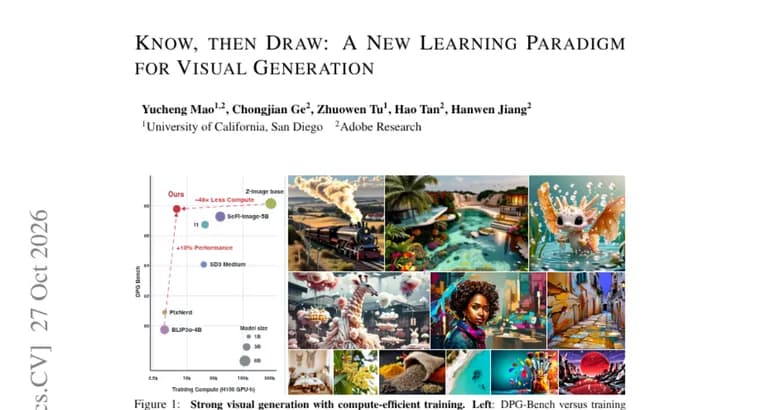
The paper "Know, then Draw" starts from the idea that visual generation needs two things: high-level semantic knowledge and fine-grained pixel detail. It proposes a learning paradigm that gives each job to a different stage. Autoregressive pretraining handles knowledge acquisition, and diffusion post-training handles high-fidelity rendering. Within that framework the authors study the objective, the representation and the scaling of both knowledge acquisition and rendering.
Their first finding comes from controlled comparisons: autoregression is the stronger pretraining objective for downstream rendering, improving both learning efficiency and final generation quality. Their second finding is that how well a model generates images with autoregression alone does not necessarily correlate with final performance; semantic quality matters more. That motivates a purely semantic tokenizer trained with language supervision alone, with no image decoder and no reconstruction loss.
The authors also establish compute-optimal scaling laws for knowledge acquisition and rendering. According to the fitted laws, autoregressive pretraining lowers the asymptotic rendering loss compared with pixel diffusion models trained from scratch.
Guided by those laws, they train a 3B-parameter text-to-image model using only 6,600 H100 GPU-hours. It achieves 86 on GenEval and 87 on DPG-Bench, which the authors present as validating the paradigm at scale.
Key facts
- The proposed paradigm assigns knowledge acquisition to autoregressive pretraining and high-fidelity rendering to diffusion post-training.
- Controlled comparisons show autoregression is the stronger pretraining objective for downstream rendering, improving learning efficiency and final quality.
- AR-only generation quality does not necessarily correlate with final performance; semantic quality matters more, motivating a purely semantic tokenizer trained with language supervision alone.
- Fitted scaling laws show autoregressive pretraining lowers the asymptotic rendering loss versus pixel diffusion models trained from scratch.
- A 3B-parameter text-to-image model trained with 6,600 H100 GPU-hours reaches 86 on GenEval and 87 on DPG-Bench.
Why it matters
Text-to-image systems usually have to learn what a scene should contain and how to render it at the same time. This paper argues for separating the two: learn the knowledge with an autoregressive objective first, then hand rendering to diffusion. The claim that autoregressive pretraining lowers the fitted asymptotic rendering loss against pixel diffusion trained from scratch, together with a compute-optimal scaling analysis, gives builders a way to plan training budgets rather than guess. The headline result is a 3B model trained with 6,600 H100 GPU-hours.
Who it affects
Mainly researchers and engineers who train text-to-image models, especially teams with modest compute. The finding about tokenizers is relevant to anyone designing image representations: the authors point to a purely semantic tokenizer trained with language supervision alone, without an image decoder or reconstruction loss.
How to use it
The paper offers a recipe in outline: pretrain autoregressively on semantic image tokens, then post-train with diffusion for rendering, and use the established scaling laws to split compute between the two stages. Judge a pretraining stage by its final performance after rendering, not by AR-only generation quality, which the authors say does not necessarily track it. The source mentions no code or weights release.
How solid is it
The claims are the authors' own, drawn from controlled comparisons and fitted scaling laws, and the 3B model is presented as validation at scale. The text names no other models on GenEval or DPG-Bench and does not state the benchmark scales, so the scores of 86 and 87 cannot be placed against competitors from this material. The size of the lowered asymptotic rendering loss is not quantified, and the pixel diffusion baselines are not named.
Risks and caveats
The comparison with pixel diffusion covers fitted asymptotic rendering loss, not benchmark scores. The result rests on a single 3B model, and the abstract mentions no training data, dataset size or inference cost. Fitted scaling laws are extrapolations, so the advantage at other scales is a projection from the fit, not something this text demonstrates.
“AR-only generation quality does not necessarily correlate with final performance; semantic quality matters more.”
— Know, then Draw (paper abstract)