WISD self-distillation trains reasoning models against a weakened copy
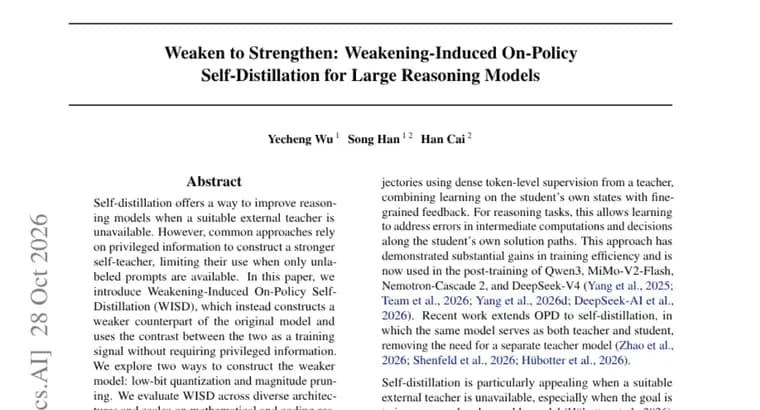
Self-distillation is a way to improve a reasoning model when no suitable external teacher exists. The paper's authors say the usual approaches depend on privileged information to build a stronger self-teacher, which limits them when only unlabeled prompts are available.
The paper introduces Weakening-Induced On-Policy Self-Distillation (WISD). Instead of building a stronger teacher, it builds a weaker counterpart of the original model and uses the contrast between the two as a training signal. No privileged information is required. The authors explore two ways of making the weaker model: low-bit quantization and magnitude pruning.
WISD was evaluated across diverse architectures and scales on mathematical and coding reasoning tasks. Across these benchmarks, the quantization and pruning variants improve average accuracy over the original models by 4.0 and 5.5 percentage points, respectively. The authors describe this as state-of-the-art performance even without privileged information.
The abstract gives two model-level examples. With pruning, Qwen3.5-4B rises from 57.7% to 70.5% on HMMT 2025 and from 39.1% to 56.7% on LiveCodeBench v6. With quantization, Qwen3.6-35B-A3B rises from 68.5% to 74.6% on HMMT 2025 and from 61.8% to 69.5% on LiveCodeBench v6. In points, that is 12.8 and 17.6 for the pruned Qwen3.5-4B, and 6.1 and 7.7 for the quantized Qwen3.6-35B-A3B. The authors conclude that the results establish WISD as a novel and effective self-distillation framework for large reasoning models.
Key facts
- WISD (Weakening-Induced On-Policy Self-Distillation) builds a weaker copy of a model and uses the contrast between the two as a training signal, with no privileged information.
- The weaker model is made by low-bit quantization or magnitude pruning; the two variants lift average accuracy over the original models by 4.0 and 5.5 percentage points, respectively.
- Pruning raises Qwen3.5-4B from 57.7% to 70.5% on HMMT 2025 and from 39.1% to 56.7% on LiveCodeBench v6.
- Quantization raises Qwen3.6-35B-A3B from 68.5% to 74.6% on HMMT 2025 and from 61.8% to 69.5% on LiveCodeBench v6.
- Evaluation covers mathematical and coding reasoning tasks across diverse architectures and scales.
Why it matters
Most self-distillation methods need privileged information, such as extra data, to make a stronger teacher. That is a problem when a team has only unlabeled prompts. WISD turns the usual idea around: the training signal comes from a deliberately degraded copy of the model itself, so the method does not depend on such information. If the reported gains hold, it offers a route to improve a reasoning model with nothing beyond the model and its prompts.
Who it affects
The work is aimed at people training or post-training large reasoning models, especially those without a strong external teacher or labeled data. The reported results cover Qwen3.5-4B and Qwen3.6-35B-A3B on math and coding tasks, so those working with models of that kind are the closest audience.
How to use it
The abstract describes the recipe only at a high level: create a weaker version of your model by low-bit quantization or magnitude pruning, then use the contrast between the two as an on-policy training signal. The quantization bit width and the pruning ratio are not stated. No code or model release is mentioned, so anyone wanting to try it would have to wait for fuller details from the paper.
How solid is it
This is a preprint listed on Hugging Face Papers, and the source is its abstract. The results are the authors' own, and no independent verification is mentioned. The baselines behind the state-of-the-art claim are not named. The number of models and benchmarks behind the average gains of 4.0 and 5.5 points is not given beyond math and coding tasks.
Risks and caveats
The abstract does not explain why contrast with a weakened model yields a useful training signal. Training cost, compute and number of training steps are not stated, so the price of the gains is unknown. The two single-model examples use different weakening methods on different models, pruning for Qwen3.5-4B and quantization for Qwen3.6-35B-A3B, so they should not be read as a like-for-like comparison. The headline averages come from the authors' own evaluation.
“constructs a weaker counterpart of the original model and uses the contrast between the two as a training signal without requiring privileged information”
— WISD paper abstract