A paper argues the linear representation hypothesis needs a group action
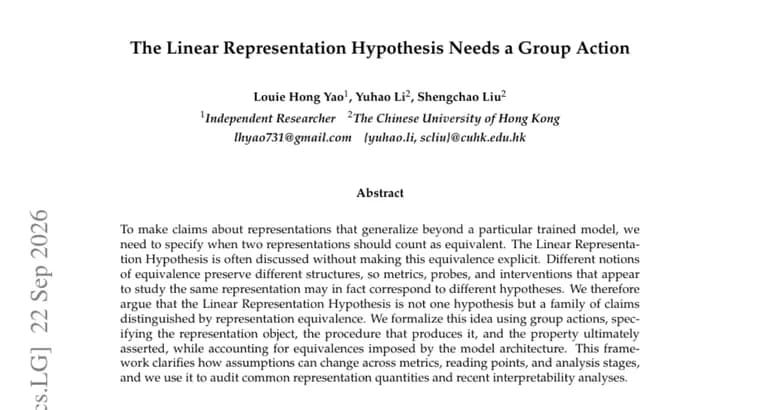
A paper posted on Hugging Face's papers section takes aim at a foundational idea in AI interpretability research, the Linear Representation Hypothesis, which holds that concepts inside trained models are encoded along linear directions. The authors argue that any claim about representations that is meant to generalize beyond one particular trained model requires specifying when two representations should count as equivalent, and that this equivalence is usually left unstated when the hypothesis is discussed. Because different notions of equivalence preserve different structures, metrics, probes, and interventions that look like they are studying the same representation can in fact be testing different, incompatible hypotheses without anyone noticing. On that basis, the authors contend that the Linear Representation Hypothesis is not a single hypothesis at all but a family of claims that differ according to which notion of representation equivalence they assume. To fix this, they formalize the idea using group actions: specifying the representation object itself, the procedure used to produce it, and the property ultimately being asserted about it, while accounting for the equivalences that the model's own architecture imposes. The authors state that this framework clarifies how assumptions can shift across different metrics, different points at which a representation is read out, and different stages of analysis, and that they use it to audit common representation quantities and recent interpretability analyses. The source text does not name specific quantities or analyses audited, does not report experimental results or numbers, and does not give the mathematical details of the group-action construction; it also does not name the paper's authors or their institutions.
Key facts
- The paper argues that discussions of the Linear Representation Hypothesis typically omit an explicit definition of when two representations count as equivalent.
- Because different equivalence notions preserve different structures, metrics, probes, and interventions that appear to test the same representation can correspond to different underlying hypotheses.
- The central claim is that the Linear Representation Hypothesis is not one hypothesis but a family of claims distinguished by representation equivalence.
- The authors formalize representation equivalence using group actions, covering the representation object, the procedure producing it, the asserted property, and equivalences imposed by model architecture.
- The framework is used to audit common representation quantities and recent interpretability analyses, though the source text gives no specifics of which ones or what the audit found.
Why it matters
The Linear Representation Hypothesis underpins a large share of current mechanistic interpretability work, from probing classifiers to activation steering. If different studies quietly assume different, incompatible notions of what counts as 'the same representation,' their results and comparisons can be less commensurable than they appear. Making the equivalence notion explicit, as this paper proposes, is meant to expose and prevent that kind of hidden mismatch.
Who it affects
This concerns interpretability researchers who build metrics, probes, and interventions to study how neural networks represent concepts, and anyone who relies on such studies to argue that a model 'really' encodes a concept in a particular linear direction.
How to use it
The group-action framework is offered as a tool for researchers to check their own work: specifying the representation object, the procedure that produces it, the property being asserted, and the equivalences the model architecture already imposes, so that assumptions stay visible across metrics, reading points, and analysis stages. The paper itself does not describe a software tool, price, or release, only a conceptual method that its authors say they applied to audit existing representation quantities and interpretability analyses.
How solid is it
The available text is the paper's abstract-level description rather than the full paper; it does not name the authors or their institutions, does not include experimental results or numbers, and does not spell out the mathematical details of the group-action construction, so the framework's concrete payoff cannot be verified from this text alone.
Risks and caveats
Because the source does not specify which 'common representation quantities' or 'recent interpretability analyses' were audited, or what the audit found, the practical impact of the argument is not established here; it should be read as a conceptual and methodological argument rather than a validated empirical result.
“the Linear Representation Hypothesis is not one hypothesis but a family of claims distinguished by representation equivalence”
— the paper's authors