a16z: only 4.5% of US consumers pay for ChatGPT, Gemini or Claude
Venture capital firm Andreessen Horowitz (a16z) has published the seventh edition of its ranking of the most-used consumer AI products. After three years the top of the list looks increasingly locked in: only eleven products made it on for the first time, the fewest newcomers ever. Beyond web traffic and mobile user counts, a16z now also tracks observed spending on US consumer cards, using data from YipitData. The figures come from panels and do not represent total revenue, but they give a new view of how people actually pay for AI.
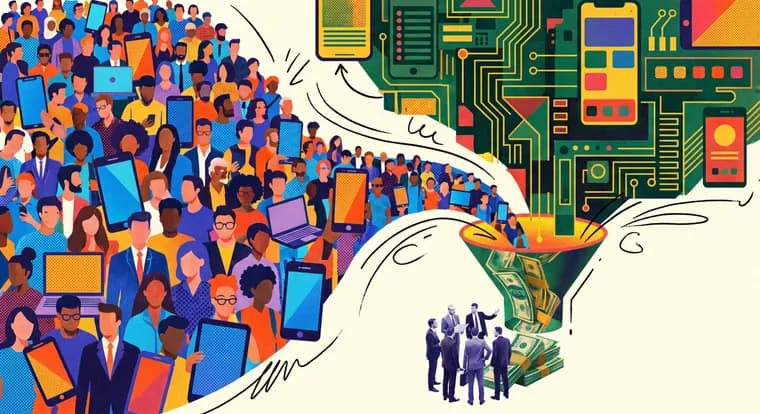
The headline finding is wide adoption and shallow monetization. Nearly half of US consumers now use AI, according to a16z, but only a quarter do so daily. Just 4.5 percent had an active paid personal subscription to ChatGPT, Gemini or Claude in August, up from roughly half that a year earlier.
Within that narrow base, revenue is extremely concentrated. The top one percent of spenders accounts for nearly a fifth of all observed AI spending, more than the entire bottom half combined. That top one percent averages about $900 per month and keeps climbing, while the typical paying user spends about $25 and has held steady at that level for a while. These top spenders favor building and automation tools such as n8n, Manus and fal at much higher rates, along with creative tools such as Higgsfield, Figma and HeyGen. They are prosumers buying software to build, design and work, and a16z says consumer AI has found its first real paying market in this group. Only seven companies rank in the top tier across all three rankings, including ChatGPT, Claude, Perplexity and Canva.
The article also links the gap between many users and few payers to depth of engagement. Paid accounts offer far more features but are more complex and demand a steeper learning curve, so free users typically scratch the surface. That creates a growing skills gap between high-level users and people who barely use AI, which could deepen existing social inequality, or AI may simply keep getting easier and cheaper. The article's author adds that OpenAI CEO Sam Altman talks about "unlimited brilliance" for everyone in this context, though with a fairly naive outlook.
Among the three leading language models, ChatGPT remains first, with roughly double Gemini's web traffic and six times Claude's, and the gap is wider on mobile. The biggest shift is Claude's rise to a clear number three. It did not appear on the first web list in 2023 but has since passed Deepseek and Perplexity in traffic and pulled even with Gemini among US subscribers. Anthropic also monetizes better than its rivals, with a much larger share of Claude users on the priciest tier, starting at $100 per month, than similar plans from OpenAI and Google. Momentum shifted by midsummer, though: daily Claude sessions fell in July and August, while ChatGPT picked up speed again with new models and ChatGPT Work. The question, according to a16z, is less about who wins and more about how well each company capitalizes on its window.
Personal assistant agents are the next race. Six months ago an agent like OpenClaw was not usable for most consumers, according to a16z. Now startup agents such as Instinct and Tomo report hundreds of thousands of users, and big players are countering with Meta's Muse, OpenAI's Dots and xAI's Grok Bot. Agents become an economic force once they trigger real purchases: Instinct founder Noah Shinn says 40 percent of users link a credit card within three weeks and then spend four-figure amounts per month through the service, much of it on travel. Platforms are already picking sides. Amazon blocked Meta's Muse within two weeks, while Shopify, Instacart, OpenTable and others signed official integrations. Muse hit a quarter million daily users in its first week and topped five million downloads in under a month, which is still modest next to Meta's Threads, with more than 15 million downloads in three weeks at launch.
On business models, established players are the most likely to make money from AI: Canva and Notion rank in the web top ten, and Google alone holds five web spots. Startups carve out space mainly through a differentiated model, a multi-model experience, a specific audience, or by bypassing entrenched interfaces. The vast majority of top AI-native products rely on subscriptions or usage fees, with only a small fraction using ads or transaction fees. According to a16z this inverts the pre-AI internet, where users were the product and advertising drove the bulk of revenue at Meta and Alphabet; high model costs prevent AI companies from forgoing early revenue to build a large user base first. Alternatives are taking shape: OpenAI reported an annualized revenue run rate of $1 billion from ChatGPT advertising in August, and personal agents could open a path through affiliate fees or transaction cuts.
The sixth edition, six months earlier, focused more on geographic splits, such as the rise of Yandex Browser with its AI assistant Alice in Russia and Deepseek's role as a bridge between Western and Chinese user bases. Even then a16z warned that web traffic and app downloads say less and less about which AI products people actually use as AI shifts from a standalone product to an embedded feature. The new spending data is a direct attempt to close that gap.
Key facts
- Nearly half of US consumers use AI and a quarter do so daily, but only 4.5 percent had an active paid personal subscription to ChatGPT, Gemini or Claude in August, roughly double the share a year earlier.
- The top one percent of spenders accounts for nearly a fifth of all observed AI spending, more than the entire bottom half combined, averaging about $900 per month against about $25 for the typical paying user.
- Spending data comes from YipitData panels of US consumer cards, a first for the a16z list, and does not represent total revenue; only eleven products are new this edition, the fewest ever.
- ChatGPT has roughly double Gemini's web traffic and six times Claude's; Claude is a clear number three and has a much larger share of users on its tier starting at $100 per month, but daily Claude sessions fell in July and August.
- The vast majority of top AI-native products rely on subscriptions or usage fees rather than ads, and OpenAI reported a $1 billion annualized run rate from ChatGPT advertising in August.
Why it matters
Until now the list was built on web traffic and app downloads, which a16z itself warned say less and less about what people actually use. Adding observed card spending gives the first direct look at who pays. The picture is a thin paying layer on top of broad free use: 4.5 percent paying for the three leading assistants, and a top one percent of spenders outspending the bottom half combined. According to a16z, this inverts the pre-AI internet, because high model costs stop AI companies from giving up early revenue to build a user base first. That is why subscriptions and usage fees dominate and ads and transaction fees remain a small fraction.
Who it affects
AI companies and startups are the main audience: the money sits with prosumers who buy tools to build, design and work, and Claude, ChatGPT and Gemini compete for them directly. Platforms and merchants are affected as personal agents start triggering purchases; Amazon blocked Meta's Muse within two weeks, while Shopify, Instacart and OpenTable signed integrations. Ordinary users who stay on free tiers are affected too: the article ties the gap between paid and free use to a growing skills gap that could deepen existing social inequality.
How to use it
Treat the list as a map of where paying demand is. Top spenders favor building and automation tools such as n8n, Manus and fal, plus creative tools such as Higgsfield, Figma and HeyGen. For founders, a16z says startups carve out space mainly through a differentiated model, a multi-model experience, a specific audience, or by bypassing entrenched interfaces. For anyone pricing an AI product, the contrast between the typical $25 monthly payer and the roughly $900 top-one-percent average, and Claude's tier starting at $100 per month, shows where heavy users are willing to spend.
How solid is it
The spending figures are observed US consumer card spending from YipitData panels, not total revenue, and the source says so explicitly. a16z is a venture capital firm summarizing its own ranking, and the article is The Decoder's account of it. The $25 figure is described only as what the typical paying user spends, and the article does not state whether that is a median or a mean. The article does not give the year of the August measurement. The 4.5 percent figure covers paid personal subscriptions to ChatGPT, Gemini or Claude only, not all AI products. The comparison to a year earlier is stated only as roughly half.
Risks and caveats
No absolute dollar total of consumer AI spending is given, so the concentration figures are shares within a panel, not market size. The $900 and $25 numbers describe card spending visible to the panels and may not reflect everything people pay. The skills-gap and inequality points are the article's reasoning, offered with 'could', and the article adds that AI may simply get easier and cheaper. The 'fairly naive outlook' remark about Sam Altman's 'unlimited brilliance' is the article author's own comment, not a16z's. Momentum can also shift quickly: Claude's daily sessions fell in July and August, and Meta's Muse, at five million downloads in under a month, is modest next to Threads.
“Consumer AI has found its first real paying market in this group, according to a16z.”
— The Decoder, summarizing a16z's Top 100 consumer AI report