A2-MEAS robot framework reports 0.6411 Q-score on BEHAVIOR 2026
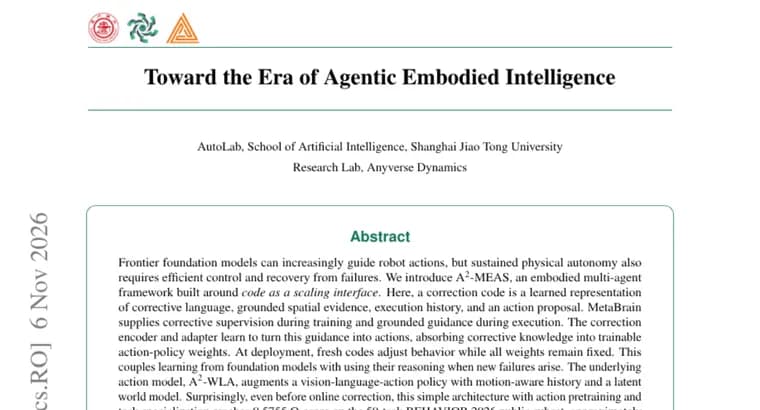
A paper listed on Hugging Face introduces A2-MEAS, an embodied multi-agent framework "built around code as a scaling interface". The starting point is that foundation models increasingly guide robot actions, yet sustained autonomy needs efficient control and recovery from failure.
The core idea is the learned correction code. These codes combine corrective language, spatial evidence, execution history and action proposals. A component called MetaBrain provides training supervision and runtime guidance. During training, a correction encoder and adapter absorb this knowledge into the policy weights. At deployment, fresh codes adapt the robot's behavior while the weights stay frozen.
The action model is A2-WLA, which adds motion-aware history and a latent world model to a vision-language-action policy. The authors call it surprising that this simple design, with action pretraining and task specialization, reaches a 0.5755 Q-score on the 50-task BEHAVIOR 2026 public subset before online correction. They put that at 2.21x the 2025 winner's reported 0.2605, and note that the comparison spans different benchmark editions and training configurations. On all 100 BEHAVIOR 2026 public tasks, A2-MEAS achieves a 0.6411 Q-score and 45.40% task success.
On RoboTwin 2.0, A2-WLA reaches 93.98% average success, rising to 95.05% with the complete system. On real hardware, across 12 tasks in five household settings, A2-WLA averages 57.92% success against 26.67% for pi0.5.
The recovery claim is tested on long-horizon pour-over coffee preparation. There, a history-conditioned adapter raises post-failure completion at two filter-handling steps from 14% to 94% and from 8% to 82%, compared with A2-WLA retries.
The authors also report training infrastructure that delivers 427.1 samples per second, 4.03x the throughput of a pi0.5 reference implementation on matched hardware. They say they will release the system, models, training scripts and infrastructure to support efficient embodied learning.
Key facts
- A2-MEAS is an embodied multi-agent framework in which learned correction codes (corrective language, spatial evidence, execution history, action proposals) steer a robot policy; at deployment fresh codes adapt behavior with frozen weights.
- On the 50-task BEHAVIOR 2026 public subset, A2-WLA scores 0.5755 Q-score before online correction, 2.21x the 2025 winner's reported 0.2605, across different benchmark editions and training configurations.
- On all 100 BEHAVIOR 2026 public tasks, A2-MEAS reaches 0.6411 Q-score and 45.40% task success; on RoboTwin 2.0, A2-WLA averages 93.98% success, 95.05% with the complete system.
- Across 12 real-robot tasks in five household settings, A2-WLA averages 57.92% success versus 26.67% for pi0.5.
- The authors say they will release the system, models, training scripts and infrastructure; the release is a promise, not yet delivered.
Why it matters
Robot policies built on foundation models still struggle to keep working over long tasks and to recover when a step goes wrong. This paper attacks that with correction codes that carry feedback into the policy, and it reports recovery numbers on a long-horizon coffee task: completion after failure at two filter-handling steps rises from 14% to 94% and from 8% to 82% against A2-WLA retries. The authors also describe the result on the BEHAVIOR 2026 subset as surprising given how simple the underlying design is.
Who it affects
Robotics researchers working on vision-language-action policies, household manipulation and failure recovery are the main audience, along with teams that compete on BEHAVIOR or evaluate on RoboTwin 2.0. Anyone training robot policies may care about the reported 4.03x training throughput over a pi0.5 reference implementation on matched hardware, if the promised infrastructure arrives.
How to use it
Nothing can be used yet. The authors say they will release the system, models, training scripts and infrastructure. No release date, repository link or license is given for the promised release. For now the paper is a source of design ideas: corrective language, spatial evidence, execution history and action proposals combined into codes, with a correction encoder and adapter absorbing them during training and fresh codes adapting behavior at deployment.
How solid is it
These are self-reported results from an abstract on Hugging Face's paper listing. The abstract names no authors or institutions. The 2.21x comparison is against the 2025 winner's reported score on a different benchmark edition and different training configuration, so it is not like-for-like, and the 2025 winner is not named. The 0.5755 figure is for a 50-task public subset before online correction; the abstract does not say what the score is after online correction on that subset. It does not state how many trials were run for the real-robot or coffee experiments, nor any confidence intervals, and it does not say whether the results have been peer reviewed or independently reproduced.
Risks and caveats
The headline multiple rests on a cross-edition comparison, so it should not be read as a measured advantage over the 2025 winner. Real-robot success of 57.92% means the system still fails on a large share of tasks, even though it is more than double pi0.5's 26.67% on the same 12 tasks. The abstract does not say which model sizes or hardware were used, or what the matched hardware for the throughput comparison is. The release of code and models is a stated intention only.
“We will release the system, models, training scripts, and infrastructure to support efficient embodied learning.”
— Paper abstract, Hugging Face papers listing