AES and HDC improve multimodal agent training beyond simple scaling
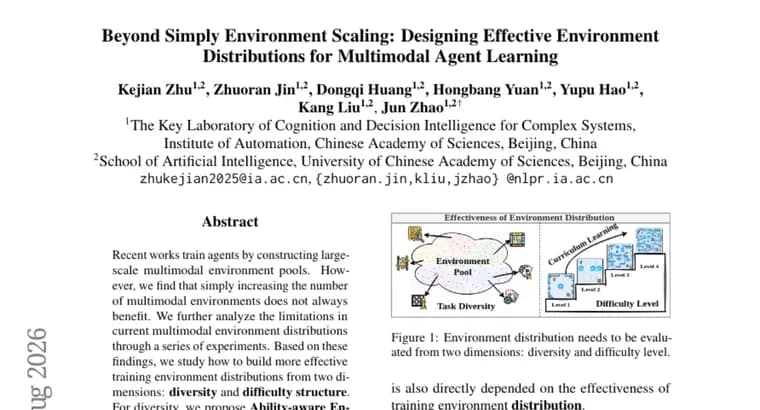
A paper posted to Hugging Face's papers listing pushes back on a common assumption in multimodal agent training: that pooling together more interactive environments simply makes for a better agent. The authors report that increasing the number of multimodal environments in a training set does not always help performance, and after a series of experiments examining the limitations of current multimodal environment distributions, they argue the more useful question is how those distributions are built rather than how large they are.
They split the problem into two dimensions. The first is diversity, addressed with a method called Ability-aware Environment Selection (AES), which selects environments to build a diverse set rather than an arbitrarily large one. The second is difficulty structure, addressed with a method called Hierarchical Difficulty Curriculum (HDC), which organizes curriculum learning across two difficulty levels the authors name harness weakening and state-scale progression. The text does not spell out what those two levels mechanically involve beyond naming them.
The authors state that experiments show AES and HDC effectively improve multimodal agent training, though no benchmark names, datasets, or numerical results such as accuracy figures accompany that claim in the material available here.
Key facts
- The authors find that simply increasing the number of multimodal environments in a training pool does not always improve agent performance.
- Ability-aware Environment Selection (AES) is proposed to build diverse environment sets, addressing the diversity dimension of environment distributions.
- Hierarchical Difficulty Curriculum (HDC) organizes curriculum learning through two difficulty levels: harness weakening and state-scale progression.
- The authors report that experiments show AES and HDC effectively improve multimodal agent training, though the available text gives no benchmark names or numerical results to support that claim.
Why it matters
Training agents that operate across multiple modalities usually relies on large pools of interactive environments, and the common assumption is that adding more environments makes for a better agent. The authors report this is not always true: simply increasing the number of multimodal environments in a training pool does not consistently improve performance. That shifts the question from how many environments to use toward how those environments should be selected and structured, which is a more direct lever for anyone building agent training pipelines than raw scale.
Who it affects
The work speaks to researchers and teams building multimodal agents through large-scale environment pools, particularly anyone assembling or curating environment collections for agent training rather than just scaling them up.
How to use it
The authors propose two methods for two separate dimensions of environment distributions. Ability-aware Environment Selection (AES) targets diversity: it selects environments to obtain a diverse set rather than simply the largest one. Hierarchical Difficulty Curriculum (HDC) targets difficulty structure: it organizes curriculum learning through two difficulty levels described as harness weakening and state-scale progression. The text names these two levels without describing the mechanics behind them.
How solid is it
The available text states that experiments show AES and HDC effectively improve multimodal agent training, but it gives no benchmark names, datasets, or numerical results such as accuracy figures or score deltas to back that claim, and no author names or institutional affiliations appear either. The improvement claim is the authors' own summary of their experiments as stated in the abstract, not something that can be independently checked from what is available here.
Risks and caveats
Without the benchmarks or numbers behind the reported improvement, the size and reliability of the effect cannot be assessed from what is available; confirming whether AES and HDC hold up across different environment pools, or only in the settings actually tested, requires the full paper. The terms harness weakening and state-scale progression are used without a mechanical description in the source, so readers should not assume a specific technique from the names alone.