AEWM edits an AI agent's own reasoning instead of predicting what happens next
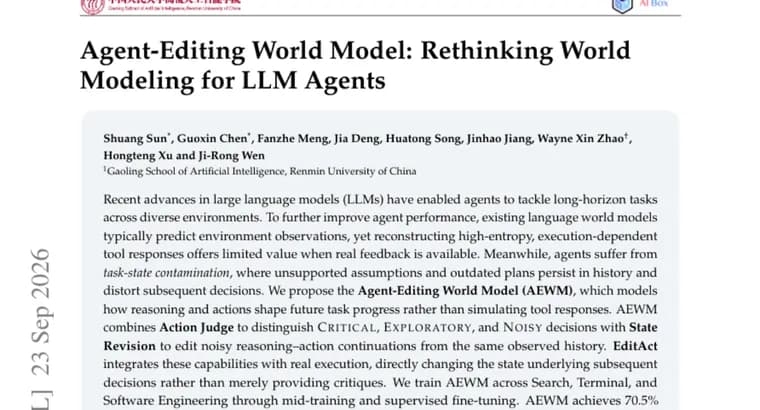
Researchers propose the Agent-Editing World Model (AEWM), a different take on world modeling for large language model agents that carry out long, multi-step tasks. Most existing language world models try to predict what the environment or a tool will return next, but the authors argue this has limited value once an agent can just get real feedback from execution, since tool responses are high-entropy and depend heavily on execution context. Instead, they identify a separate problem they call task-state contamination: unsupported assumptions and outdated plans that get stuck in an agent's history and distort its later decisions. AEWM addresses this by editing the agent's own reasoning-and-action history rather than simulating future observations. It combines two components: an Action Judge that sorts an agent's decisions into three categories, Critical, Exploratory, and Noisy, and a State Revision component that rewrites the noisy reasoning-action continuations found in that same history. These two pieces are packaged together as EditAct, which plugs into real execution and directly changes the state that drives an agent's subsequent decisions, rather than just producing critiques of what it did. The team trained AEWM across three domains, Search, Terminal, and Software Engineering, using mid-training followed by supervised fine-tuning; no details on model size, compute, or training duration are given. On the paper's own Action Judge benchmark, AEWM reaches 70.5% macro-F1, beating the strongest frontier baseline by 10.6 points. Across six benchmarks and three different agent backbones, EditAct raises average scores by 3.2 to 6.7 points over the strongest baseline in each case. The team also tested a variant called AEWM-RFT, which fine-tunes on verified EditAct trajectories via rejection sampling; without any online guidance from AEWM at inference time, it still improves over a Self-RFT baseline by 2.2 to 2.6 points across three domains. The paper does not name the authors, their institutions, the six benchmarks, the three agent backbones, or the frontier and Self-RFT baselines it compares against.
Key facts
- AEWM edits an agent's own reasoning and action history instead of predicting future environment or tool observations
- Action Judge classifies an agent's decisions as Critical, Exploratory, or Noisy; State Revision then rewrites noisy reasoning-action continuations
- EditAct, which combines both components with real execution, improves average scores by 3.2 to 6.7 points over the strongest baseline across six benchmarks and three agent backbones
- AEWM scores 70.5% macro-F1 on the paper's own Action Judge benchmark, 10.6 points above the strongest frontier baseline
- AEWM-RFT, fine-tuned on verified EditAct trajectories via rejection sampling, beats a Self-RFT baseline by 2.2 to 2.6 points across three domains without online AEWM guidance
Why it matters
Most language world models for agents try to predict what a tool or environment will return next, which the authors say is wasted effort once real execution feedback is available. AEWM targets a different failure mode instead: agents accumulating unsupported assumptions and stale plans in their own history that quietly corrupt later decisions. By editing that history directly rather than forecasting the environment, the approach reframes what a 'world model' should even be doing for an agent.
Who it affects
The work is aimed at builders of LLM agents that operate over long, multi-step tasks in domains like web search, terminal use, and software engineering, where accumulated reasoning errors compound over many turns.
How to use it
AEWM and EditAct are research components: Action Judge and State Revision, trained via mid-training and supervised fine-tuning across Search, Terminal, and Software Engineering domains. The paper gives no model size, compute budget, release details, or licensing information, so there is nothing yet to deploy directly.
How solid is it
The reported gains come from the authors' own experiments: 70.5% macro-F1 on their own Action Judge benchmark (10.6 points over the strongest frontier baseline), 3.2 to 6.7 point average-score improvements from EditAct across six benchmarks and three agent backbones, and 2.2 to 2.6 point gains for AEWM-RFT over Self-RFT across three domains. The identities of those six benchmarks, the three backbones, and the specific baselines are not disclosed in the available text, which limits independent verification.
Risks and caveats
The source text does not name the authors, their institutions, a publication date, model sizes, or training compute, and does not identify the specific benchmarks and baselines behind the headline numbers. All reported improvements are the authors' own comparisons against unnamed baselines rather than independently reproduced results.
“existing language world models typically predict environment observations, yet reconstructing high-entropy, execution-dependent tool responses offers limited value when real feedback is available”
— from the paper