Agensh scales self-organized AI agent teams to 1,024 workers
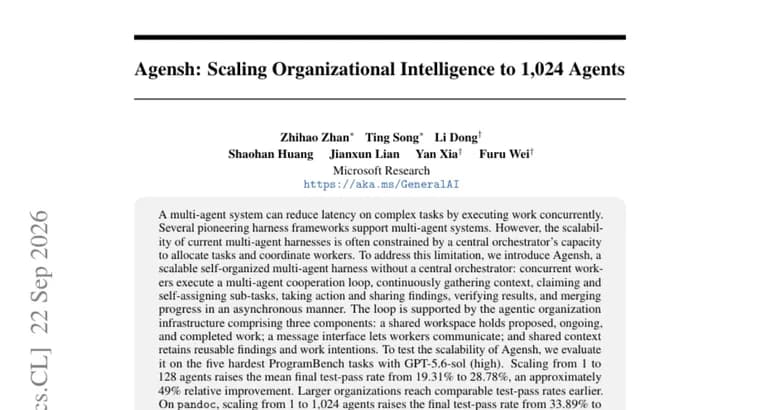
Researchers have introduced Agensh, a multi-agent AI harness designed to scale without a central orchestrator directing the work. Most existing multi-agent frameworks route task allocation and coordination through a single orchestrator, which the authors say caps how far these systems can grow. In Agensh, concurrent worker agents instead run a shared cooperation loop: they gather context, claim and self-assign sub-tasks, act, share findings, verify results and merge progress asynchronously. This loop runs on top of an infrastructure with three parts: a shared workspace tracking proposed, ongoing and completed work; a message interface for workers to communicate; and a shared context store that retains reusable findings and stated intentions.
To test whether this design actually scales, the team evaluated Agensh on the five hardest tasks in ProgramBench using the GPT-5.6-sol (high) model. Going from 1 agent to 128 agents raised the mean final test-pass rate from 19.31% to 28.78%, a roughly 49% relative improvement. Larger teams of agents also reached comparable test-pass rates earlier than smaller ones. On a separate pandoc task, scaling from 1 to 1,024 agents raised the final test-pass rate from 33.89% to 55.06%. Looking at individual worker trajectories, the researchers observed that distinct patterns of self-organized cooperation gradually emerged and became more standardized as the size of the agent organization grew.
The authors frame these results as evidence that the number of agents is itself a new scaling dimension for multi-agent systems, alongside familiar levers like model size or compute per agent. They argue this offers a practical way to handle complex tasks when there are hard limits on latency or time budgets, since adding more concurrent agents can substitute for giving any single agent more time or a bigger model.
Key facts
- Agensh is a self-organized multi-agent harness with no central orchestrator; workers claim sub-tasks and merge progress asynchronously through a shared workspace, a message interface and shared context.
- On the five hardest ProgramBench tasks with GPT-5.6-sol (high), scaling from 1 to 128 agents raised the mean final test-pass rate from 19.31% to 28.78%, about a 49% relative improvement.
- On a pandoc task, scaling from 1 to 1,024 agents raised the final test-pass rate from 33.89% to 55.06%.
- Larger agent organizations reached comparable test-pass rates earlier than smaller ones, and worker trajectories showed self-organized cooperation patterns standardizing as the team grew.
- The authors present agent count as a new scaling dimension for multi-agent systems, useful for complex tasks under hard latency or time-budget constraints.
Why it matters
Current multi-agent frameworks typically rely on a single orchestrator to hand out tasks and coordinate workers, which limits how large the team can grow before coordination becomes the bottleneck. Agensh removes that central point by having agents self-organize through a shared workspace and message interface, and the reported gains from scaling to 128 or even 1,024 agents suggest agent count can act as an independent lever for improving results, separate from making any single model bigger or smarter.
Who it affects
The work is aimed at researchers and engineers building multi-agent AI systems for complex tasks, particularly those facing hard latency or time-budget limits where running many agents concurrently could substitute for giving one agent more time.
How to use it
The source describes a research harness and its benchmark results rather than a released product; it gives no pricing, licensing or availability details, so there is nothing to report about accessing or deploying Agensh beyond the described architecture.
How solid is it
The reported numbers come from a defined test setup: the five hardest ProgramBench tasks and a separate pandoc task, evaluated with the GPT-5.6-sol (high) model. The source text names no authors or affiliated institution and does not compare Agensh directly against other named multi-agent frameworks, only against the general limitation of centrally orchestrated systems, so the claims of superiority rest mainly on the paper's own before-and-after numbers.
Risks and caveats
The scaling benefits are shown on a small set of tasks, five ProgramBench tasks plus pandoc, and the relative improvement from 1 to 128 agents (about 49%) is well short of proportional to the agent count increase, indicating diminishing returns. Without author or institutional information, or a head-to-head comparison against other multi-agent harnesses, it is hard to independently judge how the approach would generalize beyond these benchmarks.
“These results reveal the number of agents as a new scaling dimension for multi-agent organizations to expand the frontier of general intelligence, offering a practical solution for complex tasks under hard latency constraints or time budgets.”
— the researchers behind Agensh