AI research agents cut token use up to 73% by pruning early
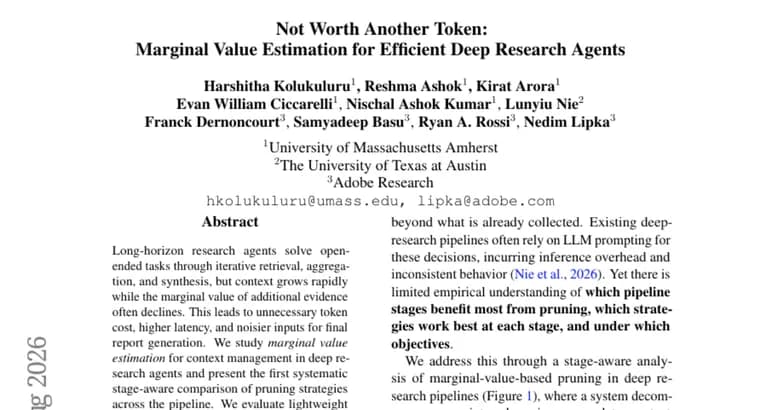
Long-horizon research agents work by repeatedly retrieving, aggregating, and synthesizing evidence to answer open-ended questions. The problem is that context keeps growing across those iterations even as each new piece of evidence adds progressively less value, driving up token cost, latency, and noise in the final report. A new paper studies how to manage that growing context by pruning it, and runs what it describes as the first systematic, stage-aware comparison of pruning strategies across the full agent pipeline. The researchers test both lightweight heuristic scoring rules and a learned value model, applying each at three different points: before retrieval, after retrieval, and before final synthesis. The central finding is that the stage at which pruning happens matters more than which scoring method is used to decide what to cut. Pruning early, before or right after retrieval, produces the largest end-to-end savings, because it stops low-value content from accumulating in the first place. Pruning later, just before synthesis, mainly cleans up the final context rather than reducing overall cost. On the numbers, lightweight heuristics cut token usage by up to 73% with little quality degradation, and the learned value model stays competitive on some trade-offs without clearly beating the heuristics overall. No single method wins across quality, efficiency, and faithfulness at once; the choice depends on which of those three a given system needs to prioritize. The paper frames the results as practical guidance for anyone building efficient long-horizon agentic systems, pointing builders toward stage placement as the higher-leverage design decision, ahead of picking a specific pruning algorithm.
Key facts
- First systematic, stage-aware comparison of context-pruning strategies for deep research agents, tested at pre-retrieval, post-retrieval, and pre-synthesis stages.
- Where pruning happens in the pipeline matters more than which scoring method is used to decide what to prune.
- Early pruning delivers the largest end-to-end token savings; late pruning mainly refines the final synthesis context rather than cutting overall cost.
- Lightweight heuristic pruning cuts token usage by up to 73% with little quality degradation.
- The learned value model stays competitive on some trade-offs, but no single method dominates across quality, efficiency, and faithfulness simultaneously.
Why it matters
Research agents that iterate over many retrieval and synthesis steps accumulate context faster than that context stays useful, since the value of each new piece of evidence tends to decline as the agent gathers more. Left unmanaged, this drives up token cost, latency, and the amount of noise the model has to sift through when writing its final report. The paper's core contribution is showing that the fix is less about finding a smarter pruning rule and more about picking the right point in the pipeline to prune at all.
Who it affects
Anyone designing or operating long-horizon, multi-step research agents that retrieve and synthesize information iteratively rather than in a single pass. The findings speak to engineering choices about pipeline architecture rather than to a specific product or deployed tool.
How to use it
The practical guidance is to prune early: applying pruning before or immediately after retrieval, rather than waiting until just before synthesis, captures most of the available token savings by preventing low-value context from piling up in the first place. Late-stage pruning still has a role, but mainly for tidying the final synthesis context rather than cutting overall cost. Because no single scoring method wins on every axis, teams should pick heuristic or learned pruning based on whether they are prioritizing quality, efficiency, or faithfulness for their specific system, rather than assuming one universally dominant method exists.
How solid is it
The paper describes itself as the first systematic, stage-aware comparison of pruning strategies across the deep-research-agent pipeline, testing both lightweight heuristics and a learned value model at three distinct pipeline stages. The source text does not name specific benchmarks, datasets, or task domains, nor does it give authors or institutional affiliations, which limits independent assessment of how the evaluation was constructed.
Risks and caveats
The 73% token reduction figure is a maximum ('up to'), not a typical or average result, and applies specifically to lightweight heuristic pruning; the learned value model's savings and quality trade-offs are described only qualitatively as 'competitive,' with no accompanying figures. The source text does not specify what benchmarks or task domains the comparison used, and explicitly states that no single pruning method dominates across all three evaluated dimensions, so results likely vary by system and use case.