Anthropic launches reporting tools to show what enterprise token spend buys
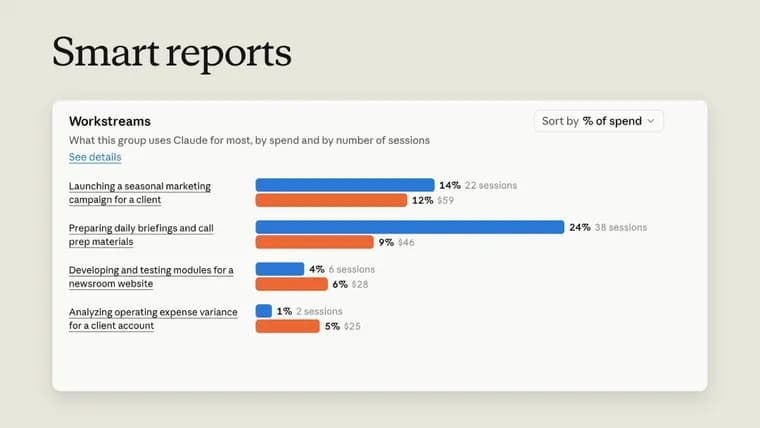
On Wednesday Anthropic announced a new suite of reporting tools for enterprise customers, built to give them a more granular view of the value they get from their token spend. Using internal analytics and employee surveys, managers can see a team's work over a chosen date range, what the team produced, how much it cost, and where its workflows broke down. The reports will also offer recommendations on how to improve results. Anthropic says it won't use this data for model training by default. The company is also creating pooled group budgets so teams can manage token spending better.
TechCrunch reads this as a clear attempt to demonstrate the return on investment of Anthropic's tools and to show customers how to improve it, a major concern among large customers. The article opens with financials Anthropic shared with investors this week, which it says suggest Claude Code is the business success the lab wanted: an operating profit in the second quarter and 900% net revenue retention, meaning spending from the same customers in Q3 2025 grew nine times by Q3 2026.
The article adds that businesses are hunting for this kind of information as they work out how to deploy AI. In its own voice it says that while usage among venture-backed firms is driving token spend, most of the Fortune 500 are not seeing major gains from deploying AI.
To show the scale of the spending question, TechCrunch cites a report Jellyfish, a company that makes tools for software developers, released the day before. It is based on agentic coding tool use by 276,000 Jellyfish customers. Claude Code and other tools built on Anthropic models remain the most widely used in the survey, responsible for nearly a third of all proposed code changes submitted for review. Spending on those tools has grown 10x since the beginning of the year, and their cost now equals about 2% of total engineering cost. Nicholas Arcolano, Jellyfish's chief scientist, told TechCrunch: "Even if you're saying 2% is still small, that 10x growth is growth that most CFOs didn't plan for." He added that people are realizing it is no longer enough to just spend a lot; you have to optimize it and make it work.
The article then turns to competition. OpenAI's Astra model, released this summer, seemed like a potential threat to Anthropic, but so far it hasn't slowed Anthropic's adoption numbers. Nikolas Albarran, Jellyfish's AI product lead, said it took a long time for Codex to show up in Jellyfish's data at all, and it has risen with Astra. Social media gives the impression that the race is more heated, he said, with everyone in the Valley saying Codex is better. In reality, he said, Anthropic had strong enterprise motions and an incumbent weight of its own; the tools worked well, many people standardized workflows around them, and there is not a big enough reason to switch.
Albarran also argues that once a frontier lab is inside a large customer, switching is harder than for an individual programmer or a small team. He points to the investment the major AI labs are making in forward-deployed engineering (FDE) organizations, teams that embed AI consultants inside customer companies. TechCrunch says the new reporting tools can be seen as a kind of FDE-lite, a lighter version of that hands-on help. Albarran said that even if the tools are mostly the same, each has its own quirks in how it handles agent.md files, so the cost to switch is not zero.
Key facts
- Anthropic announced enterprise reporting tools that use internal analytics and employee surveys to show a team's work over a date range, what it produced, what it cost and where workflows broke down, with recommendations for improvement.
- Anthropic says it won't use this data for model training by default, and it is adding pooled group budgets for managing token spending.
- Financials Anthropic shared with investors, as reported by TechCrunch, show an operating profit in Q2 and 900% net revenue retention: spending from the same customers grew nine times from Q3 2025 to Q3 2026.
- A Jellyfish report covering 276,000 customers says Claude Code and other Anthropic-based tools account for nearly a third of proposed code changes, with spending up 10x this year and equal to about 2% of total engineering cost.
- Jellyfish's Nikolas Albarran says OpenAI's Astra has not dislodged Anthropic because enterprises have standardized workflows around it and switching costs are not zero.
Why it matters
Token bills for AI coding tools are growing fast, and the people paying them want to know what they get back. Jellyfish's data puts the spending at 10x growth since the start of the year, still only about 2% of total engineering cost, but as Arcolano puts it, growth most CFOs didn't plan for. Anthropic's tools are an attempt to answer the return-on-investment question with its own data. TechCrunch also sees a retention angle: reporting that helps customers optimize their usage can work as a lighter version of the embedded consulting help the big labs already offer.
Who it affects
Enterprise customers of Anthropic, and the managers and finance teams who have to justify token spend. The reports are aimed at team-level views, and the pooled group budgets are meant for teams managing spending together. The employees whose work and workflows are analyzed and surveyed are affected too. Competitors such as OpenAI are also in the frame, since the article discusses whether Astra and Codex can pull customers away.
How to use it
Managers can pick a date range and see what a team produced, what it cost and where its workflows broke down, then act on the recommendations the reports provide. Group budgets can pool token spending across a team. The article does not name the tools or give a price or an availability or rollout date, so anyone interested would need to check with Anthropic directly.
How solid is it
The launch itself is Anthropic's announcement as reported by TechCrunch. The investor figures (Q2 operating profit, 900% net revenue retention) are described only as financials Anthropic shared with investors this week; the article cites no document and gives no absolute revenue or profit numbers. It does not say whether the nine-times figure covers Claude Code alone or all of Anthropic. The Jellyfish numbers come from a report based on 276,000 of its customers, released the day before the article. The claim that most of the Fortune 500 are not seeing major gains from AI is stated in the author's own voice with no source named.
Risks and caveats
The 2% figure is a share of total engineering cost, not of company spend, and no dollar amounts are given. Anthropic's no-training promise applies by default; the article does not say how to change it or whether any customers are exempt. It also does not say how the employee surveys are run or who is surveyed, or how pooled budgets work and what limits they enforce. Albarran's warning that switching costs rise once a customer is embedded cuts both ways: it explains Anthropic's lead, and it suggests tools like these deepen lock-in. The article gives no Codex or OpenAI market share numbers from Jellyfish's data.
“Even if you’re saying 2% is still small, that 10x growth is growth that most CFOs didn’t plan for”
— Nicholas Arcolano, chief scientist at Jellyfish, to TechCrunch