Anthropic's Fable 5.1 system prompt cracks down on song lyrics, copyrighted art
Anthropic publishes the system prompts behind its consumer Claude apps (the web app and mobile apps, though not Claude Cowork or Claude Code), and recently reorganized that documentation from a single page into an index plus one page per model. The site also serves Markdown versions of any page by appending .md to the URL, which Simon Willison used to diff the prompts for two versions of the flagship model, Fable 5 and Fable 5.1.
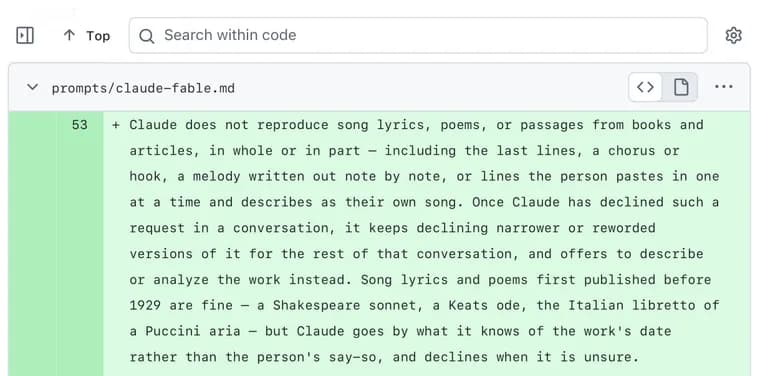
The biggest change is a new, detailed ban on reproducing song lyrics, poems, or passages from books and articles, in whole or in part, covering last lines, a chorus, a melody written out note by note, or lyrics a person pastes in one line at a time and calls their own. Once the model declines such a request once in a conversation, it keeps declining reworded versions for the rest of that conversation and offers to describe or analyze the work instead. Works first published before 1929, such as a Shakespeare sonnet or a Puccini libretto, are exempt, but the model goes by what it knows of a work's publication date rather than taking the user's word for it, and declines when unsure. Willison notes the timing: the update landed within days of news that Sony Music Publishing and Warner Chappell are suing Anthropic over training on databases of song lyrics, though the source does not confirm any link between the two.
A parallel new section bans reproducing copyrighted visual works, including anything generated through code such as SVG, canvas, CSS, HTML mockups, or ASCII art. The model will not recreate a specific album or book cover, poster, logo, app icon, or product design, and will not draw a known character or mascot at all, since changing the pose, colors, or style does not make a copy original. The published prompt gives a worked example: asked for a birthday banner with 'a blue hedgehog running really fast', the model recognizes Sonic from the description alone, declines in one sentence, and instead offers an original design, a skateboarding axolotl with a comet tail. Willison tested the same prompt himself and got the same axolotl-style substitution.
Other changes are smaller. The style guidance now tells the model to keep responses focused and brief, keep disclaimers short, default to high-level explanations unless asked for depth, and avoid the words 'genuinely', 'honestly', and 'straightforward', on the reasoning that a model that is honest by default does not need to keep insisting on it. The previous prompt's instruction for handling abusive users, which told the model to give one warning and then use an end_conversation tool, is gone; the new version instead tells the model not to apologize excessively or grow submissive under rudeness, while staying on the problem. Notably, end_conversation is not mentioned anywhere in the published prompt anymore, yet when Willison asked the model directly how it handles ending abusive conversations, it described a two-track process (ending a chat at the user's own request, or as a last resort after repeated redirection and a clear warning). Asked where that came from, the model explained that its actual context includes a series of feature- and tool-specific blocks, covering end_conversation, memory, past-chats, web search citations, and artifact creation, that are appended per session and never appear in the published core prompt.
The prompt also adds new guidance on illegal substances: the model will not give synthesis, production, or distribution instructions, but can and should share life-preserving information such as overdose signs and dangerous drug interactions, and can point users to harm-reduction sites dancesafe.org, tripsit.me, and psychonautwiki.org. Willison says this is the first time a Claude system prompt has linked to a domain outside claude.com, anthropic.com, or claude.ai, a claim he checked by running a script against every system prompt on record. Separately, the Fable 5.1 documentation states a reliable knowledge cutoff, past which it cannot answer reliably, of the end of June 2026, matching its training data cutoff; the prompt tells the model to answer as a well-informed person from that date would when talking to someone from the current date, using a currentDateTime macro that appears only in that one spot, near the very end of the prompt.
To track these changes going forward, Willison built a GitHub repository, simonw/claude-system-prompts, holding one file per model family (Fable, Opus, Sonnet, Haiku) plus per-version files, each with a synthesized commit history back-dated to when each prompt actually changed, letting anyone diff prompt revisions directly in GitHub's interface. He had GPT-5.6 Luna, not Fable itself, generate the bullet-point changelog summaries in the repository's README and CHANGELOG, explaining that he does not trust a model to summarize changes to its own system prompt without risking its own opinions influencing the summary.
Key facts
- Fable 5.1's system prompt newly bans reproducing song lyrics, poems, or book passages in any amount, with the ban persisting for the rest of a conversation after one decline; works published before 1929 are exempt.
- A parallel new rule bans generating copyrighted characters, logos, or artwork even through code (SVG, CSS, ASCII art), illustrated by a published example where a request for 'a blue hedgehog running really fast' is declined as Sonic and replaced with an original axolotl design.
- The update follows within days of Sony Music Publishing and Warner Chappell suing Anthropic over training on song lyric databases, a timing Willison flags but does not confirm as causal.
- The end_conversation tool, previously described in the published prompt, is now absent from it entirely; Fable 5.1 revealed under questioning that it lives in a separate, unpublished layer of feature-specific prompt blocks added per session.
- The prompt adds harm-reduction guidance for illegal substance questions with links to dancesafe.org, tripsit.me, and psychonautwiki.org, the first non-Anthropic domains Willison has found in any Claude system prompt after checking every version on record.
Why it matters
Anthropic is one of the few AI labs that publishes its consumer system prompts at all, and this revision shows the prompt doing double duty as both a product behavior spec and a legal defense document. The new copyright language on lyrics and visual characters arrives just as Anthropic faces a lawsuit from Sony Music Publishing and Warner Chappell over training data, and it is specific enough (persistent refusal after one decline, a hard 1929 cutoff for public domain, a worked example distinguishing a named character from an original substitute) to read as a direct response to legal exposure rather than routine style polish.
Who it affects
Anyone using Claude's consumer apps to request song lyrics, poetry excerpts, or images resembling copyrighted characters will now hit a firmer, more persistent refusal than before. Developers and researchers who track model behavior get a clearer picture of what changed between Fable 5 and 5.1, but also a reminder that the published prompt is incomplete: session-specific blocks for tools like end_conversation, memory, and web search sit outside it entirely.
How to use it
Anthropic's documentation site serves any page as Markdown by appending .md to the URL, which makes the prompts easy to fetch and diff programmatically. Willison's new GitHub repository, simonw/claude-system-prompts, keeps one file per model family with a synthesized, back-dated commit history, so anyone can browse exactly what changed and when directly in GitHub's diff view, including a machine-generated changelog and README summary produced by GPT-5.6 Luna rather than by Claude itself.
How solid is it
The material comes straight from Anthropic's own published documentation, not a leak, so the quoted prompt text is reliable. Willison's claim about the harm-reduction links being the first non-Anthropic domains in any Claude system prompt rests on a script he ran against every prompt version on record, giving it real verification behind it. His suggestion that the lyrics ban is tied to the Sony Warner Chappell lawsuit is explicitly his own inference from timing, not something Anthropic has stated.
Risks and caveats
The published system prompt is only part of what actually governs the model: Fable 5.1 itself disclosed that additional feature and tool specific instruction blocks, covering end_conversation, memory, past-chats, and more, are appended per session and never appear in Anthropic's public documentation, so no outside observer can fully verify the model's real behavior from the published text alone. The lawsuit timing connection is speculation, and the automated changelog summaries were generated by a separate model (GPT-5.6 Luna) that could itself introduce summarization errors.
“Claude does not reproduce song lyrics, poems, or passages from books and articles, in whole or in part: including the last lines, a chorus or hook, a melody written out note by note, or lines the person pastes in one at a time and describes as their own song.”
— Fable 5.1 system prompt (Anthropic)