AnyS1 paper reports 75-91% lower agent cost with a 4B System-1 model
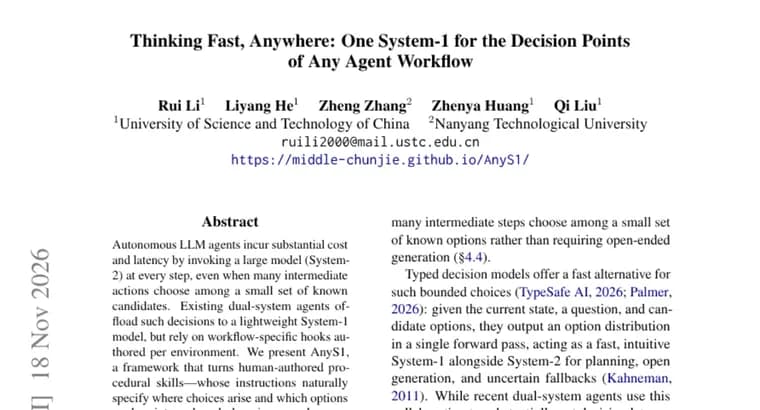
The paper starts from a cost problem. Autonomous LLM agents call a large model, called System-2 here, at every step. Yet many intermediate actions are just a choice among a small set of known candidates. Existing dual-system agents already hand such decisions to a lightweight System-1 model, but the authors say these systems depend on workflow-specific hooks written separately for each environment.
The authors present AnyS1, a framework that avoids per-environment hooks. It uses human-authored procedural skills, whose instructions naturally say where choices arise and which options apply, as a shared, domain-general source of decision points.
The work happens in two phases. Offline, AnyS1 mines grounded enumerable decisions across over 1,000 public skills. It gathers execution-grounded trajectory states inside isolated containers to build a training dataset called Any-DP. It then trains a single calibrated 4B pointer System-1 model with label smoothing.
At run time, compiled workflows resolve routine decisions in one forward pass. When the model's confidence falls below a calibrated threshold, the decision falls back to the large System-2 model.
The evaluation covers three unseen benchmarks and distinct System-2 model families. Against an uncompiled System-2 agent, the authors report that AnyS1 preserves task reliability while cutting episode cost by 75-91% and model-call time by 63-92%. They also say it maintains performance under zero-shot threshold transfer, meaning the confidence threshold carries over without retuning.
Key facts
- AnyS1 mines decision points from over 1,000 public human-authored procedural skills instead of relying on hooks written for each environment.
- A single calibrated 4B pointer System-1 model, trained with label smoothing on the Any-DP dataset, resolves routine decisions in one forward pass.
- When confidence falls below a calibrated threshold, the decision falls back to the large System-2 model.
- Across three unseen benchmarks, the abstract reports 75-91% lower episode cost and 63-92% lower model-call time versus an uncompiled System-2 agent.
- The authors say task reliability is preserved and performance holds under zero-shot threshold transfer.
Why it matters
Calling a large model at every step is a main source of cost and latency in autonomous agents, even when a step only picks among a few known options. AnyS1 aims at that waste. Its distinguishing claim is generality: one System-1 model built from public skills, rather than a separate lightweight component hand-wired for each workflow. If the reported 75-91% cost cut and 63-92% cut in model-call time hold up, routine agent steps become much cheaper to run.
Who it affects
Teams that run LLM agents on multi-step workflows and pay for a large model at every step are the natural audience. So are researchers working on dual-system agent designs, who until now needed workflow-specific hooks for each environment.
How to use it
The source describes the method but not a product. It makes no statement on code, data (Any-DP) or model release. The design pattern is clear, though: take procedural skills that spell out where choices arise, train a small pointer model on the enumerable decisions, and route to the large model only when confidence is low. A calibrated threshold controls that routing, and the authors say it transfers zero-shot.
How solid is it
The figures come from the paper's own abstract, and the text reports them as ranges across three unseen benchmarks and distinct System-2 model families. The three benchmarks are not named. The System-2 model families and the 4B model's base are not named either. The source does not say how the 75-91% and 63-92% ranges break down per benchmark or per model family. No absolute dollar costs, latencies or task-success figures are given, so 'preserves task reliability' is not quantified. The abstract names no authors or institutions.
Risks and caveats
The source gives no limitations, failure cases or fallback rate, so how often the large model is still invoked is unknown. That rate largely determines the savings in practice. The claim that reliability is preserved rests on an unquantified statement. Whether the gains carry over outside the three benchmarks tested is not something the abstract answers.
“compiled workflows resolve routine decisions in one forward pass and fall back to System-2 when confidence falls below a calibrated threshold”
— AnyS1 paper abstract