Atlas, Optimus and Neo are headed to factories before homes
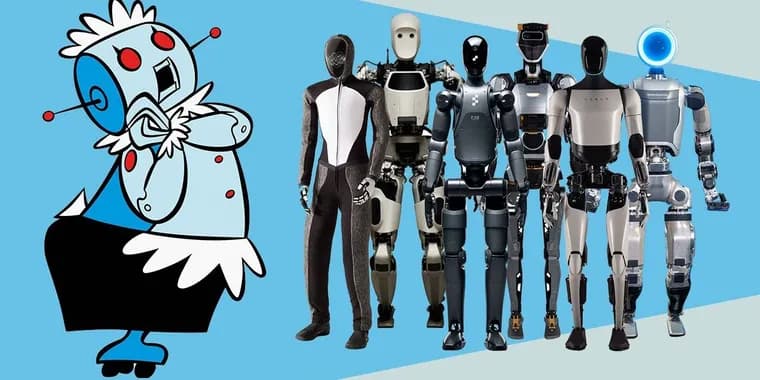
IEEE Spectrum published a non-interactive, text-and-image version of its feature 'Where's My Robot?', written by Erico Guizzo and Randi Klett as part of a special issue called 'Reinventing Invention.' First posted on November 11, 2024 and updated a week later on November 18, the piece opens by contrasting Roomba with the sci-fi ideal of Rosie, the robot maid from The Jetsons, then asks what would finally let a humanoid robot take over household chores; it later notes that Roomba first hit stores in September 2002, well before the AI boom that produced ChatGPT. It profiles the AI-powered humanoids trying to close that gap: Neo from 1X Technologies, Apollo from Apptronik, Figure 02 from Figure, Phoenix from Sanctuary AI, Optimus from Tesla, Atlas from Boston Dynamics, plus Digit from Agility Robotics, GR-1 and GR-2 from Fourier Intelligence, and H1 and G1 from Unitree Robotics.
Boston Dynamics, acquired by Hyundai in 2020, has unveiled a new, fully electric version of Atlas that drops the hydraulics of earlier models for a lighter, more compact body able to bend in ways that exceed human range of motion. Apptronik has worked on more than half a dozen humanoid robots over the past eight years, including NASA's Valkyrie; its newest, Apollo, is designed for manufacturability, and the company plans a commercial release once pilot projects prove out its autonomous skills. Figure, founded in 2022 by a team with roots in the DARPA Robotics Challenge, is iterating quickly through hardware prototypes with Figure 02 and says it wants to prove commercial viability before it moves to 'integrate humanoids into the labor force.' Agility Robotics' Digit, the piece argues, is more accurately described as 'bipedal' than 'humanoid': its legs are shaped more like an ostrich's than a person's, a side effect of a design process built purely to maximize the efficiency and robustness of two-legged walking.
1X Technologies, backed by OpenAI, builds Neo, a soft, tendon-based robot engineered for low inertia so that it is safe to have around people; it will weigh 30 kilograms and carry up to 20 kilograms, and 1X hopes it becomes 'an all-purpose android assistant to your daily life.' Tesla is building Optimus on the back of its battery, sensing and AI experience from cars, and is potentially its own first customer, putting the robots to work in its own car factories. Sanctuary AI says its goal is to 'create the world's first humanlike intelligence in general-purpose robots'; it has been recording large volumes of data from people teleoperating its Phoenix robot through complex manipulation tasks, and hopes to use that data to teach Phoenix to perform the same work on its own. Fourier Intelligence, based in Singapore and drawing on a background in health care robotics, is already mass-producing its GR-1 and GR-2 humanoids, and sees potential applications in medical and rehabilitation contexts as well as sales to researchers. Unitree Robotics, founded in China in 2016 and known for low-cost quadruped robots, built its first humanoid, H1, then followed it with a smaller model, G1; both are pitched as affordable platforms for research or for companies that want to focus on software rather than hardware.
All of this is framed as an extension of the AI boom that produced ChatGPT. The piece argues that boom is now being asked to crack problems that have kept humanoids mostly confined to labs, such as grasping arbitrary objects and other dexterous manipulation; as an example, it points to π0, a general-purpose robot foundation model from Physical Intelligence built to control many different robots, shown powering a two-armed robot that folds clothing on its own.
Despite the pace of development, the article's bottom line is that none of these machines is headed straight into people's homes. They will show up first in factories and warehouses, taking on dirty, dull and dangerous jobs that industrial settings are full of and homes are not: Figure 02 units are already working a car-factory floor, Apollo is shown lifting and carrying boxes, and Digit has been put to work carrying bins in a warehouse. For the home, the piece says plainly, these robots remain too complex, too costly and too unsafe, adding that nobody wants one staggering around a kitchen.
The piece continues past the robot profiles through its history, the uncanny valley, robot hardware and AI for robots, before closing with a section on the future of robots: the authors say they cannot say for certain how robots will evolve, sketch three possible futures rather than a single timeline, keep humanoids working in factories and warehouses in two of the three, and end on the image of a Rosie-like household helper that could still arrive if the right breakthroughs in AI and robot hardware come together. No price or cost figure is given for any of the robots covered, no figures are given for how many industrial units of any of them are currently deployed, no dollar amount is stated for OpenAI's backing of 1X, and the piece does not say that any robot, including Neo, has already shipped to a paying customer.
Key facts
- IEEE Spectrum republished its feature 'Where's My Robot?' (Erico Guizzo and Randi Klett), surveying today's AI-powered humanoid robots and asking what it would take to get one into a house.
- The article's verdict: these robots are headed to factories and warehouses before homes, since they suit dirty, dull and dangerous industrial jobs and remain too complex, costly and unsafe for domestic use.
- 1X Technologies' Neo, backed by OpenAI, is a soft, tendon-based robot built for low inertia; it will weigh 30 kilograms and carry up to 20 kilograms, and 1X hopes it becomes 'an all-purpose android assistant to your daily life.'
- Boston Dynamics, owned by Hyundai since 2020, has unveiled a new, fully electric Atlas that drops hydraulics for a lighter frame able to bend beyond human range of motion.
- Apptronik has worked on more than half a dozen humanoid robots over eight years, including NASA's Valkyrie, and its newest, Apollo, is designed for manufacturability ahead of a planned commercial release.
Why it matters
The push to build home robots rides the same AI wave that produced ChatGPT. The piece frames current AI breakthroughs as an attempt to finally crack problems, like grasping arbitrary objects and other dexterous manipulation, that have kept humanoids mostly confined to labs; as one example, it points to π0, a general-purpose robot foundation model from Physical Intelligence built to control many different robots, shown powering a two-armed robot that folds clothing on its own. That is why so many well-funded companies are building at once: Apptronik with Apollo, Boston Dynamics with Atlas (owned by Hyundai since 2020), Figure with Figure 02, Fourier Intelligence with GR-1 and GR-2, Unitree Robotics with H1 and G1, 1X Technologies with Neo (backed by OpenAI), Tesla with Optimus, and Sanctuary AI with Phoenix are all racing on the same bet: that AI can finally do what hardware alone could not.
Who it affects
Factory and warehouse workers feel the effect first: Figure 02 units are already working a car-factory floor, Apollo is shown lifting and carrying boxes, and Digit has been put to work carrying bins in a warehouse, taking over jobs the piece calls dirty, dull and dangerous. Tesla is potentially its own first customer for Optimus inside its own car factories. The eventual audience, once the robots are judged safe and cheap enough, is households: the piece invokes Rosie from The Jetsons as the aspiration, and cites the film Robot & Frank and the Apple TV+ show Sunny to argue such robots could also help aging individuals stay independent and provide company, alongside cleaning, cooking and organizing chores.
How to use it
As of the piece's November 2024 publication, none of this was available to buy for the home. What the piece describes instead is a mix of pilot projects, ongoing production for other markets, and research platforms: Apptronik plans a commercial release for Apollo only after pilot projects demonstrate its autonomous skills, Fourier Intelligence is already mass-producing GR-1 and GR-2, seeing potential applications in medical and rehabilitation contexts, with the robots also available to researchers, and Unitree pitches its H1 and G1 as affordable platforms for researchers or software developers rather than finished consumer products. The source gives no price, subscription or license figure for any robot it covers, and does not say that any of them, including 1X's Neo, has shipped to a paying customer.
How solid is it
This is a signed feature by Erico Guizzo and Randi Klett, first published November 11, 2024 and updated a week later, built as a photo-essay survey with sourcing traced to each company involved. It leans on the companies' own statements about their machines and missions rather than independent testing or third-party data, and it closes with a section on the future of robots where the authors say they cannot say for certain how robots will evolve and sketch three possible futures rather than commit to a firm timeline for home deployment.
Risks and caveats
Several of the most quotable lines are companies describing their own ambitions rather than confirmed outcomes: 1X's hope that Neo becomes 'an all-purpose android assistant,' Figure's plan to 'integrate humanoids into the labor force,' and Sanctuary AI's goal to 'create the world's first humanlike intelligence in general-purpose robots' are all stated intentions, not delivered results. No dollar figure is given for OpenAI's backing of 1X, no figures are given for how many industrial units of any robot are currently deployed, and no date is given for when, if ever, any of these machines reaches a home.
“an all-purpose android assistant to your daily life”
— 1X Technologies