AudioRubrics trains audio reasoning with self-evolving rubric rewards
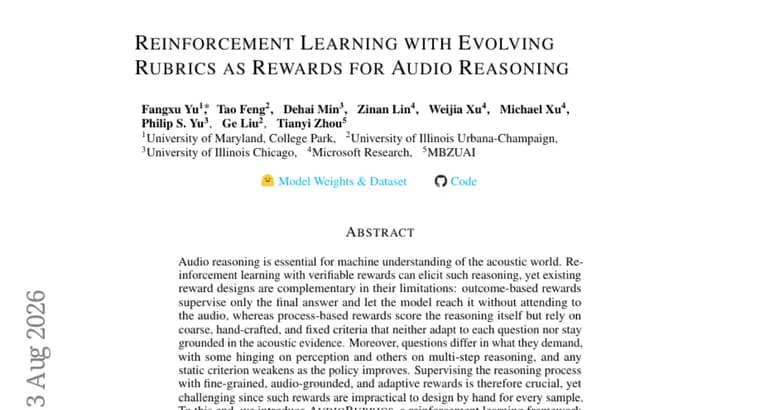
Researchers introduce AudioRubrics, a reinforcement learning framework for training audio reasoning models that replaces static, hand-written grading criteria with rubrics generated and updated during training itself.
The work starts from a gap in existing reward designs for reinforcement learning with verifiable rewards. Outcome-based rewards check only the final answer, so a model can land on the right answer without actually attending to the audio. Process-based rewards score the reasoning steps themselves, but rely on coarse, hand-crafted, fixed criteria that neither adapt to the specific question nor stay grounded in the acoustic evidence. The authors note that questions vary in what they demand, some hinge mostly on perception, others on multi-step reasoning, so any static rubric weakens as the policy improves and starts to satisfy it by rote.
AudioRubrics addresses this by synthesizing a rubric for each individual training sample directly from the raw waveform, rather than writing one set of criteria to cover every question. Conditioned on the model's own rollouts, the system regenerates and reweights the grading criteria per group of samples during training, producing a continuous reward signal that keeps targeting the current policy's weaknesses instead of going stale once the model learns to satisfy a fixed checklist.
The authors evaluate AudioRubrics across three audio reasoning benchmarks and report that it substantially outperforms a range of open-source and training-based baselines. Their analysis finds that the size of the improvement scales with the capability of the model used to generate and judge the rubrics, and that training with AudioRubrics converges to a stable reasoning length, avoiding both collapse into degenerate short answers and unbounded growth of the reasoning chain. The authors also report a gain in audio perception specifically, which they read as evidence that grounding the reward in the acoustic evidence is what drives the improvement.
Key facts
- AudioRubrics generates a rubric for each individual training sample directly from the raw audio waveform, rather than using one fixed checklist for every question.
- Rubrics are regenerated and reweighted per group during training, conditioned on the model's own rollouts, so the reward signal keeps adapting as the policy improves.
- Evaluated across three audio reasoning benchmarks, AudioRubrics substantially outperforms a range of open-source and training-based baselines.
- The size of the improvement scales with the capability of the model used to generate and judge the rubrics.
- Training with AudioRubrics converges to a stable reasoning length, avoiding both degenerate collapse and unbounded growth.
Why it matters
Reinforcement learning with verifiable rewards is the standard way to get a model to reason about audio, but the two existing reward designs each fail in a different way: outcome-based rewards only check the final answer, so a model can get there without engaging with the audio at all, while process-based rewards check the reasoning steps but use fixed, hand-written criteria that do not adapt per question and are not tied to the specific acoustic evidence in front of the model. AudioRubrics is built to close both gaps at once by generating a grading rubric for each sample from the waveform itself, then updating that rubric as the model's own answers change.
Who it affects
The framework targets researchers and engineers building audio reasoning systems who train with reinforcement learning and need reward signals that go beyond checking the final answer, without hand-writing a separate rubric for every question type.
How to use it
The authors point to a project page at audiorubrics.github.io. The source text does not state whether code, model weights, or a specific license are released, so nothing here should be assumed about availability beyond that page.
How solid is it
The claims come from the paper's own abstract: comprehensive evaluation across three audio reasoning benchmarks, comparison against a range of open-source and training-based baselines, plus an analysis of how gains scale with rubric-generator capability and how training length behaves over time. The abstract does not name the three benchmarks, the specific baselines, or give numeric accuracy figures, so the size of the improvement cannot be judged from this text alone.
Risks and caveats
The source text names no authors or institutions and gives no publication date, so provenance beyond the paper itself is unclear from this abstract. Because no baseline names or numeric results are stated, claims of a substantial improvement rest on the authors' own description rather than independently checkable figures.