BDH-CQ sets new cost-efficiency record on ARC-AGI-1 benchmark
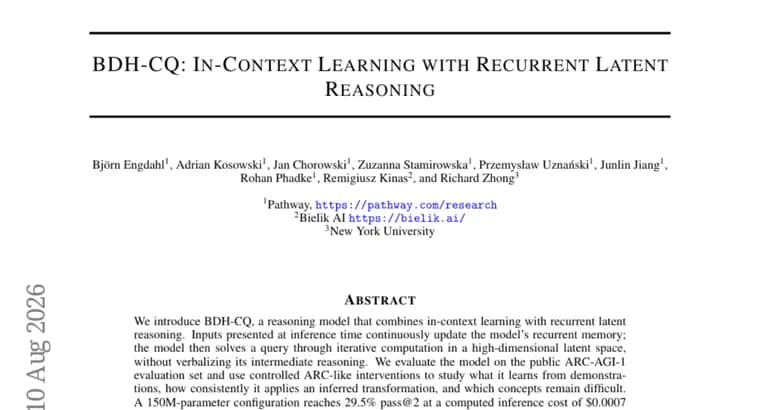
A new paper introduces BDH-CQ, a reasoning model that combines in-context learning with recurrent latent reasoning. Rather than reading a prompt once and generating a written chain of thought, BDH-CQ lets inputs presented at inference time continuously update its recurrent memory; it then solves a query through iterative computation in a high-dimensional latent space, without verbalizing any intermediate reasoning steps. The authors test the model on the public ARC-AGI-1 evaluation set, a benchmark of abstract visual puzzles designed to probe general reasoning rather than memorized patterns. Alongside the standard benchmark, they run controlled ARC-like interventions built to isolate three questions: what the model learns from the demonstration examples it is given, how consistently it applies a transformation it has inferred, and which kinds of concepts remain hard for it. The headline result comes from a 150M-parameter configuration of BDH-CQ, which reaches 29.5% pass@2 on the public ARC-AGI-1 evaluation set at a computed inference cost of $0.0007 per task. The authors describe this combination of accuracy and cost as breaking through the previously reported ARC-AGI-1 cost-accuracy Pareto frontier, which they present as a new state of the art for cost efficiency on the benchmark. The source text does not name the paper's authors or institutions, does not compare BDH-CQ against any specific named competing model, and reports results only for this single 150M-parameter configuration.
Key facts
- BDH-CQ combines in-context learning with recurrent latent reasoning: inputs update the model's memory at inference time, and it reasons iteratively in latent space without producing visible chain-of-thought text.
- The model is evaluated on the public ARC-AGI-1 evaluation set, plus controlled ARC-like interventions probing what it learns from demonstrations, how consistently it applies an inferred transformation, and which concepts stay difficult.
- A 150M-parameter configuration reaches 29.5% pass@2 at a computed inference cost of $0.0007 per task.
- The authors say this cost-accuracy point breaks through the previously reported ARC-AGI-1 Pareto frontier, a new state of the art for benchmark cost efficiency.
Why it matters
Most reasoning models today spend their compute writing out long chains of thought in natural language before answering, which is a major driver of inference cost. BDH-CQ instead reasons by iterating in a latent space, with no verbalized intermediate steps, while its inputs continuously update a recurrent memory. The paper's claim is that this architecture lets a comparatively small, 150M-parameter model land at a genuinely new operating point on ARC-AGI-1: past the accuracy-per-dollar levels other approaches had reached, at a cost of well under a tenth of a cent per task.
Who it affects
Researchers working on ARC-AGI-style abstract reasoning benchmarks, and anyone building architectures aimed at cutting inference cost for reasoning tasks, since verbalized chain-of-thought is the main cost driver in current systems. The controlled ARC-like interventions the authors run are also relevant to anyone trying to understand what a latent-reasoning model actually generalizes from a handful of demonstrations, rather than just its headline score.
How to use it
The source is a paper abstract describing an evaluation methodology and a result, not a product; it says nothing about code, weights, or a release. What is concrete is the benchmark point itself: the 150M-parameter model was scored on the public ARC-AGI-1 evaluation set at a computed cost of $0.0007 per task, giving other systems a specific cost-accuracy figure to be measured against.
How solid is it
The 29.5% pass@2 figure comes from the paper's own evaluation on the public ARC-AGI-1 set, not from an independently verified leaderboard run against the benchmark's held-out private set. The text gives no author names or institutional affiliation, no comparison to any specific named competing model, only to 'the previously reported ARC-AGI-1 cost-accuracy Pareto frontier' in the abstract, and no results for any configuration other than the 150M-parameter one, so it is not possible to say from this text alone how the approach scales up or down.
Risks and caveats
The claims rest on a single benchmark family, ARC-AGI-1, and a single reported configuration; the abstract does not state training time, publication venue, or whether the pass@2 protocol (two attempts per task) matches how other reported ARC-AGI-1 results were scored. With no author or institutional information given, and no independent replication mentioned, the cost-efficiency claim should be read as the authors' own characterization pending outside scrutiny.
“This operating point breaks through the previously reported ARC-AGI-1 cost-accuracy Pareto frontier, establishing a new state of the art in benchmark cost efficiency.”
— BDH-CQ paper