BepiColombo sheds its transfer module on final approach to Mercury
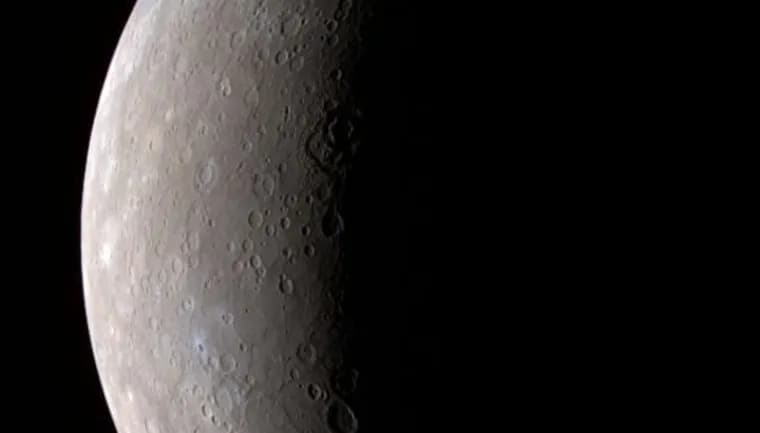
After nearly eight years since its 2018 launch, the joint European Space Agency (ESA) and Japan Aerospace Exploration Agency (JAXA) mission BepiColombo has begun its final approach to Mercury. On September 3 at around 1400 CEST, the spacecraft stack separated from the Mercury Transfer Module (MTM), the module that had powered and propelled it through the long cruise phase. Controllers picked up a preliminary signal within minutes, and by 1552 CEST had confirmed that the full set of signals showed the separation had gone as planned; the Mercury Planetary Orbiter's (MPO) solar panels were already charging its batteries.
The next milestone is orbit insertion at Mercury on November 21. From there the mission proceeds in stages: JAXA's Mercury Magnetospheric Orbiter (MMO, also called Mio) is due to be released between December 9 and 10, and about a week later the MPO will begin moving into its final science orbit of 480 by 1500 km, with science operations scheduled to start in April 2027.
The arrival is a year behind the original schedule, which had BepiColombo entering Mercury orbit in December 2025. The delay traces to problems with the spacecraft's Solar Electric Power (SEP) system, which forced a rework of the trajectory and extended the cruise. BepiColombo has already flown past Mercury six times since 2021, as well as past Venus and Earth, on its way to the planet.
The spacecraft is a split effort: ESA built the MPO and the MTM and also supplied the sunshield that protected JAXA's MMO during transit, a shield that will be jettisoned once the MMO is released. The MPO is the larger of the two craft, with a main body measuring 2.4 by 2.2 by 1.7 meters and a total mass of 1,230 kg, including an 85 kg science payload; it is three-axis stabilized and nadir-pointing. JAXA's MMO is smaller, 1.8 meters in diameter and 1.1 meters high, weighing 255 kg with a 45 kg science payload, and will instead be spin-stabilized at 15 rpm with its spin axis at 90 degrees to the Sun.
The mission's stated goal is to study Mercury's magnetosphere and how it interacts with the solar wind, along with the properties of the planet's large iron core and the origin of its magnetic field. The initial science phase at Mercury is planned to run for one Earth year, about four Mercury years, with an option to extend by another Earth year.
Key facts
- BepiColombo separated from its Mercury Transfer Module on September 3 at about 1400 CEST, with confirmation that the separation went as planned arriving by 1552 CEST.
- Mercury orbit insertion is planned for November 21, nearly eight years after the spacecraft's 2018 launch and a year later than originally scheduled, a delay blamed on problems with its Solar Electric Power system.
- JAXA's Mercury Magnetospheric Orbiter (MMO, or Mio) is due to be released between December 9 and 10, followed about a week later by the ESA-built Mercury Planetary Orbiter (MPO) moving into its final 480 x 1500 km orbit.
- The MPO weighs 1,230 kg with an 85 kg science payload, while the smaller MMO weighs 255 kg with a 45 kg payload; the two orbiters use different stabilization methods, three-axis versus spin-stabilized at 15 rpm.
- Science operations are due to start in April 2027, for an initial mission of one Earth year, about four Mercury years, with a possible one-year extension.
Why it matters
Shedding the Mercury Transfer Module marks the start of BepiColombo's most delicate phase after nearly eight years in transit: threading into orbit around the solar system's innermost planet. A successful arrival gives ESA and JAXA a joint platform to study Mercury's magnetosphere, its interaction with the solar wind, and the origin of the planet's oversized iron core and magnetic field, questions that bear on how rocky planets close to a star form and evolve.
Who it affects
The mission is run jointly by ESA and JAXA, which each built and operate one of the two orbiters riding inside the BepiColombo stack: the ESA-built Mercury Planetary Orbiter (MPO) and JAXA's Mercury Magnetospheric Orbiter (MMO, or Mio). Planetary scientists studying Mercury and the inner solar system stand to benefit directly once the orbiters begin returning data in April 2027. The wider space-mission-operations community is also watching the arrival sequence itself, since the SEP-driven, year-long delay is the mission's most visible setback so far.
How to use it
There is nothing to buy or install here; readers tracking the mission can watch two dates in particular. November 21 is when BepiColombo is due to enter orbit around Mercury, and April 2027 is when its science instruments are scheduled to start operating. In between, the MMO separates between December 9 and 10, and the MPO settles into its 480 by 1500 km science orbit about a week after that; each step is a further check on whether the delayed spacecraft is back on track.
How solid is it
The report gives precise separation times, 1400 and 1552 CEST, and specific technical figures for the spacecraft, including mass, dimensions and orbit parameters, that read as drawn from mission documentation rather than estimated. It does not quote any named mission scientist, engineer or agency official, and gives no cost or budget figures for BepiColombo. The byline carries an odd wrinkle: the reporter's credited title is Microsoft Ecosystem Reporter, unexplained in a story about a European and Japanese planetary mission, though nothing in the report itself suggests this affected its accuracy.
Risks and caveats
Parts of the timeline remain provisional: the MPO's move to its final 480 by 1500 km orbit is pinned down only as about a week after the MMO release, with no exact date given, and the mission has already slipped by a year once because of the SEP system problem. Orbit insertion on November 21 and the MMO release in December are the next points where the recovered schedule will be tested before science operations can begin as planned in April 2027.