Bernie Sanders' AI-doom stance splits the American left
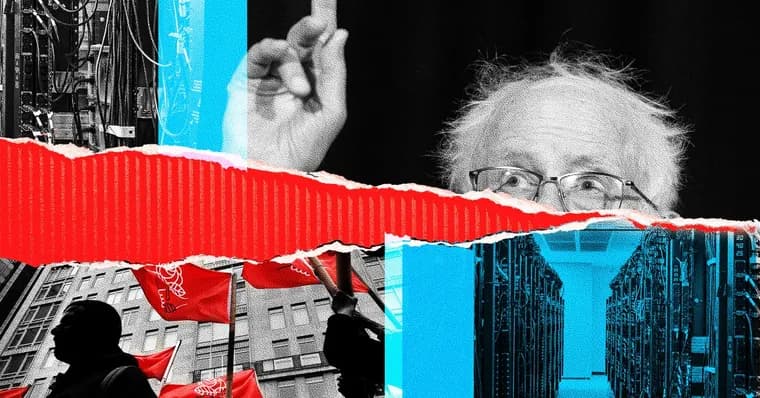
On September 10, two days after Jacob Coxon, a researcher who had recently quit his job at Anthropic, publicly warned that the AI industry could bring about the end of humanity, the New York City chapter of the Democratic Socialists of America (the largest DSA chapter in the country) posted an Instagram carousel through its Tech Action Working Group. The lead image showed an ouroboros, a dragon eating its own tail, with text reading: "AI alarmism and AI hype are the same story: both keep your attention on a science-fiction future to distract you from the real harms experienced in the present." The post drew more than 25,000 likes, alongside pushback in the comments, including one calling it a "horrible and dangerous take." Tech Action member Alan Dang told Wired that "AI has become the latest tool of capitalist exploitation" and that "as socialists, we don't trust these corporations to craft their own regulations."
The post surfaced a broader split among American leftists over whether to take tech companies' warnings about AI's world-ending potential seriously, or to treat those warnings as a distraction manufactured by the same companies. On the other side of that divide is Senator Bernie Sanders, 85, described in the piece as the unofficial leader of the American left. Sanders was an early opponent of data center construction and has increasingly spoken about AI's potential harms, from job losses to existential risk. His data center moratorium bill, released in March, explicitly tied a construction pause to federal regulation to protect "the future of humanity." That positioning has put him in an unusual alliance with Steve Bannon, President Donald Trump's former adviser and a right-wing podcast host, and has fed into messaging from left-wing candidates: on September 9, six Working Families Party candidates, four of them backed by Sanders, released statements calling for federal AI regulation to prevent existential threats to humanity.
Democratic strategist Alexander McCoy, who works on AI issues and helped found the pro-AI-safety group Irreplaceable, argued there is no real divide between leftist leaders on the issue: "The same people concerned about frontier governance and the development of superintelligence are also addressing those current harms." He added that frontier AI capabilities "are true and increasing in power" and "not fake or hype." Sanders' turn toward AI safety has drawn criticism from AI researcher and industry critic Timnit Gebru, who has accused him and others on the left of "taking their cues from literal doomsday eugenicist cults," a reference to the effective altruist and rationalist philosophies behind Silicon Valley's AI safety discourse. Rumman Chowdhury, CEO of the nonprofit Humane Intelligence and formerly head of Twitter's machine learning ethics team, told Wired that the attention generated by AI safety discourse ultimately benefits frontier labs: companies "grab all the attention, time, energy, and money by spouting really extreme perspectives" before backtracking to more modest positions, and investors are drawn in by how "scarier and more fantastic" CEOs make their companies sound. She also noted that OpenAI and Anthropic, both aiming to go public, benefit from the scrutiny now, since it lets them later point to "a full regulatory regime" they helped establish.
Other voices sit between the two poles. Pragathi Balasubramanian, a Tech Action member who helped win a one-year New York data center moratorium, said existential risk "doesn't come up at all" in on-the-ground organizing, where the operating assumption is simply that AI and data center companies "don't have our interests at heart." Phil Aroneanu, executive director of Irreplaceable, drew a parallel to climate activism, comparing the split to the relationship between the direct harms of fossil fuel extraction and the broader, longer-term fight over emissions. New York representative Alexandria Ocasio-Cortez has taken a more guarded position than Sanders: she cosponsored his data center moratorium bill, including its language on AI threatening humanity, but has largely focused her own AI commentary on data centers, job losses and fears of an economic bubble, telling a reporter that "two things can be true at once" and warning of a possible collision between "an economic bubble" and "a technological frontier."
The question is not settled inside the DSA either: a convention resolution before the organization proposes backing a Sanders and Greg Casar bill to ban superintelligence outright. McCoy dismissed critics like Gebru as "marginal, unrepresentative," arguing the choice between fighting current harms and governing frontier AI is a false one. Outside these organizing debates, a Politico poll released the same week found that two in three Americans believe there is at least some risk AI could "destroy humanity." Balasubramanian, for one, said she was simply "happy that everyone is talking about AI now."
Key facts
- NYC DSA's Tech Action Working Group posted an Instagram carousel on September 10 arguing AI alarmism and AI hype 'are the same story,' drawing more than 25,000 likes.
- The post came two days after researcher Jacob Coxon, who had recently quit Anthropic, warned AI could bring about the end of humanity.
- Senator Bernie Sanders, 85, has embraced AI existential-risk framing, including a March bill tying a data-center construction moratorium to protecting 'the future of humanity,' an alliance that has also drawn Steve Bannon's support.
- On September 9, six Working Families Party candidates, four backed by Sanders, released statements calling for AI regulation to prevent existential threats to humanity.
- A Politico poll found two in three Americans believe there is at least some risk AI could 'destroy humanity.'
Why it matters
This is a fault line inside a political coalition that usually moves together. It shows AI existential risk becoming a live wedge issue in American left politics, not just a Silicon Valley or think-tank debate, with real consequences for which regulations get championed: a ban on superintelligence and a data center moratorium framed around 'the future of humanity' versus regulation aimed squarely at present-day harms like surveillance and labor displacement.
Who it affects
Directly: the NYC DSA's Tech Action Working Group, Senator Bernie Sanders and allied Working Families Party candidates, representative Alexandria Ocasio-Cortez, and strategists and critics such as Alexander McCoy, Timnit Gebru, Rumman Chowdhury and Phil Aroneanu. Indirectly: frontier labs like OpenAI and Anthropic, whose public narratives around AI risk are shaped by how this debate resolves, and voters, two-thirds of whom, per the cited Politico poll, already register some belief that AI could pose an existential threat.
How to use it
For anyone tracking AI policy, the piece is a map of where the current fault line sits and who stands where: Sanders and McCoy toward taking existential risk seriously alongside present harms, the NYC DSA's Tech Action Working Group and Gebru skeptical that doom framing serves anything but the labs, and Balasubramanian, Aroneanu and Ocasio-Cortez occupying positions in between. The outstanding marker to watch is the DSA convention resolution on the Sanders-Casar bill to ban superintelligence, whose outcome the article does not report.
How solid is it
The reporting rests on named, on-record quotes from participants on multiple sides, including DSA members, strategists and outside critics, plus a data point from a Politico poll. It does not give the poll's methodology or sample size, does not detail what, specifically, Coxon warned about beyond 'sounding the alarm,' and does not report the outcome of the pending DSA convention resolution.
Risks and caveats
The framing rests heavily on activists and strategists who agreed to speak to Wired, and the piece does not carry a direct, on-record rebuttal from Sanders himself to the criticism aimed at him. Chowdhury's and Gebru's arguments, that AI-safety alarm ultimately serves the labs' interests, are their own interpretations, not established fact. The Politico poll's single top-line figure, without methodology, should be read as indicative of public sentiment rather than a precise measurement.
“taking their cues from literal doomsday eugenicist cults”
— Timnit Gebru, AI researcher and tech industry critic