Cheap armed drones raise civilian risk from Ukraine to Sudan
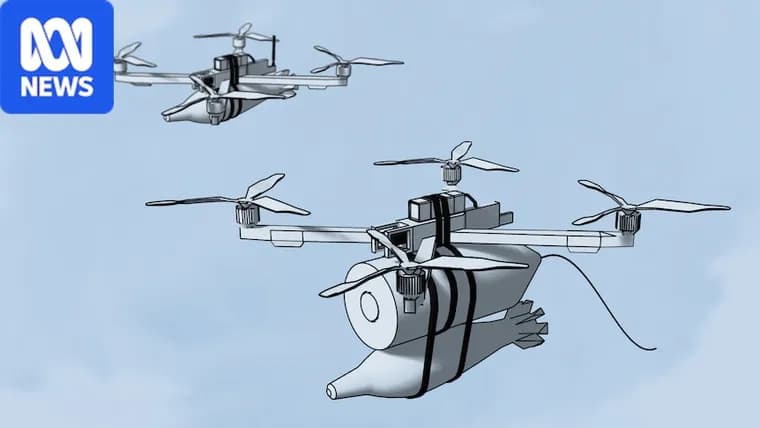
Off-the-shelf quadcopter drones fitted with explosives are being used far more widely in conflicts around the world, a surge ABC says has been supercharged by the war in Ukraine. According to the UN, drone attacks of all kinds rose 4,000 per cent globally between 2020 and 2024. People living under them have words for the sound: "zanana" in Arabic across Gaza and Lebanon, "zumbido" in Colombia.
The feature opens in Ukraine's southern Kherson region, where footage shows a small armed Russian drone scanning village rooftops and zooming in on a lone man repairing roof tiles. A person who hears one approaching usually has about three to 10 seconds to run and hide. Some so-called waiter drones lie in wait by the roadside. Ukrainians call the deliberate attacks the "human safari", and the UN says they constitute crimes against humanity. In August, Ukrainian authorities shared video of a Russian drone chasing a vegetable vendor around his van. Local authorities say up to 6,500 first-person-view (FPV) drones a week are launched towards Kherson. Resident Valentina Fedorchuk described a man who crashed his bike after panicking at a drone chasing him: "The drone didn't directly kill him, but he died because of the drone." Russia has repeatedly denied targeting civilians.
FPV quadcopters cost a few hundred dollars and were once niche hobby racing toys, flown with gaming goggles and a remote control. Strapped with grenades, they came to dominate Ukraine's battlefields. Added spools of fibre-optic cable stretched their range from about 20km to up to 50km; because a hair-thin thread links drone and operator in place of a radio frequency, ABC describes these as "unjammable". Both Russia and Ukraine are expected to produce nearly 8 million FPV drones this year.
The pattern reaches well beyond Ukraine. Myanmar's civil war has become the world's second-largest drone conflict. In Colombia, drones are now the weapon of choice for armed and criminal groups; attacks quadrupled between 2024 and 2025 and more than doubled in early 2026. In southern Lebanon, where Israeli forces and Hezbollah have increasingly used the weapons this year, resident Zeina Hilal says drones are "part of everyday life".
In Sudan, drones have become the leading killer of civilians. UN figures show 2,230 civilians killed in the civil war so far this year, nearly three-quarters of them by drone strikes, and at least 300 drone-related deaths were reported in the first three weeks of October. Both sides increasingly have access to larger, longer-range military drones. A UN fact-finding mission cited models made by China, Iran and Türkiye, supplied by countries such as the United Arab Emirates, which denies involvement.
In Gaza, the UN has accused Israel of breaching international law through its use of armed quadcopters. A UN commission of inquiry found they were used to "deliberately" target children; Israel rejects the report as "deeply flawed".
AI is adding to the concern. ABC says there is evidence that Russia's fixed-wing Molniya drones now include AI-guided versions that can independently identify and attack targets. The week before ABC's report, delegates from 120 countries met at the UN in Geneva on regulating so-called killer robots. After resistance from countries such as Russia, the US and Israel, a push for firm rules ended in a watered-down agreement to extend talks to 2028.
Key facts
- The UN says drone attacks rose 4,000 per cent globally between 2020 and 2024; Colombia's quadrupled between 2024 and 2025.
- FPV quadcopters cost a few hundred dollars, and both Russia and Ukraine are expected to produce nearly 8 million of them this year.
- UN figures put Sudan's civilian war deaths at 2,230 so far this year, with drone strikes accounting for nearly three-quarters.
- There is evidence of AI-guided Russian Molniya drones, a fixed-wing type, that can independently identify and attack targets.
- UN talks in Geneva with delegates from 120 countries ended with an agreement to extend killer robot discussions to 2028.
Why it matters
Cheap, mass-produced weapons are changing how civilians are exposed to war. Michael Horowitz, a senior fellow for technology and innovation at the Council on Foreign Relations, calls this "the era of precise mass in war" and says it makes the risks to civilians much higher. Human rights monitors and military analysts warn that tactics seen in Ukraine are being replicated elsewhere. Analysts at the Institute for the Study of War say strikes on critical infrastructure and humanitarian convoys are part of a trend that "weaponises civilian harm as a purposeful tool of war".
Who it affects
Civilians in Ukraine, Sudan, Gaza, Lebanon, Colombia and Myanmar appear in the report. Noah Taylor, an Australian who heads operations for the Norwegian Refugee Council in Sudan, says drones hit displacement camps and reach into homes, and children mimic drone and weapon sounds in schoolyard play. Yasir Zaidan, an adjunct lecturer in Seattle University's political science department, visited Khartoum in June and says drones now attack power grids, hospitals and even weddings. In Gaza, emergency physician Mimi Syed documented severe injuries in 2024 from quadcopters mainly mounted with rifles, and says that from August to September a child came in with a single gunshot wound every day she was there.
How to use it
For anyone following the policy debate, the baseline is that no single dedicated treaty explicitly bans armed drones. Existing international humanitarian law governs them: according to the International Committee of the Red Cross, they may only be used against combatants and military objectives, with all feasible precautions to avoid or at least minimise civilian harm. The UN and civil society groups want urgent international regulation, accountability and strict control, especially as AI capabilities grow. Robert Tollast, a land warfare researcher at the RUSI think tank, points to parts transfer controls and sanctions on drone supply chains as options, while warning that the many commercial components make the trade "very, very hard to regulate".
How solid is it
This is an ABC feature that combines UN figures, local authority data, analyst views and first-hand accounts. Several points are contested: Russia denies targeting civilians, Israel rejects the commission of inquiry's findings, and the UAE denies involvement in Sudan. The 4,000 per cent figure covers 2020 to 2024 and all drone attacks, not only FPV quadcopters. No absolute number of attacks and no worldwide civilian death toll from drones is given. The report also leaves open whether the nearly 8 million production forecast is a combined total or a figure for each country. The AI capability described concerns Molniya drones, and how often they attack autonomously is not stated.
Risks and caveats
Tollast says Molniyas carry larger payloads and fly further, which makes the AI additions especially dangerous. He cites growing evidence that Russia is using them against fuel stations and energy infrastructure, and essentially training the models to go after civilians. Regulation is lagging. Amnesty International said the Geneva outcome "falls shamefully short of what is needed to meet the reality of the moment". Shiri Krebs, a Deakin University law professor who researches drone warfare, says the principles of humanitarian law are vague enough that countries have so far been able to argue for justifications of violence. Tollast sees no end in sight.
“You continue with your day because you have to. But becoming familiar with that sound is not the same as feeling safe.”
— Zeina Hilal, a resident of southern Lebanon who works for CARE International