Claude Code, Codex beat hand-engineered planners at task planning
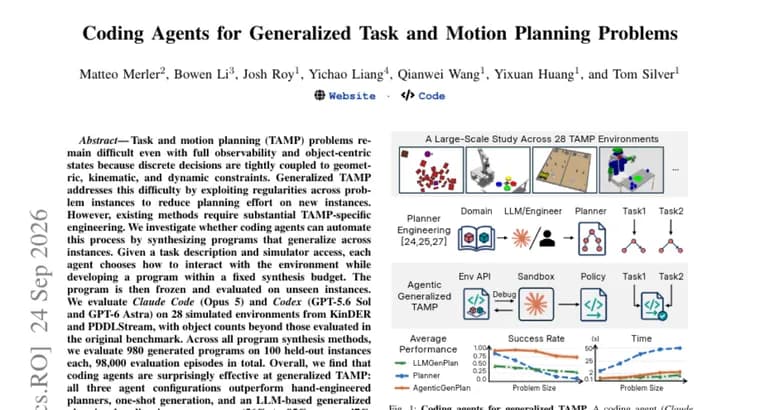
Task and motion planning (TAMP) asks a system to combine discrete decisions, like which object to grasp next, with continuous constraints from geometry, kinematics and dynamics. Generalized TAMP tries to make this easier by reusing regularities across many problem instances so that new instances need less planning effort, but building such generalized planners has traditionally required extensive TAMP-specific engineering. A new study asks whether coding agents can do that engineering themselves, by writing programs that generalize across instances rather than solving each problem from scratch.
The researchers gave each agent a task description and simulator access, let it interact with the environment while writing a program within a fixed synthesis budget, then froze the program and tested it on unseen instances. They evaluated three agent configurations, Claude Code (Opus 5) and Codex running on GPT-5.6 Sol and on GPT-6 Astra, across 28 simulated environments drawn from the KinDER and PDDLStream benchmarks, using object counts larger than those in the original benchmarks. In total the study covered 980 generated programs, each tested on 100 held-out instances, for 98,000 evaluation episodes.
On the 16 environments where a hand-engineered planner exists for comparison, all three coding-agent configurations beat that planner, along with one-shot program generation and an LLM-based generalized planning baseline, on mean success: the agents scored between 56% and 95%, versus 47% for the planners. As the number of objects in an environment grew, the agents' programs kept a higher success rate than the planner while using an order of magnitude less computation per instance on average. Logs of the agents' work showed them using interaction with the simulator to calibrate physical models, test edge cases and refine their strategies. The authors say they will release all code, including the full prompts given to the agents, and conclude that coding agents are a strong baseline for generalized TAMP.
Key facts
- Three coding-agent configurations, Claude Code (Opus 5), Codex on GPT-5.6 Sol and Codex on GPT-6 Astra, were tested on 28 simulated environments from the KinDER and PDDLStream benchmarks.
- The study evaluated 980 generated programs on 100 held-out instances each, for 98,000 evaluation episodes in total.
- On the 16 environments where a hand-engineered planner exists, the agents' mean success ranged from 56% to 95%, versus 47% for the planners.
- As object counts grew, the agents' programs kept higher success than the hand-engineered planner while using an order of magnitude less computation per instance on average.
- The authors plan to release all code and the full prompts given to the agents.
Why it matters
Generalized TAMP has historically demanded substantial TAMP-specific engineering to build planners that reuse structure across problem instances. This study shows that coding agents can take on that engineering work themselves, by writing programs during a synthesis budget and freezing them for evaluation, suggesting a much cheaper path to generalized planners.
Who it affects
The work is aimed at researchers and engineers working on task and motion planning and robotics simulation, particularly those building or comparing generalized planners against hand-engineered baselines.
How to use it
The authors say they will release all code from the study, including the full prompts given to the agents, which would let others reproduce the setup or apply the same coding-agent approach to their own TAMP environments; no pricing or product is involved since this is a research study.
How solid is it
The claims come from a single study with a large evaluation, 980 generated programs across 28 environments totaling 98,000 episodes, and the comparison against hand-engineered planners is restricted to the 16 environments where such a planner exists. The source text does not name the authors or give institutional affiliations or a publication date, and it does not specify what the 'LLM-based generalized planning baseline' used for comparison actually consists of.
Risks and caveats
The reported success rates and computation savings are the authors' own findings on their chosen set of 28 environments and object counts beyond the original benchmarks, so it is not yet established how the approach performs outside this test suite. The source text gives no release date or link for the promised code and prompts.