CLBench-V finds multimodal context learning far from solved
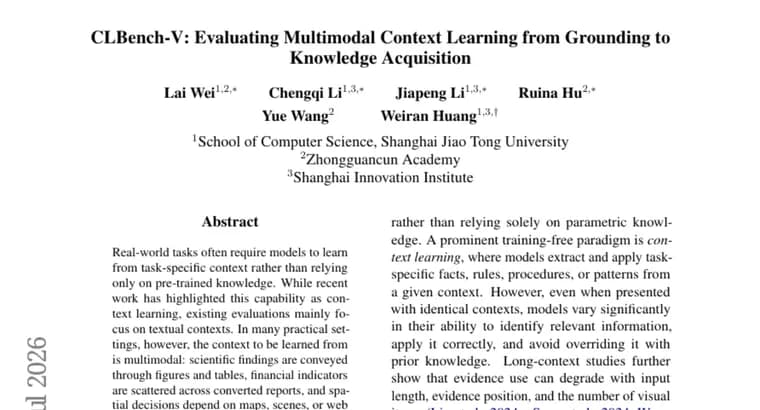
Researchers have introduced CLBench-V, a benchmark for what they call multimodal context learning: a model's ability to learn from task-specific context supplied at inference time rather than from what it absorbed during pretraining. The authors argue that most existing evaluations of this skill focus on textual context alone, while many real tasks hand the model context that is multimodal instead: scientific findings sit in figures and tables, financial indicators are scattered across converted reports, and spatial decisions depend on maps, scenes or web pages.
CLBench-V organizes tasks around three dimensions meant to localize where context use actually breaks down: context grounding, new information application, and new knowledge learning. The benchmark combines converted public benchmarks with newly constructed datasets spanning science, finance, long-document understanding, spatial reasoning and web-based visual question answering. To keep the cost of building domain-specific context-learning tasks down, the authors used automated construction and filtering procedures for the new datasets.
The finished benchmark totals 3,443 instances. Tested against six recent multimodal models, the best overall score reached only 0.2847, which the authors read as evidence that multimodal context learning remains far from saturated. Breaking the result down by dimension, InternVL3.5-30B-A3B performed best on context grounding and on new knowledge learning, while Qwen3.5-Plus performed best on new information application. The paper further analyzes judge reliability, context length, image count, and walks through representative failure cases. Code for CLBench-V is available on GitHub.
Key facts
- CLBench-V evaluates multimodal context learning across three dimensions: context grounding, new information application, and new knowledge learning.
- The benchmark totals 3,443 instances, combining converted public benchmarks with new datasets across science, finance, long-document understanding, spatial reasoning and web-based visual question answering.
- Across six recent multimodal models, the best overall score reached only 0.2847.
- InternVL3.5-30B-A3B performed best on context grounding and new knowledge learning; Qwen3.5-Plus performed best on new information application.
- The authors also analyze judge reliability, context length and image count, and release the benchmark's code on GitHub.
Why it matters
Real tasks often hand a model context beyond its training data, and that context is frequently not plain text: scientific figures and tables, financial reports, maps and web pages all carry information a model has to learn from on the spot. The authors note that existing evaluations of this skill focus mainly on textual context, leaving multimodal context learning largely untested. CLBench-V is built to close that gap and to pinpoint which part of the skill, grounding, applying new information, or acquiring new knowledge, actually fails.
Who it affects
Researchers and teams building or evaluating multimodal models, particularly for domains where context arrives as images or documents rather than text: scientific literature, financial reporting, spatial and navigation tasks, and web-based question answering.
How to use it
CLBench-V is a public benchmark with code released on GitHub, meant for running evaluations of multimodal models rather than for direct product use. There is no pricing or licensing tier mentioned in the source; it is an open research artifact.
How solid is it
The benchmark spans 3,443 instances across domains including science, finance, long-document understanding, spatial reasoning and web-based visual question answering, and was tested against six recent multimodal models, giving it reasonable coverage for a first release. The authors used automated construction and filtering to build the new datasets affordably, and separately analyzed judge reliability, context length and image count as checks on their own results. The low top score, 0.2847, is itself evidence the benchmark has headroom rather than being trivially solvable.
Risks and caveats
Automated construction and filtering of the new datasets can introduce its own noise or bias, which is part of why the authors examined judge reliability directly. Only six models were tested, so the ranking between InternVL3.5-30B-A3B and Qwen3.5-Plus may not generalize to other architectures or to future model versions.