Cody Wilson claims first AI-made gun, a 3D-printed .22 called WASP
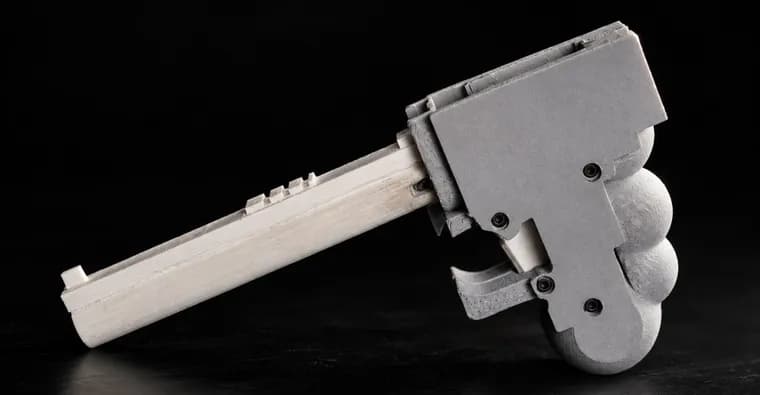
Cody Wilson, the gun-rights activist who made the first 3D-printed firearm 13 years ago and leads Defense Distributed and the DEFCAD file repository, says he now has "the first AI-made gun." It is called the WASP. The Verge's reporter watched it being test-fired outside Defense Distributed headquarters in Austin, Texas.
The WASP is a 3D-printed .22 caliber handgun that is, in the reporter's words, little more than a pistol barrel attached to a spring-loaded plastic box. It resembles Wilson's single-shot 3D-printed Liberator, with some distinctly AI-generated oddities such as a bubbly grip that does not quite fit a human hand. Wilson and a colleague clamped it to a DIY test mount and aimed it at a green slope in the backyard of a semi-residential neighborhood. A long black string ran from the trigger to Wilson, who crouched about 10 feet back behind a police riot shield; the reporter stood about 20 feet away.
The first attempt produced only a loud click. The gun's striker had hit the cartridge but failed to set off the primer, Wilson said, adding "This didn't happen last time." After some fiddling, the second try gave a bang about as loud as a firecracker and tore a hole through the top left corner of a cardboard target. Wilson then unclamped the gun, put on a protective glove and fired it by hand: another bang, a miss slightly high. The tally was two successful shots out of three attempts.
Asked why make such a functionally suspect firearm in Texas, where buying a conventional gun is often easy, Wilson took issue with the premise: "I would argue that what we've made is not an AI-generated gun, but an AI that can generate guns." The AI is a custom, unfiltered model he calls GatGPT. It answers questions about firearms, is trained on DEFCAD's library of gun files, and can help enthusiasts pick the parts they need for a build. DEFCAD, launched in 2012, is described as the world's largest online repository of digital gun and component files. GatGPT is currently in limited early access.
Wilson claims the WASP's whole development, from its name to safety tweaks (an early grip design could have cost someone a finger), came out of a natural-language dialogue between the model and its human user, which makes it essentially a vibe-coded gun. Chat logs viewed by The Verge show how it began. A Defense Distributed employee asked the model to build a new gun based on "Ergo Harlot," a variation of the more popular "Harlot," a compact single-shot .22 handgun. The prompter framed it as a challenge and said the entry "must be completely and fully functional and have a unique design." The model replied with a plan for a design called the WASP and submitted it for approval. It listed six key changes to the original, including a slightly longer barrel and a grip made of three grooved, circular lobes. After a Defense Distributed employee approved the plan, the logs show the model checking and testing each component, much as a coding agent such as Claude Code works through a checklist. The team printed the WASP in its office on a Bambu Lab printer in standard plastic filaments, with a handful of common metal parts for the firing pin and barrel. Wilson said the print took about six hours. The AI did not explain its name; Wilson said it resembles the insect, and denied it stands for "white Anglo-Saxon Protestant."
The Verge calls the WASP mostly a proof of concept, but one that fires real, lethal rounds and has no serial number. Its author also judges that a novice with GatGPT could plausibly make a gun with only a handful of prompts, which is the barrier-lowering critics such as Everytown have long warned about. Justin Wagner, Everytown's senior vice president for law and policy, said Wilson "admits the goal here": to lower the barrier to entry so anyone, regardless of background check status or legal eligibility, can own a gun, and to let anyone design and manufacture weapons, "and that's dangerous." Wagner also said the WASP is a development but not necessarily that novel: "It's another way to 3D print a gun," and, as a victim of a ghost-gun shooting told him, all guns are just as lethal.
The design drew sceptical reviews. Ashley Hlebinsky, a firearms historian and founder of consulting firm The Gun Code, said it is hard to judge without handling the gun, but the AI appears to have started a trigger guard and not finished it, leaving the trigger exposed for no apparent reason, and appears to have inverted a modern beavertail-style grip. It reminded her of AI-drawn pictures of guns that get most of the way there with weird parts missing. Jonathan Ferguson, keeper of firearms and artillery at the Royal Armories Museum in Leeds, England, said that legally a gun that fires without a breech explosion is a viable firearm, but technically he would not call it a "sound" or "good" one. It does not look comfortable to hold or easy to aim and, based on the test, seems only marginally functional. He had expected generative AI in 2026 to do better, and pointed to vestigial sights that cannot work, an open trigger guard and a weirdly shaped grip.
The story sits inside a wider fight over regulating 3D-printed guns. New York and California recently passed laws that will require 3D printer makers to install firearm-blocking software that detects guns or gun parts before they print; experts have questioned how and whether this would work. Wilson did not cite evading detection as a reason for building the AI gun maker, but it follows his August rollout of Hochulization, a tool (named as a jab at New York Gov. Kathy Hochul) that he says subtly alters a file's underlying hash, the file's digital fingerprint. By late September Wilson claimed to The Verge that files had been "Hochulized" more than 26,000 times, some more than once. The aim is to defeat purely hash-based detection. A brand-new AI-generated design would also not yet be in any detection database, and it is unclear whether AI-based detection software, still in development, would reliably catch a sufficiently strange-looking design. Hochul spokesperson Jess D'Amelia said individuals who intentionally aim to thwart safety regulations put themselves and New York communities at risk, and that the governor remains committed to combating ghost guns.
Wilson and others in the 3D2A movement argue gun files are computer code, a form of protected speech, a question argued in court for over a decade and one that may reach the Supreme Court. Wilson is confident the AI's designs will improve in function and uniqueness as DEFCAD grows, with the biggest gains coming from users chatting with the model and pushing it to refine its choices. He predicts design cycles will speed up: "It's like you're speedrunning the available possibilities, the materials, the platforms, the concepts."
Key facts
- Cody Wilson's Defense Distributed says the WASP, a 3D-printed .22 caliber handgun, is the first AI-made gun, designed by its custom model GatGPT, which is trained on DEFCAD's gun files.
- In The Verge's observed test in Austin, Texas, the gun misfired once, then fired twice: one hit on the corner of a cardboard target and one miss slightly high, so two shots out of three attempts.
- Chat logs show the model proposed the WASP after an employee asked for a new design based on the Ergo Harlot; the model listed six changes, and the print took about six hours on a Bambu Lab printer.
- Firearms experts Ashley Hlebinsky and Jonathan Ferguson point to an unfinished trigger guard, an odd grip and sights that cannot work; Ferguson calls it only marginally functional.
- Everytown's Justin Wagner warns the aim is to lower the barrier to making guns but calls the WASP not necessarily novel; the story ties into Wilson's Hochulization tool against hash-based gun detection.
Why it matters
Wilson has spent years at the centre of the fight over 3D-printed guns, and this is his attempt to add generative AI to it. The claim is that a model trained on gun files can propose its own design from a plain-language request, with a human mostly approving. Even if the first result is crude, the idea is that a novice could make a gun with only a handful of prompts, and Wilson predicts faster cycles of new designs. It also lands while New York and California move to require firearm-blocking software in 3D printers, and Wilson is already working to complicate that software.
Who it affects
Lawmakers and gun-safety groups such as Everytown, who have argued that sites like DEFCAD feed the spread of untraceable ghost guns. Makers of 3D printers and of gun-detection software, who face the New York and California requirements. Hobbyists and gun-rights advocates in the 3D2A movement, who treat gun files as protected speech. Anyone who could end up holding an unserialised, untested printed firearm.
How to use it
This is not a product to use. GatGPT is in limited early access, and the source gives no release timeline. The practical reading for policy and security teams: AI-generated designs may not match any existing detection database, and hash-altering tools like Hochulization are aimed at defeating simple hash checks, so detection based on file fingerprints alone is the weak point to watch.
How solid is it
The test firing is firsthand reporting: The Verge's reporter watched three shots from about 20 feet away, and the writer viewed the chat logs that show the design process. Specialists named in the piece gave their own assessments. But the claim that the AI designed the gun, from its name to safety tweaks, is Wilson's, and the article treats it as his claim. The source does not say the test was independently verified beyond the reporter's own observation of three shots. The 26,000 Hochulization figure is also Wilson's claim to The Verge.
Risks and caveats
The WASP fires real, lethal rounds and has no serial number, yet was unreliable in the test and judged only marginally functional by one expert. The design is a remix of an existing model, the Harlot, so its originality is open to challenge, and Everytown's Wagner doubts it is novel. It is unclear whether AI-based detection software, still in development, would reliably flag a sufficiently strange-looking AI-generated design. Experts have also questioned how and whether the New York and California printer rules would work. Legal questions about gun files as speech remain unsettled.
“From a technical perspective, I would not call this a 'sound' or 'good' firearm.”
— Jonathan Ferguson, keeper of firearms and artillery at the Royal Armories Museum in Leeds, England