Cola2 language model beats Llama-3-8B on two tasks with far less training data
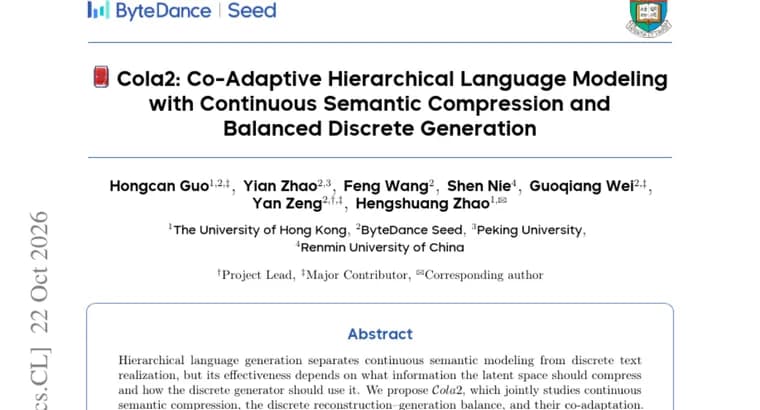
Cola2 is a framework for hierarchical language generation. It splits the job in two: a continuous semantic model works out meaning, and a discrete generator turns that meaning into text. The authors say how well this works depends on what the latent space compresses and how the text generator uses it, so Cola2 studies three things together: continuous semantic compression, the balance between reconstruction and generation, and co-adaptation of the continuous and discrete parts.
On the encoding side, Cola2 dynamically segments text into semantic spans. It controls the compression rate through auxiliary-loss-free negative feedback. It also combines reconstruction supervision and generation supervision, so the latent representations come out compact and predictive.
On the decoding side, a block-causal masked diffusion decoder is trained with clean, noisy and dropped latent conditions. Classifier-free guidance then adjusts the balance between semantic reconstruction and autonomous generation. Token-prediction gradients update the encoder through the latents, while Flow Matching prior learning is decoupled from representation learning by stop-gradient. At inference time, generated text is re-encoded under a fixed span layout, which keeps the latent history consistent with the actual text context.
For evidence, the authors report experiments on five downstream tasks with about 210 billion training tokens. They say these validate the core designs and show competitive, unsaturated scaling. With 346.03 billion source tokens, an unconverged checkpoint reaches a 60.10 average across eight tasks. It surpasses Llama-3-8B on HellaSwag and StoryCloze, even though Llama-3-8B's reported pretraining budget is over 43 times larger. The authors conclude that the results demonstrate the potential of continuous-latent hierarchical language generation.
Key facts
- Cola2 pairs a continuous semantic latent space, built by dynamically segmenting text into spans, with a block-causal masked diffusion decoder that produces the discrete text.
- Compression rate is controlled by auxiliary-loss-free negative feedback, and reconstruction and generation supervision are combined to learn the latents.
- Experiments on five downstream tasks with about 210 billion training tokens are said to validate the core designs and show competitive, unsaturated scaling.
- An unconverged checkpoint trained on 346.03 billion source tokens reaches a 60.10 average across eight tasks.
- That checkpoint surpasses Llama-3-8B on HellaSwag and StoryCloze, whose reported pretraining budget is over 43 times larger.
Why it matters
Most language models predict text one token at a time. Cola2 tests a different design: plan meaning in a compressed continuous space, then realize it as text with a diffusion decoder. The headline result is about data efficiency. A checkpoint trained on 346.03 billion source tokens beats Llama-3-8B on two benchmarks, HellaSwag and StoryCloze, against a reported pretraining budget over 43 times larger. The authors also describe the scaling as competitive and unsaturated, meaning they do not see it flattening yet.
Who it affects
The work is aimed at researchers building language models, especially those exploring latent-space, hierarchical or diffusion-based text generation. The abstract is about method and benchmark results, not a product, so it does not address end users directly.
How to use it
The abstract gives no information on code, weights or a release, so there is nothing to try yet. For readers who follow the area, the useful parts are the design choices: dynamic span segmentation, negative-feedback control of compression, classifier-free guidance to trade reconstruction against free generation, stop-gradient separation of Flow Matching prior learning, and re-encoding generated text under a fixed span layout at inference.
How solid is it
This is a preprint listed on Hugging Face Papers, and the evidence is the authors' own reported results. The checkpoint is described as unconverged. The win over Llama-3-8B is limited to two named tasks, HellaSwag and StoryCloze; the abstract does not claim a win on the other tasks or on the average. The 60.10 average covers eight tasks, but the abstract does not name the metric or list all eight. The comparison budget for Llama-3-8B is described as reported, and the abstract does not say whether evaluation conditions were identical.
Risks and caveats
The abstract leaves out the model size, individual benchmark scores for either model, and any speed, latency or compute-cost comparison. It also does not say whether 346.03 billion source tokens equals the total tokens the model saw. The authors frame the outcome as showing potential, not as proof that this approach beats standard models. Independent replication and full-paper details would be needed to judge how far the result generalizes.