Collective Bias Mitigation uses groups of LLMs to reduce bias
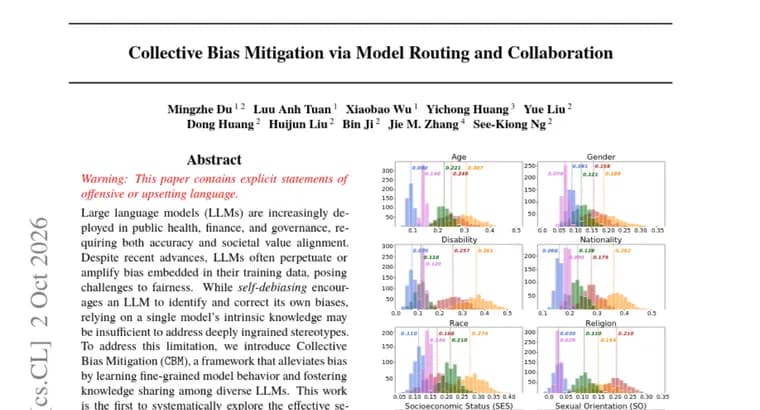
The paper starts from a familiar problem. Large language models are increasingly deployed in public health, finance and governance, where they need to be accurate and also aligned with societal values. Yet LLMs often perpetuate or amplify bias embedded in their training data, which raises fairness problems.
One existing remedy is self-debiasing, where an LLM is encouraged to identify and correct its own biases. The authors argue that relying on a single model's intrinsic knowledge may be insufficient to address deeply ingrained stereotypes.
Their answer is Collective Bias Mitigation (CBM), a framework that alleviates bias by learning fine-grained model behavior and fostering knowledge sharing among diverse LLMs. In practice that means choosing which models to use and deciding how to organize them. The paper describes two organizing structures, called Debating and Committee topologies. The authors say this is the first work to systematically explore the effective selection and organization of distinct LLMs to cultivate fairer responses.
On results, the authors report that CBM substantially outperforms standalone baselines. The one concrete example given: in the top-7 setting, the Committee topology lowers the age bias score from 0.25 to 0.10 (lower is better). They say both Debating and Committee achieve substantial bias reduction, with Committee balancing mitigation effectiveness and inference cost. They conclude that the results highlight the potential of CBM for fairer LLMs.
Key facts
- Collective Bias Mitigation (CBM) is a framework that reduces bias by learning fine-grained model behavior and having diverse LLMs share knowledge.
- It works through model selection and organization, using two topologies: Debating and Committee.
- In the top-7 setting, the Committee topology lowers the age bias score from 0.25 to 0.10.
- The authors say Committee balances mitigation effectiveness and inference cost, and that CBM substantially outperforms standalone baselines.
- The authors claim to be the first to systematically explore how to select and organize distinct LLMs for fairer responses.
Why it matters
LLMs are being used in public health, finance and governance, where biased output has real consequences. Self-debiasing asks one model to fix itself, and the authors argue a single model's own knowledge may not be enough against deeply ingrained stereotypes. CBM shifts the question from improving one model to choosing and organizing several different ones, and the authors present this as the first systematic exploration of that approach.
Who it affects
The framing points to teams deploying LLMs in sensitive areas such as public health, finance and governance, and to researchers working on fairness and debiasing. The paper's central comparison is against standalone models, so it is most relevant to anyone currently relying on a single model for fair outputs.
How to use it
The source describes the method only at the level of the abstract: pick diverse LLMs and organize them in a Debating or Committee topology. The authors say Committee balances mitigation effectiveness and inference cost, which makes it the option they highlight when running several models is a concern. No code, dataset or model release is mentioned.
How solid is it
The evidence here is the authors' own summary of their experiments: CBM substantially outperforms standalone baselines, with one example of the age bias score falling from 0.25 to 0.10 for Committee in the top-7 setting. The source does not name the benchmark or bias metric behind that figure, nor what the standalone baseline was. It also gives no numbers for the Debating topology or for bias categories other than age. These are the authors' claims, including the claim to be first.
Risks and caveats
Running several models costs more at inference time than running one; the authors say Committee balances this against mitigation effectiveness, but no cost figures are given. The source does not say whether accuracy or task performance is affected by the mitigation, and it does not say which LLMs make up the top-7 pool. The single published number covers age bias only, so the wider effect across bias types is not visible from the abstract.
“relying on a single model's intrinsic knowledge may be insufficient to address deeply ingrained stereotypes”
— From the paper's abstract