CSIS: DOD munitions rebuild hinges on Congress funding, not framework deals
A CSIS analysis asks how quickly the Department of Defense (DOD) can rebuild and recast the U.S. munitions industrial base. Its starting point is that earlier work has already identified why stockpiles shrank. The task now, it says, is to grow the arsenal and change its composition for modern high-intensity wars of precision and attrition, with a "high-low mix" of exquisite and affordable missiles and interceptors that gives the joint force both magazine breadth and magazine depth. To judge the timeline, the analysis looks at the president's fiscal year 2027 budget request, later initiatives, quarterly company reporting and recent contract announcements.
On the exquisite end, requests jump. Patriot PAC-3 MSE interceptors go from 341 in FY 2026 (Army and Navy) to 3,203 in FY 2027 (Army and Navy), a rise of 839 percent. THAAD interceptors go from 37 (Missile Defense Agency) to 857 (Army), up 2,216 percent. Tomahawk missiles go from 57 (Navy) to 1,049 (Navy and Army), up 1,740 percent. These systems are high-performance and expensive, but they were built for performance, not for production at scale, and their manufacturing lead time runs 25 to 51 months. Multiyear agreements, coproduction efforts under consideration and direct-to-supplier agreements could potentially help shorten that.
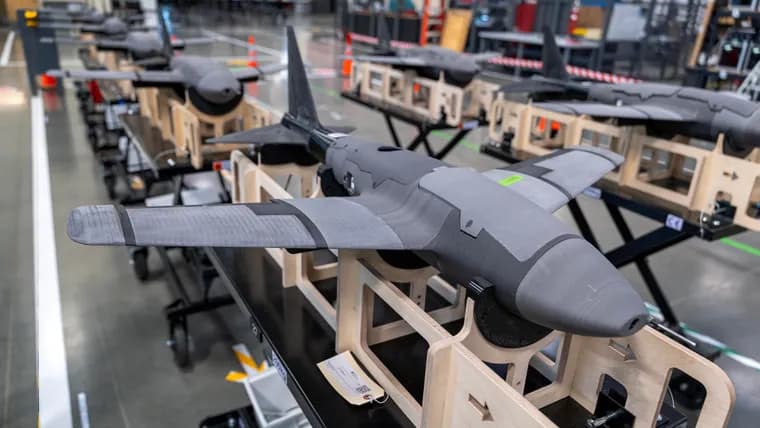
The low-cost end is growing fast. The Pentagon launched the Drone Dominance Program in December 2025: $1.1 billion to scale domestic small drone production and field some 340,000 units by the end of 2027. Since May 2026 it has signed several multiyear framework agreements for cheap cruise missiles. The Air Force's Family of Affordable Mass Missile (FAMM) program covers over 27,000 air-launched cruise missiles requested over five years. The Low-Cost Containerized Missiles (LCCM) program covers some 10,000 ground-launched cruise missiles delivered by the beginning of 2030. The Navy plans to request roughly 4,500 hypersonic air-launched cruise missiles through FY 2031. The Army's low-cost interceptor (LCI) initiative targets modular interceptors under $1,000,000 per unit, and a Missile Defense Agency effort of the same name aims at less than $750,000 per interceptor against ballistic and hypersonic threats. Newer firms such as Anduril, CoAspire and Zone 5 Technologies hold framework production agreements for LCCM and FAMM. Roughly 49 percent of munitions units requested for FY 2027 cost less than $600,000 per unit, rising to over 70 percent in FY 2031 on projected requests (shares of units, not of spending).
The analysis says DOD budget documents confirm that low-cost systems will arrive at scale before most exquisite ones. Under framework agreements of up to seven years with Lockheed Martin, DOD expects PAC-3 MSE capacity to grow 233 percent, from roughly 600 to 2,000 interceptors a year by 2030; THAAD output to grow 317 percent, from 96 to 400 units a year; and Precision Strike Missile capacity to grow fourfold to roughly 550 a year. RTX, backed by a DOD procurement commitment of up to seven years, plans to raise annual production of Tomahawk to more than 1,000, AMRAAM to over 1,900 and SM-6 to over 500. By contrast, the LCCM framework agreement was signed in May 2026 and the first 1,000 Anduril Barracuda-500M systems are expected in 2027, far less than the 34 months between contract award and first delivery projected for Tomahawk in the FY 2027 budget documents. FAMM has 1,000 units requested in 2027 and more than 5,000 requested for delivery in 2028.
The analysis also points to cheaper drones used against Iran. LUCAS, a reverse-engineered Iranian Shahed-136 one-way attack drone, was used in combat by the United States for the first time in Operation Epic Fury. Complete assessments of its performance remain undisclosed, but its $55,000 unit cost, 18-month concept-to-development timeline and 500-mile range make it a credible low-cost complement to legacy strike systems. Admiral Brad Cooper told the Senate Armed Services Committee in May 2026 that LUCAS "flipped the cost curve" against Iran. Army Secretary Dan Driscoll told a House Appropriations Defense Subcommittee in April 2026 that the Army bought 13,000 Merops interceptor drones, designed by United States-owned Perennial Autonomy and costing less than $10,000 each, to counter Shahed drones. The Army is running a "compressed" LCI timeline: initial Request for Information in May 2026, first live-fire demonstrations targeted for fall 2026, and a split of the interceptor into subsegments whose intellectual property rights the Army is acquiring, to speed acquisition and avoid future production bottlenecks.
The central caution is that framework agreements are not appropriations. They are demand signals meant to give industry confidence to invest in facilities, workforces and supply chains. Whether they become capacity depends on Congress appropriating funds, the Pentagon signing contracts, and industry delivering effective systems. Congress took a first step in the FY 2026 appropriations bill by approving multiyear procurement authority for eight munitions (PAC-3 MSE, THAAD, Tomahawk, AMRAAM, SM-6, SM-3 IB, JASSM-ER and LRASM), which is the legal basis for the frameworks. But FY 2027 funding is uncertain. A sizable portion of the money for the Munitions Acceleration Council's initial 14 prioritized munitions is mandatory spending tied to a reconciliation bill with an unclear path through Congress. Of the 3,203 PAC-3 MSE interceptors requested for FY 2027, 2,936 (92 percent) require that mandatory funding to pass. The president's request called for a 188 percent increase in missile orders, but how much will actually be procured is uncertain.
Some contracts are already out, using FY 2026 appropriations and reconciliation funds. In July 2026 Lockheed Martin received a contract worth up to $58.6 billion to triple PAC-3 MSE production by 2030, supporting a 50 percent increase in jobs at its Camden, Arkansas, facility. A month earlier it got a seven-year undefinitized contract action for up to $35 billion to quadruple THAAD interceptor production. On August 10, 2026 the Missile Defense Agency awarded RTX $745 million for SM-3 Block IIA production and sustainment, and the following week DOD announced a $22.9 billion contract with RTX to scale Tomahawk production "at unprecedented speed." The frameworks also committed companies to internally funded capital spending on factories and equipment; Lockheed Martin, for example, has committed more than $9 billion to expand capacity. The available text ends partway through that section.
Key facts
- FY 2027 requests for PAC-3 MSE interceptors rise 839 percent (341 to 3,203), THAAD 2,216 percent (37 to 857) and Tomahawk 1,740 percent (57 to 1,049).
- Roughly 49 percent of munitions units requested for FY 2027 cost under $600,000 each, projected to pass 70 percent by FY 2031; low-cost systems are expected at scale before most exquisite ones.
- Framework agreements are demand signals, not appropriations; 2,936 of the 3,203 requested PAC-3 MSE units (92 percent) depend on a reconciliation bill with an unclear path.
- Contracts already announced include up to $58.6 billion for Lockheed Martin PAC-3 MSE, up to $35 billion for THAAD, and $22.9 billion for RTX Tomahawk.
- Lockheed Martin has committed more than $9 billion to expand capacity; exquisite munitions still face a 25-to-51-month manufacturing lead time.
Why it matters
The Pentagon is trying to refill weapons inventories drawn down by the ongoing conflict against Iran, and the analysis argues the answer is both a larger arsenal and a different one: a high-low mix of exquisite and affordable missiles. The scale of the requests is large, such as PAC-3 MSE going from 341 to 3,203 interceptors in one year. The analysis says the real test is not announcements but whether money, contracts and factory investment follow.
Who it affects
DOD and the services (Army, Navy, Air Force) and the Missile Defense Agency, which make the requests. Congress, which controls appropriations and the reconciliation bill. Established producers Lockheed Martin (PAC-3 MSE, THAAD, Precision Strike Missile) and RTX (Tomahawk, AMRAAM, SM-6, SM-3 Block IIA). Newer firms such as Anduril, CoAspire and Zone 5 Technologies, which hold framework agreements for low-cost cruise missiles, and drone makers such as Perennial Autonomy. Also workers at sites like Lockheed's Camden, Arkansas, facility, where the PAC-3 MSE contract supports a 50 percent increase in jobs.
How to use it
For anyone following defense procurement, the analysis offers a three-step checklist: Congress appropriates funds, the Pentagon signs contracts, and industry delivers effective systems. Framework agreements alone do not complete the chain. Useful markers to watch are the fate of the reconciliation bill, further contract awards like the Lockheed and RTX ones, company capital spending such as Lockheed's more than $9 billion, and the first LCCM deliveries of Anduril's Barracuda-500M in 2027 against the 34 months projected for Tomahawk.
How solid is it
This is an analysis from CSIS built on the FY 2027 budget request, DOD budget documents, quarterly company reporting and contract announcements, and most figures are cited to those. Its forward numbers are plans and requests, not deliveries. The figures it refers to (Figures 1 to 3) are not in the text available here, and the visible text gives no single overall answer or date for how quickly the industrial base will be rebuilt. The text ends partway through the section on company investment.
Risks and caveats
FY 2027 funding is uncertain: a sizable portion of the funding for the 14 prioritized munitions is mandatory spending tied to a reconciliation bill with an unclear passage, and it is uncertain how much of the 188 percent increase in missile orders will be procured. Exquisite systems were built for performance, not scale, and lead times of 25 to 51 months could only potentially be reduced by multiyear, coproduction and direct-to-supplier deals. Low-cost systems still have to be developed, rigorously tested, delivered and integrated into the joint force. Complete assessments of LUCAS's initial performance remain undisclosed.
“Framework agreements are not appropriations; rather, they deliver demand signals intended to instill industry with confidence in future government purchases”
— CSIS analysis, How Quickly Can the DOD Rebuild and Recast the Munitions Industrial Base?