D^3-MOPD closes 97% of student-teacher distillation gap
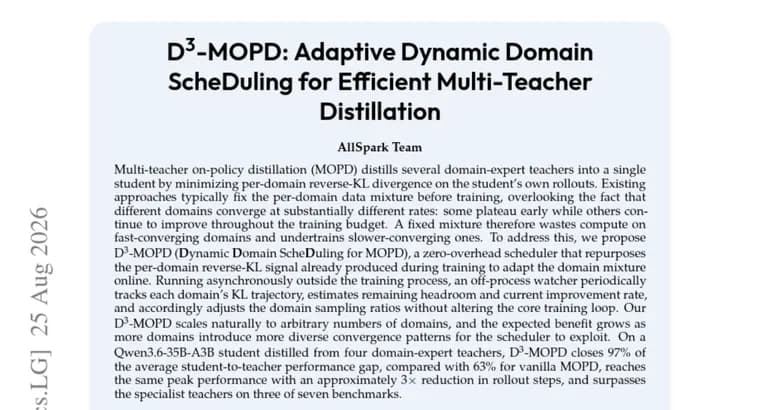
Researchers propose D^3-MOPD (Dynamic Domain ScheDuling for MOPD), a scheduler for multi-teacher on-policy distillation (MOPD), a technique that compresses several domain-expert teacher models into a single student model by minimizing per-domain reverse-KL divergence measured on the student's own rollouts. The paper's starting observation is that existing MOPD approaches fix the mixture of training data across domains before training begins, which ignores the fact that different domains converge at substantially different rates: some plateau early, while others keep improving for the whole training budget. A fixed mixture therefore wastes compute on domains that have already converged and undertrains the domains that are still improving.
D^3-MOPD addresses this without adding computational overhead. It repurposes the per-domain reverse-KL signal that MOPD training already produces as a byproduct, rather than computing anything new. An off-process watcher runs asynchronously alongside training, periodically checking each domain's KL trajectory to estimate how much headroom for improvement remains and how fast that domain is currently improving, then adjusts the domain sampling ratios accordingly, all without altering the core training loop itself. The authors report that the method scales naturally to any number of domains, and that its benefit should grow as more domains are added, since more domains mean more diverse convergence patterns for the scheduler to exploit.
In the reported experiment, a Qwen3.6-35B-A3B student model was distilled from four domain-expert teachers. D^3-MOPD closed 97% of the average performance gap between the student and its teachers, compared with 63% closed by vanilla MOPD using a fixed mixture. D^3-MOPD also reached the same peak performance as the baseline with an approximately threefold reduction in the number of rollout steps required. Across seven benchmarks used to evaluate the distilled student, D^3-MOPD's student surpassed the specialist teacher models outright on three of them.
Key facts
- D^3-MOPD adjusts per-domain data mixture ratios during multi-teacher on-policy distillation by reusing the per-domain reverse-KL signal already produced by training, via an asynchronous off-process watcher that does not touch the core training loop.
- On a Qwen3.6-35B-A3B student distilled from four domain-expert teachers, D^3-MOPD closed 97% of the average student-to-teacher performance gap, versus 63% for vanilla MOPD with a fixed mixture.
- D^3-MOPD reached the same peak performance as the baseline with an approximately threefold reduction in rollout steps.
- The distilled student surpassed the specialist teacher models outright on three of the seven benchmarks tested.
- The scheduler is designed to scale to an arbitrary number of domains, with the authors stating its benefit should grow as more domains introduce more diverse convergence patterns.
Why it matters
Distilling several domain-expert teachers into one student model is a standard way to build a compact model that covers many specialties, but the mixture of training data across domains is normally fixed in advance. D^3-MOPD's premise is that this wastes compute: domains that converge quickly keep receiving the same share of training as domains that are still improving late in the run. Since the fix reuses a signal (per-domain reverse-KL) that on-policy distillation already computes, it adds no extra computational overhead of its own.
Who it affects
The method targets teams building multi-teacher distillation pipelines, where a single student model needs to absorb the specialties of several domain-expert teacher models under a fixed training budget. The reported gains scale with the number of domains involved, since more domains give the scheduler more variation in convergence rates to act on.
How to use it
D^3-MOPD runs as an off-process watcher alongside an existing MOPD training setup. It periodically reads each domain's reverse-KL trajectory, estimates the remaining headroom for improvement and the current rate of improvement in that domain, and adjusts the domain sampling ratios accordingly, without modifying the core training loop. Because it repurposes a signal training already produces, adopting it does not require adding new instrumentation to the training process itself.
How solid is it
The evidence comes from a single reported setup: a Qwen3.6-35B-A3B student distilled from four domain-expert teachers, evaluated on seven benchmarks and compared only against vanilla MOPD with a fixed data mixture. The source text does not name the paper's authors or institutions, the four domains, the seven benchmarks, or the training's wall-clock time or compute budget, and it does not describe how the watcher estimates remaining headroom beyond stating that it does so.
Risks and caveats
The comparison is against one baseline, vanilla MOPD, rather than against other domain-scheduling methods, so it is not yet clear how D^3-MOPD stacks up against alternative approaches to the same problem. The gains are reported for one student size and one set of four teacher domains; how they hold up at different scales or with different domain mixes is not addressed in the available text.