DecoEvo co-evolves an LLM's solver and its grading rubric together
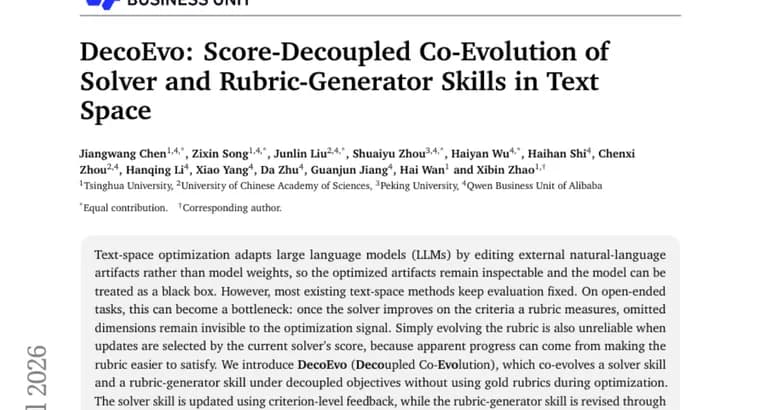
Text-space optimization improves an LLM's behavior by editing external natural-language artifacts, such as prompts or skill instructions, instead of updating the model's weights. That keeps the optimized artifacts human-readable and lets the underlying model stay a black box. Most existing text-space methods, however, keep the evaluation rubric fixed while the solver's prompt or skill is optimized against it. On open-ended tasks this becomes a bottleneck: once the solver learns to satisfy everything the rubric checks for, any dimension of quality the rubric omits stops showing up in the optimization signal at all.
An obvious fix, evolving the rubric alongside the solver, turns out to be unreliable on its own. If rubric updates are chosen based on the current solver's score, the score can rise simply because the rubric became easier to satisfy, not because the solver actually improved.
The paper introduces DecoEvo (Decoupled Co-Evolution), which runs a solver skill and a rubric-generator skill through separate, decoupled update rules, and does not use gold-standard reference rubrics at any point during optimization. The solver skill is updated from criterion-level feedback. The rubric-generator skill is revised through audits of requirement coverage and response discrimination that are independent of the solver's aggregate score. That separation steers rubric updates toward weaknesses the solver has not yet fixed, instead of repeatedly reinforcing criteria it already satisfies.
Tested under each benchmark's own official evaluation protocol, DecoEvo outperformed every compared method across five benchmarks and three different LLM backbones, with 2.8 to 5.0 percent relative gains over the prior SkillOpt method in the five-benchmark average.
Key facts
- DecoEvo co-evolves a solver skill and a rubric-generator skill in text space, without touching model weights.
- The rubric-generator is updated using audits of requirement coverage and response discrimination, not the solver's aggregate score, specifically to stop the rubric from drifting toward easier grading.
- No gold reference rubrics are used at any point during optimization.
- Across five benchmarks and three LLM backbones, DecoEvo outperformed every method it was compared against.
- It beat the prior SkillOpt method specifically, with 2.8 to 5.0 percent relative gains in the five-benchmark average.
Why it matters
Text-space optimization is an increasingly common way to improve an LLM's behavior without retraining it, by editing inspectable prompts or skill instructions instead of weights. But a fixed grading rubric creates a blind spot on open-ended tasks: once the solver satisfies everything the rubric measures, further gains on uncovered dimensions become invisible to the training signal. DecoEvo's contribution is evolving the rubric itself while blocking the obvious failure mode, letting the rubric quietly get easier so scores rise without real improvement.
Who it affects
The audience is researchers and engineers building LLM agents or pipelines that optimize prompts or skills for open-ended tasks judged by a grading rubric rather than a single exact answer, including anyone currently using SkillOpt-style text-space optimization. It is not a consumer product or a commercial release.
How to use it
DecoEvo is a method, not a shipped tool: the source gives no code repository, license or pricing. The recipe described is to update the solver skill from criterion-level feedback, update the rubric-generator skill separately using coverage and discrimination audits decoupled from the solver's score, and iterate the two in tandem without ever consulting a gold rubric.
How solid is it
The work is credited to Jiangwang Chen and co-authors and was evaluated across five benchmarks and three different LLM backbones, each scored under that benchmark's own official evaluation protocol, against multiple prior methods including SkillOpt. It appears on Hugging Face Papers with 26 points and 1 comment, indicating early-stage attention rather than broad independent verification.
Risks and caveats
The reported edge over SkillOpt is a 2.8 to 5.0 percent relative gain in a five-benchmark average, an incremental improvement rather than a large leap. The source text does not name the specific benchmarks or LLM backbones used, nor does it give absolute scores, so the practical size of the improvement and the extra complexity of maintaining two co-evolving skills are hard to judge from this description alone.
“This separation focuses generator updates on newly exposed solver weaknesses, reducing repeated emphasis on criteria the solver already satisfies.”
— DecoEvo paper abstract, Jiangwang Chen and co-authors