Decoy Direction Optimization blocks LLM refusal-ablation jailbreaks
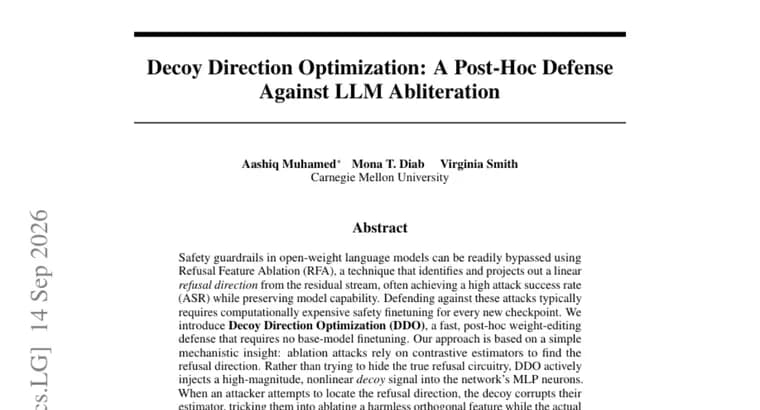
Open-weight language models can be jailbroken with Refusal Feature Ablation (RFA), also known as abliteration: an attacker finds a single linear "refusal direction" inside the model's residual stream and projects it out, often achieving a high attack success rate (ASR) while leaving the model's other capabilities intact. The usual fix, safety finetuning, is computationally expensive and has to be redone for every new checkpoint. Researchers now propose Decoy Direction Optimization (DDO), a fast, post-hoc weight-editing defense that needs no finetuning of the base model at all. The idea rests on how RFA works mechanically: ablation attacks rely on contrastive estimators to locate the refusal direction. Rather than trying to hide the model's real refusal circuitry, DDO injects a high-magnitude, nonlinear decoy signal into the network's MLP neurons. When an attacker runs its estimator to find the refusal direction, the decoy corrupts that search, so the attacker ends up ablating a harmless, unrelated feature instead while the model's actual safety mechanism stays intact. The researchers prove a spectral bound formalizing why this works and test DDO across six model families (not individually named in the source), reporting under 10% ASR against standard RFA attacks. On Llama-3-8B-Instruct specifically, DDO holds up reasonably against a harder, adaptive multi-phase attack, though not as well as a trained defense: 65% worst-case ASR for DDO versus 58% for the trained baseline. Against a separate weight-level attack called Heretic, DDO cuts ASR on the same model from 88.7% down to 18%. The paper's headline efficiency claim is cost: DDO reaches these results at 30 to 450 times lower optimization cost per configuration than the trained defenses it is compared against.
Key facts
- Decoy Direction Optimization (DDO) is a post-hoc weight edit that defends open-weight LLMs against Refusal Feature Ablation (abliteration) jailbreaks without any base-model finetuning.
- It works by injecting a high-magnitude, nonlinear decoy signal into MLP neurons, which corrupts an attacker's contrastive estimator so it ablates a harmless feature instead of the real refusal direction.
- Across six model families, DDO holds standard RFA attack success under 10%.
- On Llama-3-8B-Instruct it cuts Heretic weight-level attack success from 88.7% to 18%, and stays close to a trained defense under adaptive multi-phase attacks (65% vs. 58% worst-case ASR).
- DDO's optimization cost per configuration is 30 to 450 times lower than the trained baselines it is measured against.
Why it matters
Abliteration is one of the most common ways open-weight models get their safety guardrails stripped: it needs no retraining, just finding and removing one linear direction in the model's activations, and it tends to preserve the model's normal capabilities while it does so. The standard countermeasure, safety finetuning, is expensive and has to be repeated for every new model checkpoint. DDO instead targets the attack's mechanism directly: since the attacker's method depends on a contrastive estimator to find the refusal direction, feeding that estimator a convincing fake target neutralizes the attack without touching the model's actual safety behavior.
Who it affects
The direct audience is teams that release or maintain open-weight models and want a cheap way to harden already-trained checkpoints against ablation-based jailbreaks, plus researchers working on interpretability-based attacks and defenses more broadly. It is a defense mechanism, not a consumer-facing feature, so it does not change what end users of a chatbot or API see.
How to use it
DDO is a post-hoc weight-editing procedure applied after a model is trained, not a training-time technique or a product with pricing. Its practical selling point is cost: the paper reports 30 to 450 times lower optimization cost per configuration than training-based defenses, which is what makes it feasible to apply per checkpoint rather than only occasionally.
How solid is it
The researchers back the approach with a proved spectral bound formalizing why the decoy corrupts the attacker's estimator, and test it empirically across six model families, reporting under 10% attack success against standard RFA in that evaluation. On Llama-3-8B-Instruct specifically, they also test against an adaptive multi-phase attack and a separate weight-level attack (Heretic), which is a more thorough evaluation than a single attack setting. The source does not name the six model families individually, does not detail the spectral bound's mechanics beyond stating it is proved, and gives no publication venue or review status.
Risks and caveats
The defense is not uniformly stronger than training-based alternatives: under the adaptive multi-phase attack on Llama-3-8B-Instruct, DDO's worst-case attack success rate (65%) is actually higher than the trained defense's (58%), meaning a determined, adaptive attacker still gets through more often than not on that specific test. The source names no individual authors or institutions, does not identify the six model families evaluated, and states no publication venue or peer-review status, so the work's provenance and independent scrutiny cannot be assessed from the abstract alone.