DeepMind expands AI research partnership into EVE Online
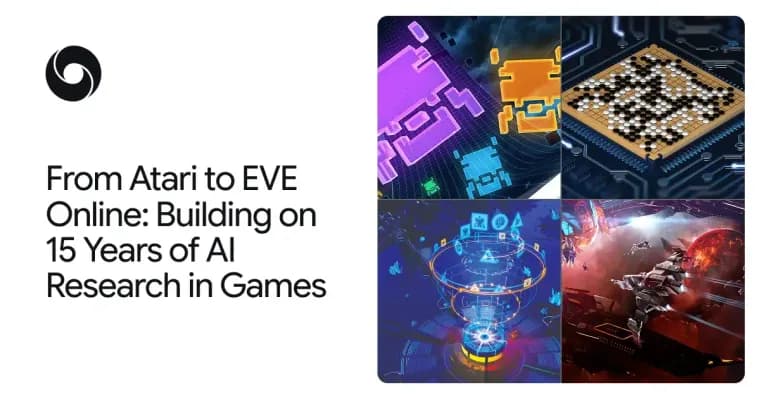
Google DeepMind used a blog post marking 15 years of AI research in games to trace its history in the field and to lay out a research partnership with Fenris Creations, the independent studio behind EVE Online, EVE Vanguard and EVE Frontier. The post frames the partnership as the next step after a run of milestones: the Deep Q-Network (DQN), described in a 2015 Nature paper, learned to play 49 different Atari 2600 games directly from raw pixels with no game-specific engineering. AlphaGo defeated world champion Go player Lee Sae Dol in 2016; AlphaGo Zero then surpassed it by learning purely from self-play, AlphaZero generalized the approach to chess, shogi and Go, and MuZero learned to play without even being told the rules. In 2019, AlphaStar reached Grandmaster level in StarCraft II. DeepMind credits the exploratory habits that emerged from these game projects with feeding into AlphaFold, whose protein-structure predictions won the 2024 Nobel Prize in Chemistry.
The post says that line of work has since shifted from mastering games with a defined score to understanding open-ended game worlds the way a person would. That is the premise behind SIMA, DeepMind's Scalable Instructable Multiworld Agent, which watches the screen, follows natural-language instructions and acts through ordinary keyboard and mouse input rather than an API. Powered by DeepMind's Gemini models, SIMA 2 is described as an interactive companion capable of real-time reasoning and conversation, achieving human-like play across 3D research environments and games including No Man's Sky, Valheim and Hydroneer.
The centerpiece of the post is the partnership with Fenris Creations, which the company says it has spent more than two decades building into one of gaming's most extraordinary persistent worlds. EVE Online, launched in 2003, is a massively multiplayer space simulation in which thousands of players have shared a single evolving universe for more than 20 years, with a player-driven economy and trade networks spanning thousands of star systems. DeepMind argues this makes EVE a rare research environment for testing continual learning, long-term memory beyond today's model context windows, long-horizon planning across weeks or years, and complex multi-agent dynamics such as negotiation and emergent social behavior. The collaboration spans three parts of the EVE Universe: EVE Online itself as a large-scale persistent universe, EVE Vanguard as a first-person, ground-level tactical layer of the same world, and EVE Frontier, whose programmable "Smart Assemblies" let players change the rules of the world itself. DeepMind says the work has already produced one concrete result for players: the Aura Guidance system, which uses Gemini to surface player-generated knowledge drawn from real Rookie Help questions and answers to assist new pilots.
DeepMind describes its research roadmap as starting with an offline instance of EVE Online, run as a sandbox separate from live players, then moving into EVE Frontier to study how humans and agents can coexist in an open-ended world. Only once capabilities are judged mature would the company consider bringing them into the live EVE Online and EVE Vanguard games, with the stated aim of enriching rather than replacing human play. The post closes by naming other studios DeepMind has partnered with on AI-in-games research, including Coffee Stain (Valheim, Satisfactory, Goat Simulator 3), Hello Games (No Man's Sky), Foulball Hangover (Hydroneer), Keen Software House (Space Engineers), RubberbandGames (Wobbly Life), Strange Loop Games (Eco), Thunderful Games (ASKA, The Gunk, Steamworld Build), Digixart (Road 96), and Tuxedo Labs and Saber Interactive (Teardown).
Key facts
- DQN learned to play 49 different Atari 2600 games from raw pixels with no game-specific engineering, described in a 2015 Nature paper that DeepMind credits with helping start the modern deep reinforcement learning era.
- AlphaGo beat world champion Go player Lee Sae Dol in 2016, and the exploratory approach behind it later fed into AlphaFold, whose protein-structure predictions won the 2024 Nobel Prize in Chemistry.
- SIMA 2, powered by Gemini, plays games including No Man's Sky, Valheim and Hydroneer through on-screen vision, natural-language instructions and ordinary keyboard and mouse input, without needing API or source-code access.
- DeepMind's research partnership with Fenris Creations covers EVE Online, launched in 2003 and running as a single shared universe for more than 20 years, plus the first-person EVE Vanguard and the rule-editable EVE Frontier.
- The plan starts with an offline EVE Online sandbox and moves to EVE Frontier; DeepMind says it would bring mature capabilities to the live EVE Online and EVE Vanguard games only once ready, aiming to enrich rather than replace human play.
Why it matters
DeepMind frames persistent, player-run worlds like EVE Online as a harder and more realistic test than any single game with a fixed objective and score. The company lists four capabilities it says EVE demands: continual learning without forgetting earlier skills as the world keeps changing, memory that spans far beyond current model context windows, long-horizon planning over weeks, months or years, and navigating complex multi-agent dynamics such as cooperation, competition, negotiation and emergent social behavior at scale. DeepMind ties this directly to a broader research goal of building systems that keep learning from experience over time, positioning the EVE partnership as a step toward that goal rather than a one-off game project.
Who it affects
The most direct stakeholders are EVE Online, EVE Vanguard and EVE Frontier players and their developer Fenris Creations, whose Aura Guidance system already uses Gemini to answer new-pilot questions drawn from real Rookie Help content. More broadly, DeepMind names a roster of studio partners it has worked with on AI-in-games research: Coffee Stain (Valheim, Satisfactory, Goat Simulator 3), Hello Games (No Man's Sky), Foulball Hangover (Hydroneer), Keen Software House (Space Engineers), RubberbandGames (Wobbly Life), Strange Loop Games (Eco), Thunderful Games (ASKA, The Gunk, Steamworld Build), Digixart (Road 96), and Tuxedo Labs and Saber Interactive (Teardown). Game developers generally stand to gain if the research yields agents that can test games during development or adapt to unpredictable player behavior after launch.
How to use it
There is no product here for a general reader to try. The one concrete, already-shipped output DeepMind names is the Aura Guidance system inside EVE, which uses Gemini to surface player-generated answers to new pilots' questions. Everything else described, SIMA-derived agents operating in EVE Online, EVE Vanguard or EVE Frontier, is explicitly research in progress: DeepMind says it begins with an offline EVE Online sandbox, moves to EVE Frontier, and would only bring mature capabilities to the live games later. No pricing, release date or public access route is mentioned for any of this.
How solid is it
This is DeepMind's own account, published on its official blog, and the historical claims (the 2015 Nature paper on DQN, AlphaGo's 2016 win, AlphaStar's 2019 Grandmaster result, AlphaFold's 2024 Nobel Prize) are well-documented, independently verifiable milestones. The claims specific to the EVE partnership, its research value, the Aura Guidance system and the staged rollout plan, come only from DeepMind's own description, with no independent confirmation, financial detail or named author; the post is written in DeepMind's collective "we".
Risks and caveats
The post does not say exactly when the Fenris Creations partnership was first announced, only that it was "unveiled earlier this year". No investment or revenue figures are given for the collaboration. There is no timeline for whether or when SIMA-derived capabilities might actually reach the live EVE Online or EVE Vanguard games, and DeepMind is explicit that this depends on capabilities reaching an unspecified bar of maturity first. The post also gives no detail on how the Aura Guidance system's player-sourced answers are checked or vetted before being shown to new pilots.
“AI as a catalyst, not a replacement.”
— Google DeepMind, from the blog post