DeltaWAM trims compute for bimanual robot world-action models
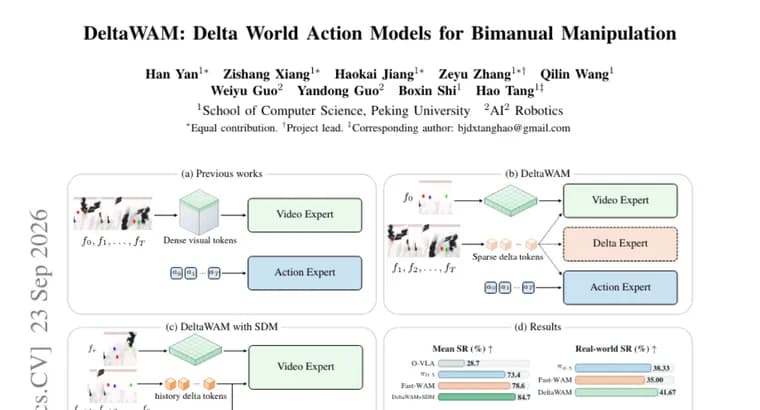
World-action models (WAMs) transfer visual and motion priors from pretrained video generators to robot control by jointly modeling visual dynamics and actions. According to the authors, existing WAMs predict dense future frames during training, which means repeatedly modeling largely unchanged scene content and coupling action-conditioned dynamics to irrelevant appearance changes. At inference, processing each complete observation with the heavy video expert component bottlenecks fast, few-step action generation. The authors propose DeltaWAM, which instead jointly predicts visual deltas (the changes between frames) and actions, using three parallel streams: a dense-anchor stream, a sparse-delta stream, and an action stream. Three DeltaWAM architectures are presented, differing in how representation and computation are shared across these streams. The paper also introduces Streaming Delta Memory (SDM), which updates a cached anchor context with compact observed deltas rather than reprocessing full observations, reducing reliance on the heavy video expert at inference time. On the RoboTwin benchmark, DeltaWAM with SDM raises average success over the Fast-WAM baseline from 81.3% to 85.4% in the clean setting, and from 75.8% to 83.9% under visual randomization. The three DeltaWAM architectures reduce training FLOPs by 17.78-23.77% compared to the baseline. SDM separately reduces one-step inference latency by 36.57% and inference FLOPs by 31.55%. The authors report that real-world evaluations also show DeltaWAM achieving the highest overall success rate and normalized progress among the policies tested. Code is released on GitHub, alongside a project website.
Key facts
- DeltaWAM predicts visual deltas (frame-to-frame changes) plus actions via dense-anchor, sparse-delta, and action streams, instead of predicting dense future frames like prior world-action models.
- Streaming Delta Memory (SDM) updates a cached anchor context with compact observed deltas, cutting reliance on the heavy video expert at inference.
- On RoboTwin, DeltaWAM with SDM improves average success over the Fast-WAM baseline from 81.3% to 85.4% in the clean setting and from 75.8% to 83.9% under visual randomization.
- The three DeltaWAM architectures cut training FLOPs by 17.78-23.77%; SDM separately cuts one-step inference latency by 36.57% and inference FLOPs by 31.55%.
- Real-world evaluations reportedly show DeltaWAM with the highest overall success rate and normalized progress among the evaluated policies.
Why it matters
World-action models borrow visual and motion priors from video generators to drive robot control, but modeling every future frame in full detail wastes compute on background that barely changes and ties the model's grasp of action dynamics to irrelevant appearance shifts. DeltaWAM targets that inefficiency directly for bimanual manipulation, by predicting only the meaningful changes between frames alongside the actions, and by caching context so inference does not need to reprocess a full observation at every step.
Who it affects
This is a research contribution aimed at people building or benchmarking world-action and video-conditioned control models for robotic manipulation, particularly bimanual setups; it is not a consumer-facing product or tool.
How to use it
The authors have released code on GitHub and a project website alongside the paper, so the three DeltaWAM architectures and the Streaming Delta Memory technique can be inspected or reused by other researchers. No pricing or licensing terms are mentioned.
How solid is it
The reported numbers, including the RoboTwin success rates and the FLOPs and latency reductions, come from the paper's own experiments and comparisons against its own baseline (Fast-WAM). No authors or institutions are named in the source text, and no publication or submission date is given, so the results cannot be cross-checked against a byline or an independent write-up here.
Risks and caveats
The headline gains are measured on the authors' own benchmark (RoboTwin) against a single named baseline; the source does not describe what RoboTwin covers beyond naming it, and no specifics are given about which robots or tasks were used in the real-world evaluations, which limits how far the reported success-rate and progress claims can be generalized.