Depth Pro 2 estimates sharp, temporally consistent metric depth
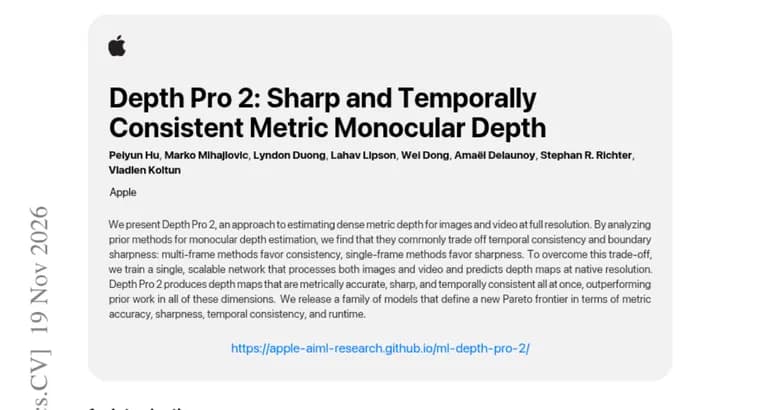
The paper presents Depth Pro 2, an approach to estimating dense metric depth for images and video at full resolution.
The starting point is an analysis of earlier monocular depth estimation methods. The authors find that these methods commonly trade off temporal consistency against boundary sharpness: multi-frame methods favor consistency, while single-frame methods favor sharpness.
To get past that trade-off, they train a single, scalable network that processes both images and video and predicts depth maps at native resolution. According to the authors, Depth Pro 2 produces depth maps that are metrically accurate, sharp and temporally consistent all at once, and it outperforms prior work in all of these dimensions.
They also release a family of models that, in their words, define a new Pareto frontier in metric accuracy, sharpness, temporal consistency and runtime. Code and weights are available on the project page at apple-aiml-research.github.io/ml-depth-pro-2.
Key facts
- Depth Pro 2 estimates dense metric depth for both images and video at full resolution.
- The authors say earlier methods trade off temporal consistency (multi-frame) against boundary sharpness (single-frame).
- A single, scalable network handles images and video and predicts depth maps at native resolution.
- The authors claim it outperforms prior work on metric accuracy, sharpness and temporal consistency at once.
- A family of models, code and weights are released on the project page.
Why it matters
Monocular depth estimation recovers distance from a single camera. The authors argue that current methods force a choice: video-oriented approaches keep depth steady from frame to frame but blur edges, while single-image approaches give crisp edges but can be unstable across frames. Depth Pro 2 is presented as removing that choice with one network that covers images and video, and as a new Pareto frontier across accuracy, sharpness, consistency and runtime.
Who it affects
Researchers and engineers working on monocular depth estimation, and teams that need metric depth from ordinary images or video. Because code and weights are released, they can try the models directly.
How to use it
Code and weights are published at https://apple-aiml-research.github.io/ml-depth-pro-2/. The authors release a family of models rather than one, with a runtime dimension in the trade-off, so the project page is the place to pick a variant.
How solid is it
The claims come from the authors' own abstract: that Depth Pro 2 outperforms prior work in all three quality dimensions and defines a new Pareto frontier. The text available here gives no numeric results, benchmark names, datasets or named baselines, so the size of the gains cannot be judged from it.
Risks and caveats
The outperformance claims are the authors' and are not backed by figures in the available text. No license for the code and weights is stated, no model sizes or runtimes are given, and the comparison methods are not named. Check the project page and the full paper before relying on the results.