DiffusionOPSD cuts diffusion training GPU-hours by up to 63%
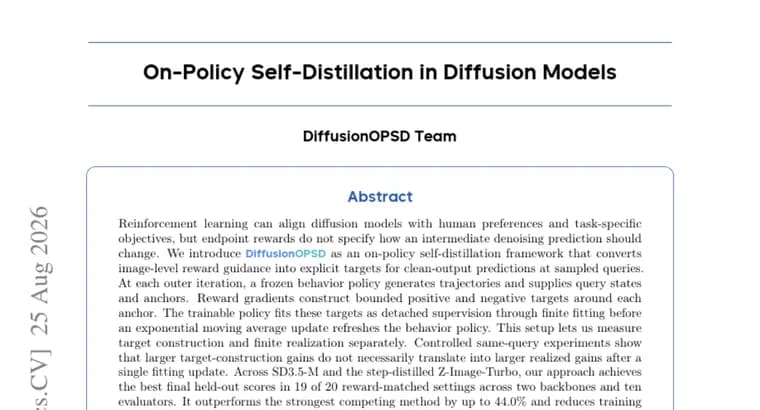
Researchers introduce DiffusionOPSD, an on-policy self-distillation framework for post-training diffusion image models with reinforcement learning. The core problem it addresses: when you train a diffusion model with a reward signal (a score for how good the final image is), that endpoint reward does not say how any single intermediate denoising step should change. DiffusionOPSD fixes this by turning that end-of-generation reward into explicit targets for what the clean output prediction should look like at points sampled along the generation trajectory. The method works in outer iterations: a frozen behavior policy generates full trajectories and supplies query states and anchor points; reward gradients then build bounded positive and negative targets around each anchor; the trainable policy fits those targets through a finite number of updates, treating them as detached supervision; only after this fitting does an exponential moving average refresh the frozen behavior policy. Because target construction and the finite fitting step are separated, the authors can measure each independently, and controlled same-query experiments show that a larger gain in target construction does not necessarily produce a larger realized gain after a single fitting update. Tested across two backbones, the SD 3.5-M model and the step-distilled Z-Image-Turbo model, and across ten evaluators, DiffusionOPSD achieves the best final held-out score in 19 of the 20 reward-matched settings tried. It beats the strongest competing method by up to 44.0%. Against DiffusionNFT specifically, it cuts training GPU-hours by 40% on SD 3.5-M and by 63% on Z-Image-Turbo. The authors present the results as evidence that on-policy self-distillation is an efficient, analyzable way to do diffusion post-training, converting image-level reward guidance into explicit, continually refreshed intermediate supervision, and argue this opens a path toward more efficient and diagnosable alignment of diffusion models.
Key facts
- DiffusionOPSD turns end-of-generation reward signals into explicit targets for intermediate denoising predictions, rather than leaving the model to infer them from an endpoint reward alone.
- It uses a frozen behavior policy to generate trajectories and anchors, then fits bounded positive and negative targets around each anchor before an exponential moving average update refreshes the behavior policy.
- Across two backbones (SD 3.5-M and step-distilled Z-Image-Turbo) and ten evaluators, it achieves the best final held-out score in 19 of 20 reward-matched settings, beating the strongest competing method by up to 44.0%.
- It cuts training GPU-hours relative to DiffusionNFT by 40% on SD 3.5-M and 63% on Z-Image-Turbo.
- Controlled same-query experiments found that larger gains in target construction do not necessarily translate into larger realized gains after a single fitting update.
Why it matters
Reinforcement learning is increasingly used to align diffusion image models with human preferences and task-specific goals, but a reward that only scores the finished image gives no direct signal about how any particular intermediate denoising step should change. DiffusionOPSD closes that gap by converting the endpoint reward into explicit, continually refreshed targets for intermediate predictions, which the authors argue makes diffusion post-training both more efficient and easier to analyze and diagnose.
Who it affects
The method targets teams training or fine-tuning diffusion image generators with reward-based post-training, since it was tested on two different backbones: the SD 3.5-M model and the step-distilled Z-Image-Turbo model. No author names, institutions, code release, or model weight release are stated in the source.
How to use it
The framework works as an outer-loop procedure: a frozen behavior policy generates trajectories and supplies query states and anchors, reward gradients build bounded positive and negative targets around each anchor, the trainable policy fits those targets as detached supervision over a finite number of updates, and only then does an exponential moving average update refresh the behavior policy. Separating target construction from finite fitting lets each be measured on its own, which the authors used to run controlled same-query comparisons.
How solid is it
The reported results come from the paper's own benchmarking: best final held-out scores in 19 of 20 reward-matched settings across two backbones and ten evaluators, a margin of up to 44.0% over the strongest competing method, and GPU-hour reductions of 40% (SD 3.5-M) and 63% (Z-Image-Turbo) against DiffusionNFT specifically. The source does not name the ten evaluators or describe DiffusionNFT beyond it being the comparison method, and no independent replication is mentioned.
Risks and caveats
The 44.0% and GPU-hour figures are upper bounds and comparisons against specific baselines and settings, not universal guarantees across every possible configuration. The paper itself notes a caveat from its own experiments: larger gains in target construction do not necessarily carry through to larger realized gains after a single fitting update, meaning the method's benefits are not uniform across every measurement it makes of itself.