Disney and Adobe build custom Firefly AI models for Disney brands
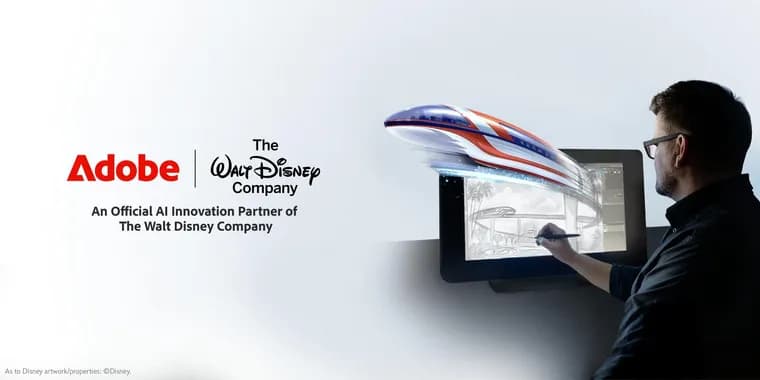
Disney and Adobe are building custom AI tools together for Disney's productions. The multi-year partnership was announced at Adobe's MAX conference. Under the deal, Disney gets early access to new Adobe technology for its theme parks, cruise line and ESPN content.
Adobe says it will use Adobe Firefly Foundry to build custom models tailored to Disney's brands. Those models will be trained on knowledge of Disney characters, environments and visual styles, with the aim of producing commercially safe, production-ready output.
Disney is not starting from zero with Firefly: its Imagineering research division already uses it for theme park development. Adobe will also expand internal creative workflows at Walt Disney Studios. The Walt Disney Studios' StudioLAB and ESPN's innovation hub ESPN Edge are part of the deal too, where AI is meant to boost fan engagement for sports content and unlock new uses for ESPN's archive.
The article adds context on Disney's earlier AI moves: the company had previously struck a deal with OpenAI and then walked away from it, and it was also involved in the bankruptcy of Character.AI. Separately, according to Bloomberg, Disney is planning to cut thousands of jobs and trim costs by 20 percent annually. If that happens, it would be Disney's fourth round of layoffs this year.
Key facts
- Disney and Adobe announced a multi-year partnership at Adobe's MAX conference to build custom AI tools for Disney's productions.
- Adobe will use Adobe Firefly Foundry to build custom models tailored to Disney's brands, trained on Disney characters, environments and visual styles for commercially safe, production-ready output.
- Disney gets early access to new Adobe technology for its theme parks, cruise line and ESPN content; StudioLAB and ESPN Edge are part of the deal.
- Disney's Imagineering research division already uses Firefly for theme park development.
- According to Bloomberg, Disney plans to cut thousands of jobs and trim costs by 20 percent annually, which would be its fourth layoff round this year.
Why it matters
The article recalls Disney's earlier AI moves: it struck a deal with OpenAI and then walked away from it, and it was involved in the bankruptcy of Character.AI. This time it is tying itself to Adobe's Firefly Foundry, with models built around Disney's own characters, environments and visual styles. The stated goal is output that is commercially safe and ready for production, which is the pitch behind the headline's 'brand-safe' framing.
Who it affects
The deal reaches several parts of Disney: theme parks, the cruise line, ESPN content, Walt Disney Studios (through StudioLAB and expanded internal creative workflows) and ESPN Edge. Imagineering is named as an existing Firefly user for theme park development. Bloomberg's reporting on planned job cuts concerns Disney's workforce more broadly; the source does not link those layoffs to the Adobe partnership.
How to use it
This is a corporate partnership, not a product release for the public. What Disney receives is early access to new Adobe technology and custom models built with Adobe Firefly Foundry. For ESPN, AI is meant to boost fan engagement for sports content and unlock new uses for the archive. No financial terms, contract value or exact length of the 'multi-year' partnership are given.
How solid is it
The partnership and its scope come from The Decoder's report on the announcement at Adobe's MAX conference, with the Firefly Foundry plan stated as what Adobe says it will do. No quotes from Disney or Adobe executives appear in the text. The layoff and cost figures are Bloomberg's reporting as relayed by The Decoder, and are described as plans, not completed actions.
Risks and caveats
The custom models are described as planned. The source does not say they exist yet or that any output has been produced. The 'commercially safe, production-ready' result is an intended outcome, not a demonstrated one. The source does not say what the 20 percent annual cost trim is measured against, nor a timescale for the job cuts, and it does not say why Disney walked away from the OpenAI deal.