DLite speculative decoding drops history to speed up agentic LLMs
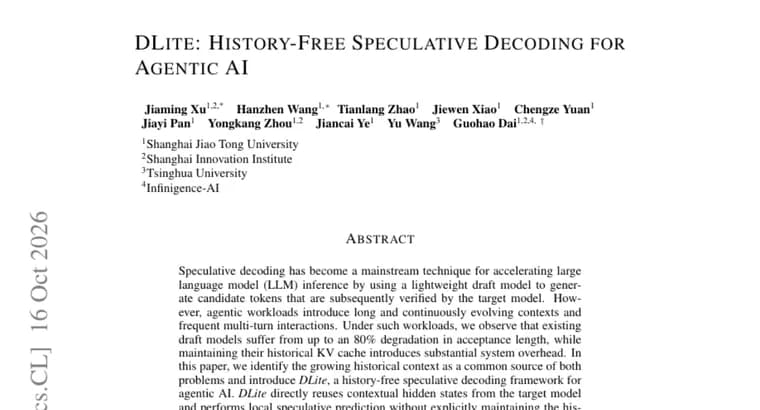
A paper listed on Hugging Face introduces DLite, a speculative decoding framework built for agentic AI workloads.
Speculative decoding is described by the authors as a mainstream way to speed up large language model inference: a lightweight draft model proposes candidate tokens, and the target model then verifies them. The authors say agentic workloads strain this setup. Such workloads bring long, continuously evolving contexts and frequent multi-turn interactions. Under them, the authors observe that existing draft models lose up to 80% of their acceptance length, and that keeping their historical KV cache adds substantial system overhead.
The paper traces both problems to one cause: the growing historical context. DLite is the answer. It is history-free. Instead of carrying the full history, it reuses contextual hidden states directly from the target model and makes speculative predictions locally, without explicitly maintaining the historical context. In the authors' words, this turns an increasingly complex modeling problem into a local, simple prediction problem.
Two further pieces complete the design. A lightweight sequential head restores intra-block causal dependencies at low overhead. And because the architecture is heterogeneous and history-free, the authors introduce a tailored two-stage training strategy to train it.
The authors tested on general-purpose, long-context and agentic workloads. They report that DLite achieves 2-6 acceptance length and outperforms DSpark, which they call the state-of-the-art speculative decoding method, by up to 70%.
Key facts
- DLite is a history-free speculative decoding framework aimed at agentic AI workloads.
- The authors observe existing draft models lose up to 80% of acceptance length under agentic workloads, while keeping their historical KV cache adds substantial overhead.
- DLite reuses contextual hidden states from the target model and predicts locally, without explicitly maintaining the historical context.
- A lightweight sequential head restores intra-block causal dependencies, and a tailored two-stage training strategy trains the architecture.
- Across general-purpose, long-context and agentic workloads, DLite achieves 2-6 acceptance length and outperforms DSpark by up to 70%.
Why it matters
Agent-style workloads keep adding context over many turns, and the authors argue that this is exactly where current draft models break down: acceptance length falls by up to 80% and the historical KV cache adds substantial system overhead. DLite attacks the shared cause, the growing history, by not keeping it at all. If the approach holds up, it would make speculative decoding more useful for the long-running, multi-turn use that agents depend on.
Who it affects
The work targets people who build and run LLM inference for agentic applications, where contexts are long and interactions come in many turns. It is also relevant to researchers working on speculative decoding and draft-model design.
How to use it
The source gives no information on code, models or availability, so there is nothing to run yet. For now it is a design to read: reuse the target model's contextual hidden states, predict locally, add a lightweight sequential head, and train with a two-stage strategy.
How solid is it
The source is a paper abstract, so the claims are the authors' own. The headline results are 2-6 acceptance length and up to 70% better than DSpark, measured on general-purpose, long-context and agentic workloads. The source does not state which metric the 70% refers to, and it does not say what the 80% degradation is measured against.
Risks and caveats
"Up to" figures describe the best case, not typical results, for both the 80% degradation and the 70% gain. The source names no target models, draft model sizes, benchmarks or datasets, and gives no wall-clock speedup, latency or throughput numbers. The two training stages are not described. Independent replication would be needed before treating the comparison with DSpark as settled.