DoltLite reaches Beta with Git-style version control for SQLite
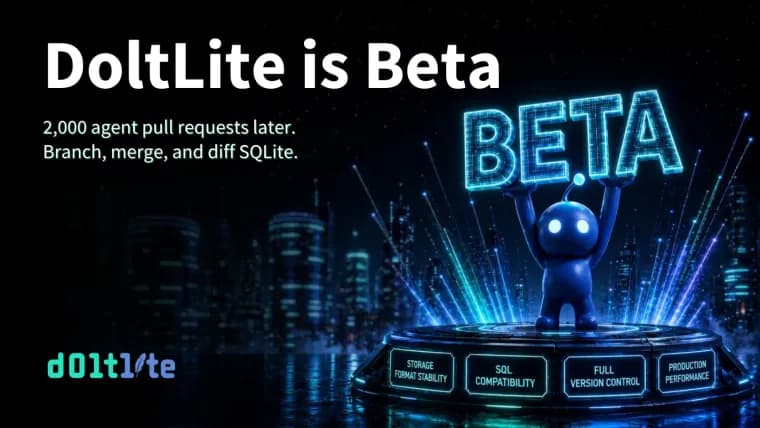
DoltLite, the embedded database from the team behind Dolt, has reached Beta at version 0.50.0, five months after it launched. The project began as a test case for Gas Town, an agent orchestrator built by Steve Yegge: the team wanted a real problem rather than a toy, and had long wanted an embedded version of Dolt but judged rewriting Dolt's storage engine in C or Rust too large a task for humans alone. SQLite looked like a workable host for that engine instead. Building DoltLite took about 2,000 pull requests, which the team frames as proof that a team of agents could pull off a project of this size.
DoltLite is a fork of SQLite: everything above the B-tree layer, including the SQL parser and analyzer, the filesystem interaction layer and the test harness, is stock SQLite. Only the B-tree storage layer is replaced, with a Prolly Tree, a content-addressed B-tree, backed by a single-file chunk store. That swap is what gives DoltLite Dolt's and Git's version control model inside a SQLite package: local branching, merging, diffing, rebasing, cherry-picking and resetting, plus remote push, pull, clone and fetch against a custom remote or DoltHub. A full Dolt Workbench GUI ships with the database, including an agent mode; if an agent misbehaves, dolt_reset('--hard') rolls the database back.
The team defines Beta as four commitments. First, storage format stability: the format changed 12 times before Beta, each change requiring users either to stay on one version or to manually dump and reimport their data, which the team calls the biggest complaint of the development period. The current format has held for 57 releases, over three months of calendar time, and any future breaking change will now ship with a supported migration path. Second, SQL compatibility: DoltLite passes 100% of sqllogictest, a suite of 5.8 million complex queries, and 99.46% of SQLite's own 892,277 TCL-based acceptance tests, leaving 4,809 known divergences, each with a documented reason. The stated top reasons are that DoltLite's tables are keyed by primary key rather than rowid (so tests that inspect rowid directly fail), that DoltLite stores data in chunks rather than pages (so page-inspecting tests fail), and that DoltLite has no WAL or journal sidecar, so WAL and journal tests are skipped outright. Third, full version control, the local and remote feature set described above. Fourth, production performance: DoltLite offers microsecond-scale embedded performance with a write-side tax for version control, while reads stay close to parity with SQLite.
A nightly benchmark comparing DoltLite to SQLite on a sysbench-style workload put in-memory DoltLite databases 10% slower on reads and 60% slower on writes than SQLite, while file-backed databases sit at parity on reads and 10% slower on batched writes. The biggest gap is small autocommit writes, which are 3.1 times slower in DoltLite: about 125 microseconds in SQLite versus about 400 microseconds in DoltLite on a small GitHub Actions runner. The team's own advice for performance-sensitive workloads is to batch writes rather than commit them one at a time. The post closes by inviting users to try DoltLite and pointing them to a dedicated Discord channel for support; it names no price, license or launch date for the project.
Key facts
- DoltLite, a SQLite fork adding Dolt's and Git's version control (branch, merge, diff, push, pull, clone, fetch), reached Beta at version 0.50.0, five months after launch.
- The project was built through about 2,000 pull requests, developed as a test case for Steve Yegge's agent orchestrator Gas Town.
- It reused stock SQLite's SQL parser, analyzer and filesystem layer, replacing only the B-tree storage layer with a content-addressed Prolly Tree over a single-file chunk store.
- DoltLite's storage format changed 12 times before Beta and has now held stable for 57 releases, over three months, with future breaking changes to ship with a migration path.
- It passes 100% of sqllogictest's 5.8 million queries and 99.46% of SQLite's 892,277 TCL-based tests, but its writes lag SQLite, most sharply on small autocommit writes at 3.1 times slower (about 400 versus 125 microseconds).
Why it matters
DoltLite gives an embedded, SQLite-compatible database full Git-style version control, branching, merging, diffing, and a conflict-aware sync engine, without building a separate SQL engine: because it keeps SQLite's parser and analyzer and only swaps the storage layer for a Prolly Tree, the team got version control for the cost of a storage engine rather than a whole database engine. That is a real advantage over other Dolt products, which had to implement a SQL engine on top of version-controlled storage from scratch. The release also serves as the team's own case study that an agent orchestrator, Gas Town, and roughly 2,000 agent-generated pull requests could carry a nontrivial storage engine through to a stable Beta.
Who it affects
Developers building embedded or local-first applications who want to branch, merge, diff, or sync a SQLite-shaped database, whether against a custom remote or DoltHub, are the direct audience. The release is also relevant to anyone evaluating agent-driven software development, since the team presents the roughly 2,000-pull-request build process as evidence for what an agent orchestrator can carry to completion.
How to use it
DoltLite behaves like SQLite for everyday queries, since the SQL layer is unchanged, with Dolt's version control commands layered on top: local branch, merge, diff, rebase, cherry-pick and reset, plus remote push, pull, clone and fetch against a custom remote or DoltHub. A full Dolt Workbench GUI ships alongside it, including an agent mode, with dolt_reset('--hard') available to undo an agent's mistake. Because version control carries a write-performance tax, the team recommends batching writes rather than committing them one at a time for performance-sensitive workloads. The post gives no price or license terms for DoltLite; support is offered through a dedicated Discord channel.
How solid is it
DoltLite is at Beta, version 0.50.0, five months after launch. Its storage format went through 12 changes before stabilizing and has now held for 57 releases, over three months of calendar time, with a migration path promised for any future breaking change. On testing, it passes 100% of sqllogictest's 5.8 million queries and 99.46% of SQLite's 892,277 TCL-based acceptance tests, with 4,809 known divergences, each carrying a documented reason: primary-key-keyed tables versus SQLite's rowid, chunk storage versus paged storage, and the absence of a WAL or journal sidecar. The team describes field reports on functionality and stability as universally positive, though that characterization comes from the team itself rather than an independent source.
Risks and caveats
Version control comes with a measured write-performance cost: in-memory DoltLite databases are 60% slower on writes and 10% slower on reads than SQLite, file-backed databases are 10% slower on batched writes, and small autocommit writes are the sharpest outlier at 3.1 times slower, about 400 microseconds versus about 125 microseconds on a small GitHub Actions runner. The 4,809 known test divergences from SQLite, while each documented, mean DoltLite is not a byte-for-byte drop-in replacement in edge cases involving rowid inspection, page inspection, or WAL and journal behavior. The source gives no calendar date for either the original launch or the Beta release, no detail on how the roughly 2,000 agent-generated pull requests were reviewed or how much human oversight they received beyond the mention of the Gas Town orchestrator, and no pricing or licensing terms.
“Could a team of agents pull it off? It only took about 2,000 pull requests but DoltLite going Beta proves a team of agents certainly could.”
— the post's author, on the DoltHub blog