EmbeddingGemma 2 embeds text, images, audio and video in one space
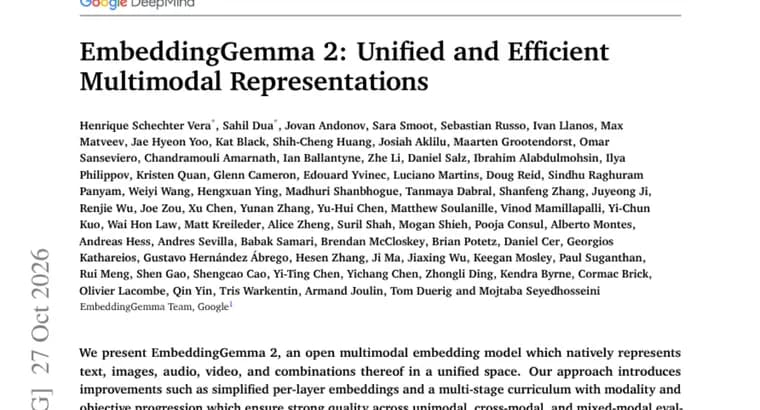
The paper introduces EmbeddingGemma 2, an open multimodal embedding model. It natively represents text, images, audio, video and combinations of them in a single unified space, so one model can serve unimodal, cross-modal and mixed-modal tasks.
The authors credit two changes for its quality: simplified per-layer embeddings, and a multi-stage curriculum with modality and objective progression. They say these ensure strong results across unimodal, cross-modal and mixed-modal evaluations.
On results, the authors report that in comprehensive embedding benchmarks across all modalities, EmbeddingGemma 2 establishes a new Pareto frontier. They say it outperforms both specialist models and models two to twelve times larger. The abstract does not name the benchmarks, the scores or the competing models, and it does not say how the size ratio is measured.
The design is also meant for resource-constrained environments. It supports selective modality encoder loading, adjustable vision token budgets, truncatable embedding dimensions and quantized weights.
The paper includes ablations that analyse the key design decisions, and the authors release EmbeddingGemma 2 to promote further research.
Key facts
- EmbeddingGemma 2 is an open embedding model that natively represents text, images, audio, video and combinations of them in one unified space.
- The approach combines simplified per-layer embeddings with a multi-stage curriculum that progresses through modalities and objectives.
- The authors say it sets a new Pareto frontier on embedding benchmarks across all modalities, outperforming specialist models and models two to twelve times larger.
- For limited hardware it offers selective modality encoder loading, adjustable vision token budgets, truncatable embedding dimensions and quantized weights.
- The paper includes ablations on key decisions, and the model is released to promote further research.
Why it matters
Embedding models turn content into vectors so it can be compared and searched. Most are built for one modality, or for a narrow pairing. The authors present a single model that places text, images, audio, video and mixtures of them in the same space, and claim it still beats specialist models. If that holds, one model could replace several. The claim of a new Pareto frontier means, in the authors' words, better results than both specialist models and models two to twelve times larger.
Who it affects
The release is aimed at researchers, since the authors say they release the model to promote further research. The flexibility features, such as loading only the modality encoders you need and shrinking embedding dimensions, point at people who run models under tight resource limits.
How to use it
The design lets you load only the modality encoders a task needs, set the vision token budget, truncate the embedding dimensions and use quantized weights. These are the knobs the authors describe for resource-constrained setups. The model is described as open and released; the abstract gives no license or release location, so check the paper's page for how to obtain it.
How solid is it
All claims come from the paper's own abstract, so they are the authors' self-reported results. The abstract says the benchmarks are comprehensive and span all modalities, but gives no benchmark names, scores or margins, and does not name the competing models. It also does not say how the 'two to twelve times larger' ratio is measured. The paper includes ablations on key decisions, which the abstract does not detail.
Risks and caveats
Without scores or named baselines, the headline claim of outperforming specialist and much larger models cannot be checked from the abstract alone. No parameter counts or embedding dimensions are given, so the real cost of running the model is unclear. The license and availability of weights are not stated beyond 'open' and 'release'.
“EmbeddingGemma 2 establishes a new Pareto frontier, outperforming both specialist models and models two to twelve times larger”
— Paper abstract