EXIMO uses a VLM planner to speed up VLA robot policy finetuning
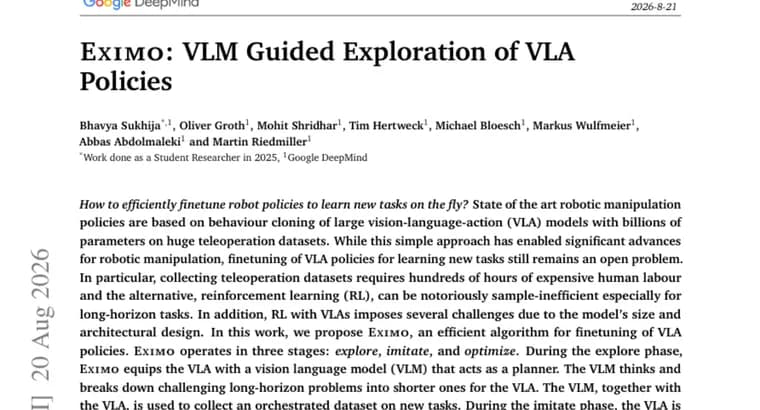
State of the art robotic manipulation policies are built by behavior cloning large vision-language-action (VLA) models, models with billions of parameters, on huge teleoperation datasets. That recipe has driven real progress, but finetuning a VLA policy so it can pick up a new task on the fly remains an open problem. Collecting a fresh teleoperation dataset for a new task takes hundreds of hours of expensive human labor. The usual alternative, reinforcement learning (RL), can be notoriously sample-inefficient for long-horizon tasks, and applying RL to VLAs brings its own difficulties tied to the models' size and architecture.
The authors propose EXIMO, an algorithm that works in three stages: explore, imitate, optimize. In the explore stage, EXIMO equips the VLA with a vision-language model (VLM) that acts as a planner: it thinks through a hard long-horizon task and breaks it into shorter subtasks, and the VLM and VLA together use that breakdown to collect an orchestrated dataset for the new task, rather than depending on human teleoperation alone. In the imitate stage, the VLA is finetuned on that orchestrated data. In the optimize stage, the authors apply residual off-policy RL to finetune the policy further on top of what imitation already achieved.
The authors report ablating all three stages and finding that EXIMO significantly outperforms existing approaches in sample efficiency and final performance. The source text does not name specific benchmark tasks, environments or robots, does not give a numeric size for the improvement, and does not state the authors' affiliations or a publication venue.
Key facts
- EXIMO is a three-stage algorithm, explore, imitate, optimize, for finetuning vision-language-action (VLA) robot policies on new tasks.
- State of the art robot manipulation policies are large VLA models with billions of parameters, trained by behavior cloning on teleoperation datasets.
- Collecting teleoperation data for a new task takes hundreds of hours of human labor; RL alone is notoriously sample-inefficient for long-horizon tasks and brings extra challenges when applied to large VLAs.
- In the explore stage, a vision-language model acts as planner, breaking a long-horizon task into shorter ones and helping the VLA collect an orchestrated dataset for it.
- The optimize stage applies residual off-policy RL after imitation finetuning; the authors say ablations of all three stages show EXIMO significantly outperforms existing approaches in sample efficiency and final performance.
Why it matters
Finetuning a large VLA policy to pick up a new manipulation task is one of the practical bottlenecks in deploying robot foundation models: teaching a new task by teleoperation is slow and labor-intensive, and plain RL struggles with long horizons and with models this size. EXIMO's idea is to let a VLM plan the exploration, breaking a hard task into short steps so the robot's own data collection is guided rather than blind, then hand that data to imitation and RL in sequence. If the reported gains hold up, that points at a cheaper path to adding new skills to an existing VLA policy instead of recollecting teleoperation data from scratch for every task.
Who it affects
Researchers and engineers building on vision-language-action policies for robotic manipulation, and anyone currently paying the cost of either large teleoperation datasets or slow, hard-to-tune RL finetuning to teach a robot policy a new task.
How to use it
EXIMO assumes a starting point of the kind already standard in the field: a VLA policy trained by behavior cloning. Applying the method means adding a vision-language model as a planner for the explore stage, using it alongside the VLA to gather an orchestrated dataset on the new task, finetuning the VLA on that data in the imitate stage, and then running residual off-policy RL in the optimize stage to finetune further. The source text does not give pricing, licensing or release details for any code or models.
How solid is it
The claim rests on the authors' own ablation study, which they say covers all three stages of EXIMO and shows it beating existing approaches on both sample efficiency and final performance. The source text gives no numeric size for that improvement, no named benchmarks, environments or robots, and no publication venue, so the result is stated qualitatively rather than shown with figures here.
Risks and caveats
The text supplies no author names, institutions or affiliations for the paper, no specific benchmark tasks, environments or robots, no numeric performance improvement behind "significantly outperforms", no publication venue or date, and no detail on what residual off-policy RL involves beyond the name. Until those specifics surface, the result should be read as a self-reported claim from the paper itself.