FAMOS predicts 3D object articulation from sparse views
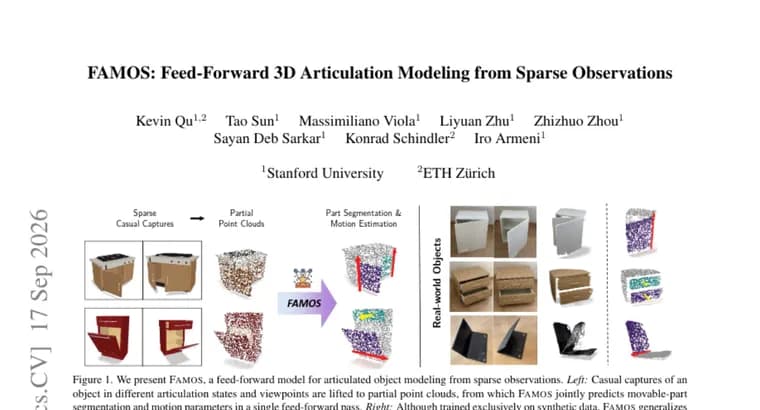
Working out how an articulated object moves, where its hinges and sliders are and which parts they connect, is hard when the only evidence is a handful of partial, monocular views: each observation shows just part of the geometry and only hints at the motion. Most existing feed-forward methods sidestep this by inferring articulation from a single observation, which makes them lean heavily on learned category-level shape priors rather than on what the input actually shows.
The authors present FAMOS, a feed-forward model that predicts movable-part segmentation and joint parameters directly from a sparse, unordered set of partial point clouds. The model reasons jointly over multiple observations at once and naturally handles a variable number of inputs, including the degenerate case of a single view. To combine articulation evidence across observations, FAMOS uses a Multi-state Articulation Transformer that alternates between state-wise attention (within one observation) and global attention (across all of them).
Training is guided by a new objective: an observed articulation span loss that supervises the actual range of motion each part shows across the input views, which is meant to push the model to draw on the full set of observations rather than defaulting to whichever single view is easiest. Because existing articulated-object datasets are small and narrow, the authors also built a procedural data generator that synthesizes self-annotated training assets rather than relying on hand-labeled sets.
On three benchmarks, PartNet-Mobility, ACD, and ArtiCraft-10K, the authors report consistent improvements over both feed-forward baselines and optimization-based methods, though the abstract itself does not give the numeric margins.
Key facts
- FAMOS predicts movable-part segmentation and joint parameters from a sparse, unordered set of partial point clouds, working with any number of views, including just one.
- A Multi-state Articulation Transformer alternates state-wise and global attention to combine articulation cues from multiple partial observations.
- A new observed articulation span objective supervises the motion range each part shows across the input views, meant to keep the model from relying on a single easy view.
- A procedural data generator synthesizes self-annotated training assets to work around the small size and narrow diversity of existing articulated-object datasets.
- On PartNet-Mobility, ACD, and ArtiCraft-10K, the method shows consistent gains over both feed-forward and optimization-based baselines, though no numeric margins are given in the abstract.
Why it matters
Most feed-forward methods for this problem infer an object's articulation from a single observation, which forces them to lean on learned category-level shape priors when the input itself is ambiguous. FAMOS instead reasons jointly over multiple partial point-cloud views, which reduces how much the model has to guess from a prior rather than from evidence actually present in the input.
Who it affects
The problem sits in 3D computer vision and graphics: recovering how an object's parts move (a drawer that slides, a hinge that swings) from limited sensor data, for building manipulable 3D assets rather than static ones. The source does not name companies, products, or specific downstream deployments, so anything beyond the method itself would be invented.
How to use it
The paper links a project page at kevinqu7.github.io/famos. No pricing, licensing, or code-release details are given in the source, so availability beyond that page is not established here.
How solid is it
The claims are tested on three datasets, PartNet-Mobility, ACD, and ArtiCraft-10K, against both feed-forward and optimization-based baselines, which is a reasonably broad comparison. But the abstract reports the improvements only as 'consistent,' with no numbers, so the size of the advantage cannot be judged from this text alone, and no publication venue or peer-review status is stated.
Risks and caveats
Without numeric results, it is not possible to tell how large the reported gains actually are or whether they hold uniformly across the three benchmarks. The approach also depends on a procedural, self-annotated data generator for training, and the source gives no detail on that generator's scale or how closely its synthetic assets match real-world objects.