Firefox's Smart Window adds live web search and model choice
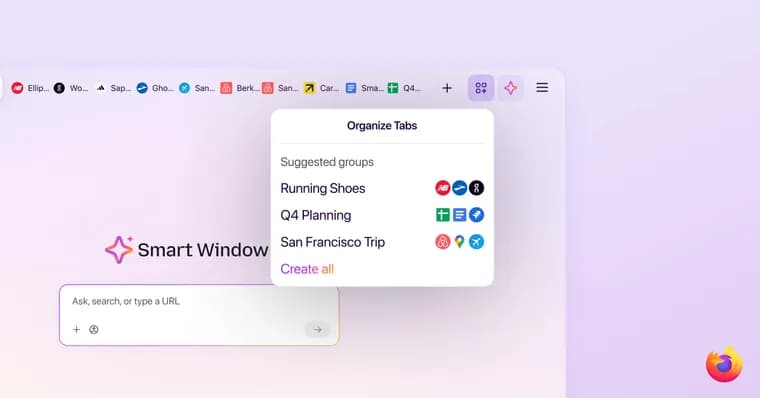
Starting today, Firefox's Smart Window AI browsing mode can pull current information from the live web and show source links inside chat responses, through a partnership with the search company Exa. The mode also automatically suggests tab groups, finds and closes duplicate tabs, and shows visual previews of pages a user previously visited when they search their browsing history in natural language. In a demo shown to The Verge, the AI sorted through a user's browsing history to surface "running shoes I looked at last week" complete with images pulled from the sites originally browsed. Mozilla's blog post says this can help people check an answer or find their place again even when they remember what was on a page but not which page it was; the company says beta users reported it helped them keep their train of thought, though no figures on how many beta users said so are given.
Ajit Varma, Mozilla's head of Firefox, described the strategy as "agnostic": offering AI features to users who want them without pushing everyone toward AI use. He contrasted Firefox with rivals: "They didn't create a browser for you to go to Wikipedia more; they created a browser for you to generate more LLM and chat queries. Whereas for us, we are just looking at more just browser experience, user experience." Part of that approach is letting users choose which AI model powers Smart Window: Google's Gemini 3.1 Flash Lite, OpenAI's oss-gpt-120b, Alibaba's Qwen3-235B-A22B-Instruct-2507, or a local AI model run on the user's own machine. Varma framed the model choice as a matter of "digital sovereignty," letting people pick AI companies based in their own region with different views from big tech firms.
Steve Truong, Firefox AI senior staff product manager, said every model option runs under a zero-data-retention contract: third-party providers of inference or API calls operate on a user's prompt only in memory, without storing it to train models, support advertising, or allow human review. He added that Mozilla itself does not retain user chats on its servers without permission, and does not use them for model training, since Mozilla does not build its own models, or for human review or advertising. Smart Window's settings also include an AI Controls section, added since the feature's original 2025 launch as "AI Window," where users can turn off all AI features or enable them individually; Truong said the top navigation bar in Smart Window was added specifically because users asked for it.
Smart Window remains an opt-in beta. Varma told The Verge there is no "precise date" yet for when it will graduate out of beta. Mozilla says future updates will add Chrome-like surfacing of a user's recent browsing journeys and AI-powered autofill for online forms. No pricing was given for any of the listed AI models, and the financial or exclusivity terms of the Exa partnership were not disclosed.
Key facts
- Smart Window's AI chat now pulls live web results and shows source citations, through a partnership with search provider Exa.
- The mode auto-suggests tab groups, finds and closes duplicate tabs, and shows visual previews of previously visited pages via natural-language history search.
- Users choose the AI model behind Smart Window: Google's Gemini 3.1 Flash Lite, OpenAI's oss-gpt-120b, Alibaba's Qwen3-235B-A22B-Instruct-2507, or a local model.
- Firefox AI product manager Steve Truong says every model option runs under a zero-data-retention contract, with no storage for training, advertising or human review.
- Smart Window is still an opt-in beta with no set date to graduate, Mozilla's head of Firefox Ajit Varma said.
Why it matters
Smart Window is Mozilla's attempt to build AI into a browser without turning the browser into a chat app. Instead of pushing users toward generating more LLM queries, as Varma frames rival browsers doing, Firefox adds AI on top of ordinary browsing: sorting a history a user already has, grouping tabs, and citing live sources in chat rather than replacing search. The model-choice angle, letting users pick a provider under a zero-data-retention contract or run a local model, is also a competitive differentiator against AI browsers that lock users into one backend.
Who it affects
Firefox users who opt into the Smart Window AI beta, and specifically anyone who wants an AI browsing assistant without their prompts being stored for training or advertising. It also matters to users who care about "digital sovereignty": the ability to pick an AI provider based outside big US tech companies, or to run AI locally instead of through any external service.
How to use it
Smart Window is opt-in; Firefox's AI Controls settings let a user disable all AI features or turn on only the ones they want. Inside Smart Window, a user can search browsing history in natural language to get suggested tab groups (which also flags and closes duplicate tabs) and visual previews of past pages, or chat with the AI to get live web answers with source citations pulled via Exa. The AI model itself is selectable: Google's Gemini 3.1 Flash Lite, OpenAI's oss-gpt-120b, Alibaba's Qwen3-235B-A22B-Instruct-2507, or a local model running on the user's own hardware.
How solid is it
The Verge reporter saw a live demo of the history-search and tab-grouping features, and interviewed both Ajit Varma and Steve Truong on the record for the privacy and strategy claims. The zero-data-retention claim rests on Mozilla's account of its contracts with third-party model providers rather than an independent audit. Mozilla's claim that beta users found the feature helped them keep their train of thought is not backed by a number of users or a study; it is reported only as "beta users said."
Risks and caveats
Smart Window has no announced date to leave beta, so its feature set can still change. No pricing is disclosed for any of the four model options, so cost to end users, if any, is unknown. The Exa partnership's terms, financial or otherwise, are not described beyond the current-web-info and citation functionality. And the zero-data-retention promise, while stated on the record by a named Mozilla product manager, is a contractual claim about third parties that a user cannot independently verify from the browser alone.
“They didn't create a browser for you to go to Wikipedia more; they created a browser for you to generate more LLM and chat queries. Whereas for us, we are just looking at more just browser experience, user experience.”
— Ajit Varma, Mozilla's head of Firefox