ForceHarness lets frozen GPT-6 Astra use force feedback on robots
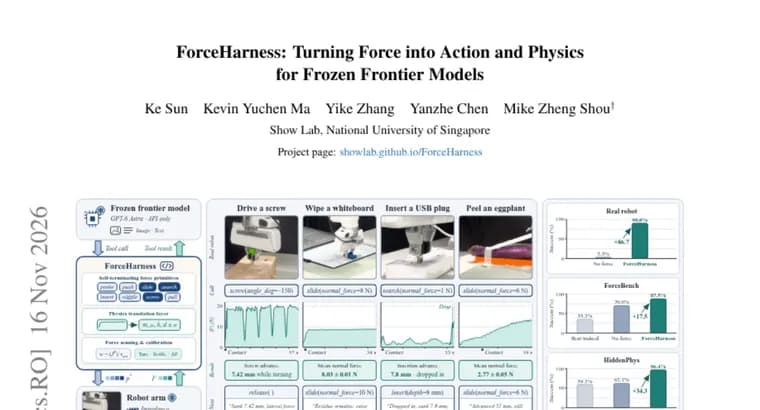
Frontier multimodal models can now control robots zero-shot from images. Many manipulation tasks, though, depend on contact forces that images cannot show. A preprint on Hugging Face Papers presents ForceHarness, a harness meant to let frozen, API-only models use force without demonstrations or finetuning.
The authors say two problems stand in the way. First, contact evolves much faster than an API model can decide, so the system must close the loop on force beneath the model. Second, a frozen model cannot interpret raw force streams, so force must be returned in a form the model can reason about.
ForceHarness handles the first problem with self-terminating force primitives. These regulate force on their own and return control to the model at a contact event. Before that, the system calibrates hand force from a wrist sensor or from joint torques alone. For the second problem, a physics translation layer turns each force trace into physical quantities with uncertainty, and hands them to the model as the tool result.
To compare ForceHarness with expert force controllers and learned policies under identical conditions, the authors also built HiddenPhys, a seven-task MuJoCo benchmark with hidden physical variables.
On a real arm without a wrist force sensor, ForceHarness raises the zero-shot success rate of GPT-6 Astra from 3.3% to 90.0%. In simulation it adds 17.5 percentage points on the public ForceBench suite and 34.3 percentage points on HiddenPhys. The authors report that it surpasses force-aware policies trained on demonstrations on both benchmarks, and matches hand-written expert controllers on HiddenPhys. Ablations further show that smaller models make significantly better decisions when given physical quantities rather than raw force values.
Key facts
- ForceHarness lets API-only frozen models use contact force without demonstrations or finetuning, using self-terminating force primitives and a physics translation layer.
- On a real arm without a wrist force sensor, GPT-6 Astra's zero-shot success rate goes from 3.3% to 90.0%.
- In simulation the harness adds 17.5 percentage points on ForceBench and 34.3 percentage points on HiddenPhys.
- The authors built HiddenPhys, a seven-task MuJoCo benchmark with hidden physical variables.
- Ablations show smaller models decide significantly better when given physical quantities instead of raw force values.
Why it matters
Vision-only control leaves out tasks where contact force decides the outcome. The authors argue force can be added to a frozen, API-only model without retraining it, by handling fast force control beneath the model and translating force traces into physical quantities the model can reason about. The reported jump on a real arm, from 3.3% to 90.0%, is large.
Who it affects
Robotics researchers and teams who drive manipulation with frontier multimodal models through an API, and who cannot finetune those models or collect demonstrations. The benchmark, HiddenPhys, is also aimed at people who compare force controllers and learned policies.
How to use it
The abstract describes the design, not a recipe. The pieces are: calibrate hand force from a wrist sensor or joint torques alone; run self-terminating force primitives that return at a contact event; and pass each force trace through a physics translation layer that gives the model physical quantities with uncertainty as the tool result. The ablations suggest smaller models also benefit from receiving physical quantities rather than raw force values.
How solid is it
This is a preprint, and the results are the authors' own, measured on their own benchmark and on the public ForceBench suite. The real-arm result runs without a wrist force sensor. The abstract gives no trial count for the real-arm experiment, so the sample size behind 3.3% and 90.0% is unknown. The 17.5 and 34.3 point gains are not tied to a named baseline model or a baseline success rate.
Risks and caveats
The abstract does not say which real arm or which wrist force sensor was used, and it does not say which smaller models were used in the ablations. No code, dataset or release availability is mentioned. The claim of matching hand-written expert controllers is stated for HiddenPhys only, a benchmark the authors built themselves.