FreeMatching finds dense correspondences across image edits where motion priors fail
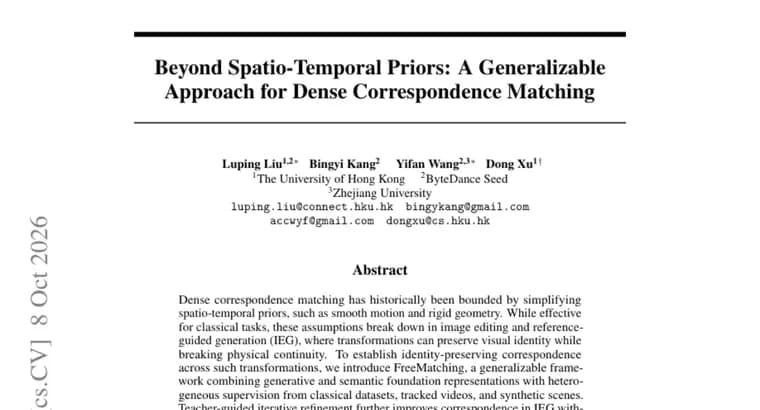
Dense correspondence matching, the task of linking points between two images, has historically relied on simplifying spatio-temporal priors such as smooth motion and rigid geometry. The paper argues that these assumptions work for classical tasks but break down in image editing and reference-guided generation (IEG). In those settings a transformation can preserve visual identity while breaking physical continuity, so the old priors no longer describe what happens between the two images.
To establish identity-preserving correspondence across such transformations, the authors introduce FreeMatching. It is described as a generalizable framework that combines generative and semantic foundation representations with heterogeneous supervision drawn from classical datasets, tracked videos, and synthetic scenes. A further step, teacher-guided iterative refinement, improves correspondence in IEG without dense correspondence annotations.
On results, the abstract says a single FreeMatching model substantially improves correspondence quality on challenging IEG image pairs while retaining competitive performance on classical benchmarks. The authors also show that FreeMatching can serve as a quantitative metric for evaluating identity preservation, with scores that correlate with human judgment. The code is available on GitHub at luping-liu/FreeMatching.
Key facts
- Classical dense correspondence methods lean on priors such as smooth motion and rigid geometry, which the paper says break down in image editing and reference-guided generation (IEG).
- FreeMatching combines generative and semantic foundation representations with supervision from classical datasets, tracked videos, and synthetic scenes.
- Teacher-guided iterative refinement further improves correspondence in IEG without dense correspondence annotations.
- A single FreeMatching model is reported to substantially improve correspondence on challenging IEG image pairs while staying competitive on classical benchmarks.
- The framework can also act as a quantitative metric for identity preservation, with scores that correlate with human judgment; code is on GitHub.
Why it matters
Image editing and reference-guided generation produce pairs of images that look like the same subject but are not related by physical motion. Matching methods built on smooth motion and rigid geometry assume continuity that these pairs do not have. FreeMatching targets exactly that gap, aiming to establish identity-preserving correspondence across transformations that keep visual identity while breaking physical continuity. The paper also proposes a use beyond matching itself: a quantitative metric for how well identity is preserved.
Who it affects
The work is aimed at researchers and engineers building or evaluating image editing and reference-guided generation systems, and at people working on dense correspondence and matching. Those who need a way to score identity preservation in generated or edited images are the other obvious audience, since the paper positions FreeMatching as such a metric.
How to use it
The code is released at https://github.com/luping-liu/FreeMatching. Two uses are described: running a single FreeMatching model to find correspondences between image pairs, including challenging IEG pairs, and using its scores as a quantitative measure of identity preservation in edited or generated images.
How solid is it
The material is a paper abstract. It states that results are substantially better on challenging IEG pairs and competitive on classical benchmarks, and that the metric correlates with human judgment. No numeric results, baselines or named benchmarks are given, so 'substantially improves' and 'competitive performance' are unquantified, and the size of the correlation with human judgment is not stated. Code release is a point in its favour, since the claims can be tested.
Risks and caveats
The headline claims cannot be sized from the abstract alone: the gains are not quantified, and 'competitive' on classical benchmarks does not mean best. The specific generative and semantic foundation models behind the representations, and the model's size or architecture, are not stated. Use of FreeMatching as an identity-preservation metric rests on a reported correlation with human judgment whose strength is not given, so it should be checked before being relied on.
“transformations can preserve visual identity while breaking physical continuity”
— FreeMatching paper abstract