Google adds TPU 8tx and TPU 8i Max to its eighth-generation TPU line
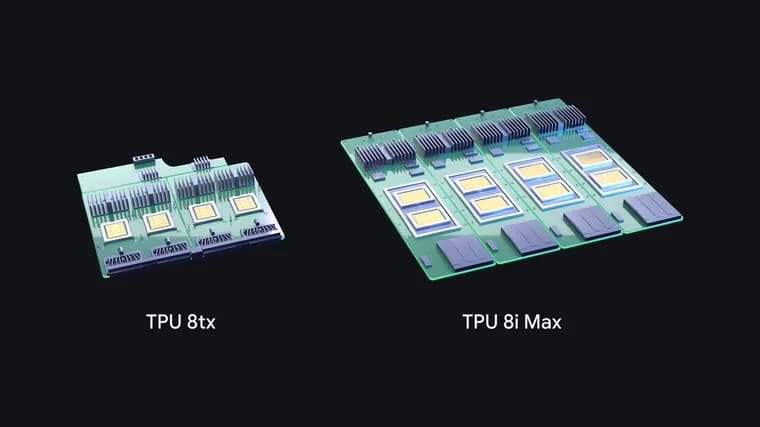
Google has expanded its eighth-generation TPU portfolio with two new systems, TPU 8tx and TPU 8i Max, in a post on blog.google. The company says it is the first time it has introduced four TPU systems in a single year. The first two, TPU 8t for large-scale training and TPU 8i for real-time reasoning, were announced at Google Cloud Next in April. Google said then that 8t and 8i offer up to 2.7 times better training performance and 80% better inference price performance, respectively, versus the previous TPU generation. Those figures date from the April announcement, not from new measurements of the two new systems.
Google frames the new systems as a response to customer feedback. With computing moving from human to agent scale, businesses want accelerators that can reason across very large context windows, and some highly regulated customers want specialized encryption for unique workloads. The post also draws a line between a chip and a system: a new chip means laying out billions of transistors in a multi-year process, while a system is how compute, networking and storage are brought together around the chip. Google says it has long built TPUs as modular building blocks inside its AI Hypercomputer, which lets it deliver specialized supercomputers in months rather than years.
TPU 8tx is the third system of the generation. It is optimized for secure and confidential inference, and Google also calls it great for small-scale training. The target is regulated enterprises and governments running frontier or proprietary models and autonomous agents next to sensitive data. The post explains that data is normally encrypted in storage and over the network but has to be unlocked in memory while being processed. TPU 8tx is built on the same silicon as TPU 8t and paired with 5th Generation AMD EPYC CPU hosts, and Google says this builds security into the hardware layer so that data and model weights stay protected and isolated even while in active use. It uses the same low-latency Boardfly network created for real-time reasoning, which Google says gives up to 2x lower latency than TPU 8t with a near-zero performance penalty. Because it pairs training-grade compute with a fast inference network, teams can fine-tune models on private data, distill large models into smaller ones and train agents with reinforcement learning on one system, without moving sensitive data between clusters.
TPU 8i Max, the fourth system, targets the memory wall. When dozens of agents work across a whole codebase or hours of video, memory bandwidth becomes the bottleneck. Google took two TPU 8i chips and combined them on a single package. The result has double the compute, double the SRAM and double the HBM bandwidth of TPU 8i. Because it fits twice the silicon in the existing rack footprint, Google says data centers can deploy significantly more computing power per square foot and per watt. For reference, the post describes TPU 8i as the reasoning engine, cutting inter-chip communication delays by up to half. In Google's summary, the four systems are TPU 8t for scale-up training, TPU 8i for low-latency reasoning, TPU 8tx for confidential computing and TPU 8i Max for massive context windows and the highest compute density per rack.
The second half of the post is about software and openness. TorchTPU was open-sourced last month, so PyTorch code and Hugging Face models run natively on TPUs, alongside out-of-the-box TPU backends for vLLM and SGLang. A new open-source TPU agent suite, now in preview, plugs into coding tools including Claude Code, Cursor and Google Antigravity to automate TPU onboarding, diagnose bottlenecks and autotune custom kernels from plain-language instructions. A new open-source XLA Serving Engine lets users train in Python and serve in a low-latency C++ runtime across TPUs, GPUs and CPUs. Google also says its native vLLM-TorchTPU stack achieved state-of-the-art price-performance marks on the InferenceX and AgentX benchmarks, with further software optimizations on the same hardware still to come.
Other items: a new Agent Compute Engine software automatically suspends and resumes idle agent sessions, which Google says cuts operational infrastructure costs. Google is open-sourcing TPU Sync, a model-state layer that treats chip HBM, host DRAM, shared storage and the data center network as one memory hierarchy, tiering large KV caches off the chip, streaming context between disaggregated prefill and decode nodes and synchronizing RL weights. Google says this cuts KV transfer latency and Time to First Token by more than 90%. Cloud Pathways, the Google DeepMind runtime behind Gemini, is now generally available on Google Kubernetes Engine. GKE dynamic slicing, also now generally available, uses optical circuit switching to assemble TPU cubes into larger topologies or split them into smaller isolated ones, and Google says it cuts job startup times by up to 5x and speeds fault recovery by up to 4.5x.
Google closes by saying TPUs are now a rapidly growing business with nearly 100 customers, including frontier labs, trading firms, retailers and universities, and that it uses AI, including AlphaChip and Gemini, to deliver chip layouts in hours rather than weeks.
Key facts
- Google added TPU 8tx (secure and confidential inference, also suited to small-scale training) and TPU 8i Max (massive context windows, highest compute density per rack) to the eighth-generation line, which now has four systems in one year.
- TPU 8i Max puts two TPU 8i chips on one package, with double the compute, double the SRAM and double the HBM bandwidth of TPU 8i, in the existing rack footprint.
- TPU 8tx is built on the same silicon as TPU 8t with 5th Generation AMD EPYC CPU hosts, keeps data and model weights protected while in use, and offers up to 2x lower latency than TPU 8t, per Google.
- Software side: TorchTPU, TPU Sync and the XLA Serving Engine are open source, the TPU agent suite is in preview, and Cloud Pathways and GKE dynamic slicing are generally available.
- Google claims TPU Sync cuts KV transfer latency and Time to First Token by more than 90%, and GKE dynamic slicing cuts job startup by up to 5x and fault recovery time by up to 4.5x.
Why it matters
Google is splitting its TPU line into more specialized systems instead of waiting for a new chip. The post argues that a system, meaning the compute, networking, storage and packaging around a chip, can be changed in months, while a new chip takes years. TPU 8tx and 8i Max are the result: one aimed at hardware-level confidentiality, the other at long-context and agent workloads where memory bandwidth is the limit. Google also says TPUs are now a growing business with nearly 100 customers and that customers can deploy TPUs in their own data centers.
Who it affects
Google names regulated enterprises and governments running frontier or proprietary models and agents on sensitive data as the audience for TPU 8tx. TPU 8i Max is for teams running many agents across large codebases or long video, and for data center operators who want more compute per square foot and per watt. The software announcements reach PyTorch and Hugging Face developers, users of vLLM and SGLang, and Google Cloud customers using GKE. The post lists customer categories (frontier labs, trading firms, retailers, universities) but names no customers.
How to use it
The post gives no availability date, region, pricing or preview or general availability status for TPU 8tx or TPU 8i Max themselves. The software is more concrete. TorchTPU is open source, so PyTorch code and Hugging Face models run natively on TPUs, with backends for vLLM and SGLang. The open-source TPU agent suite is in preview and plugs into Claude Code, Cursor and Google Antigravity. The XLA Serving Engine and TPU Sync are open source. Cloud Pathways and GKE dynamic slicing are generally available on Google Kubernetes Engine. Google says a live broadcast about the new systems ran at 9 a.m. PT.
How solid is it
This is a first-party Google announcement, so every performance figure is Google's own claim and the post names no author. The 2.7x training and 80% inference price performance numbers come from the April announcement of TPU 8t and 8i, not from the new systems. The 2x lower latency of TPU 8tx versus TPU 8t is given as 'up to', and the source does not say how it is measured or what the 'near-zero performance penalty' is quantified as. Benchmark claims for InferenceX and AgentX come with no figures. The post gives no absolute specs for any TPU system.
Risks and caveats
The post does not compare TPU 8tx or TPU 8i Max against Nvidia or other vendors' accelerators, and it names no competitor hardware for its benchmark claim. The baseline for the more than 90% cut in KV transfer latency and Time to First Token is not stated. Most headline numbers are 'up to' maximums. There are no prices, specs or availability details for the two new systems, so it is too early to judge cost or fit. The statement that upcoming software optimizations will improve results further is a promise, not a result.
“This is the first time we have introduced four TPU systems in a single year.”
— Google, blog.google