Google Research finds more European genomic data can hurt Japanese risk prediction
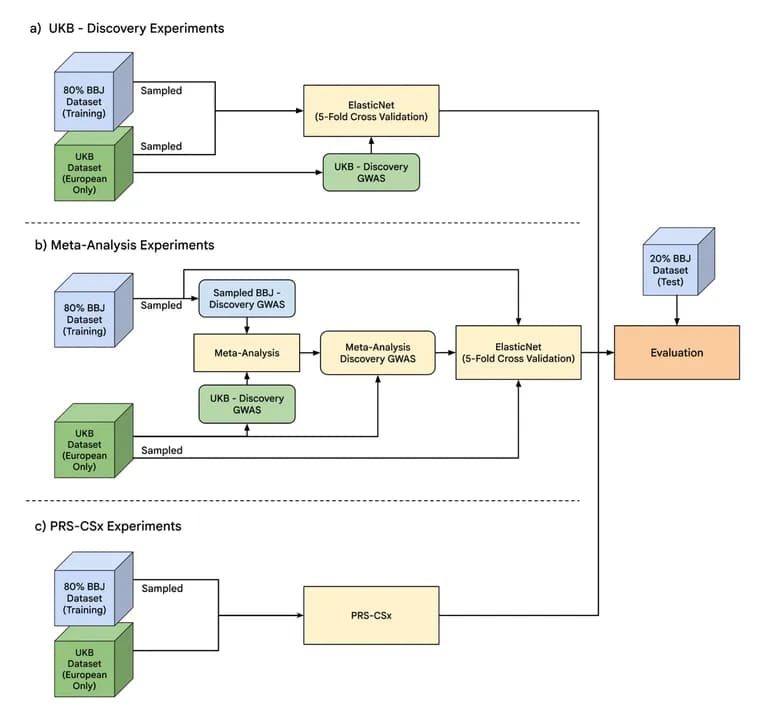
Google Research engineers Joey Poomarin Phloyphisut and Cory McLean published a study on cross population genetic risk prediction, addressing a known problem in clinical genomics: polygenic risk scores (PRSs), which predict disease risk from genetic variants using signals from hundreds to millions of them, are usually built from genome wide association studies (GWASs) run overwhelmingly on European cohorts. Applied to other populations, these scores lose accuracy because genetic architectures, population structure, and variant allele frequencies differ across ancestries. Running a full new GWAS on hundreds of thousands of people for every population is too costly for most health systems, so transfer learning, which is reusing large European-derived models and topping them up with smaller amounts of target-population data, is one proposed fix. The team tested this directly by transferring PRS models built on hundreds of thousands of European individuals in the UK Biobank (UKB) to samples from Biobank Japan (BBJ), a cohort of nearly 200,000 Japanese individuals, across eight clinical traits: body mass index, systolic and diastolic blood pressure, red and white blood cell count, HDL and LDL cholesterol, and blood glucose. Measured SNP heritability for these traits in UKB ranged from 0.07 to 0.28. Using Pearson correlation as the performance metric, the study found that pooling in European UKB data gives a real statistical boost when the Japanese target sample is very small, for example around 5,000 people, but that benefit erodes as the target sample grows, and target-population-only models overtake the transfer-learning models once BBJ sample sizes reach roughly 15,000 or more. The authors describe this crossover as surprising, and note it held across every trait they examined. Where the crossover falls depends heavily on how much genetic architecture the two populations share, measured via cross-population genetic correlation. Traits with high genetic correlation between Japanese and European cohorts, which the authors call conserved traits (BMI is one), keep benefiting from pooled European data up to much larger target sample sizes, in the 25,000 to 40,000-plus range, before Japan-specific data catches up. Lipid traits (HDL, LDL) and blood glucose behave very differently: because they are more population-specific, European data is more out of distribution for them, so the crossover to local-only training happens at a much smaller BBJ sample size. The team then tested two methods designed to also capture genetic variants unique to the Japanese cohort, rather than restricting inputs to variants discovered in Europeans. A cross-population meta-analysis approach, combining full UKB summary statistics with BBJ-specific GWAS results before fitting an elastic net model, gave little benefit for conserved traits, largely because the much smaller BBJ-only GWAS lacks statistical power on its own, but substantially outperformed single-population discovery for the population-specific traits, HDL, LDL, and to a lesser extent blood glucose; mixing in UKB data helped that method specifically when BBJ samples numbered 10,000 or fewer, with no such benefit at larger sizes. A second method, PRS-CSx, which dynamically weights the two populations' summary statistics, was expected to be less sensitive to whether a trait is conserved or population-specific, but the study found it needs more data overall than the elastic net approach to perform well: below 25,000 target samples it underperformed the best elastic net model on every trait except BMI, and only matched or beat the best model across all traits except blood glucose once sample sizes approached 100,000. The authors conclude that optimizing PRS accuracy for underrepresented populations will require both growing local, diverse biobanks and matching the modeling strategy, whether transfer learning, meta-analysis, or PRS-CSx, to a trait's heritability and the available sample size, rather than defaulting to ever-larger external datasets.
Key facts
- Google Research transferred PRS models built on hundreds of thousands of UK Biobank European samples to Biobank Japan (nearly 200,000 people), across eight clinical traits.
- Pooling in European data helps when the Japanese target sample is small (around 5,000), but target-population-only models overtake it once BBJ sample size reaches about 15,000 or more.
- The crossover point is trait-dependent: genetically conserved traits like BMI keep benefiting from European data up to 25,000-40,000+ samples, while population-specific traits (HDL, LDL, blood glucose) lose that benefit much sooner.
- A meta-analysis method combining UKB and BBJ summary statistics substantially outperformed single-population models for lipid and glucose traits, with UKB data helping only at 10,000 or fewer BBJ samples.
- PRS-CSx needed far more data to compete, trailing the best elastic net model below 25,000 target samples on all traits but BMI, and only catching up near 100,000 samples.
Why it matters
Polygenic risk scores are meant to flag disease risk from genetic data, but their clinical use has stayed limited partly because most of the underlying research was done on European cohorts, so scores built that way lose accuracy elsewhere. The default fix people reach for, transfer learning, reusing a big European model and adding a smaller local dataset on top, is exactly what this study tests directly against a real second biobank, rather than assuming it always helps.
Who it affects
The result matters most for health systems and researchers working with non-European populations who cannot afford to run a full de novo GWAS on hundreds of thousands of people, and are deciding whether to lean on existing European-derived PRS models or invest in growing their own population-specific data instead. Biobank Japan and the UK Biobank are the two cohorts used here, so the direct evidence covers Japanese versus European ancestry, though the underlying logic, that architecture-sharing between populations determines how long transfer learning stays useful, applies more broadly to any underrepresented-population PRS effort.
How to use it
The practical guidance is to match the method to the trait and the available sample size rather than always pooling in more European data: for traits highly shared across populations (like BMI), transfer learning remains useful up to fairly large local sample sizes, while for population-specific traits (like HDL, LDL, and blood glucose) it stops helping much sooner, and a meta-analysis approach that combines both populations' GWAS summary statistics does better in that regime. PRS-CSx, a more sophisticated multi-ancestry method, is not automatically the best choice either, since the study found it requires substantially more target-population data (into the tens of thousands of samples) before it reliably beats a simpler elastic net model.
How solid is it
The study is a controlled ablation using two large, deeply phenotyped, real-world biobanks (UK Biobank and Biobank Japan) rather than simulated data, evaluated consistently with Pearson correlation across eight traits and multiple modeling methods, and the authors report that the core crossover effect, transfer learning helping at small sample sizes but not larger ones, held across every trait they examined. The blog post itself does not give exact correlation or accuracy figures for any trait or sample size, describing comparisons qualitatively (for example, 'substantially outperforms' or 'matched or exceeded'), and it does not state a publication venue, peer-review status, or funding source for the underlying research.
Risks and caveats
The findings are demonstrated for one non-European population, Japanese ancestry via Biobank Japan, compared only against European ancestry via the UK Biobank, so it is not established from this post how the same crossover pattern generalizes to other underrepresented ancestries with different degrees of genetic overlap with European cohorts. No numeric accuracy values are given, no clinical adoption timeline or follow-up study is mentioned, and the post does not specify which non-BMI traits PRS-CSx still failed to match at the largest sample size tested, beyond noting that blood glucose was excluded.