Google Research unveils multi-agent framework for coherent long-form AI video
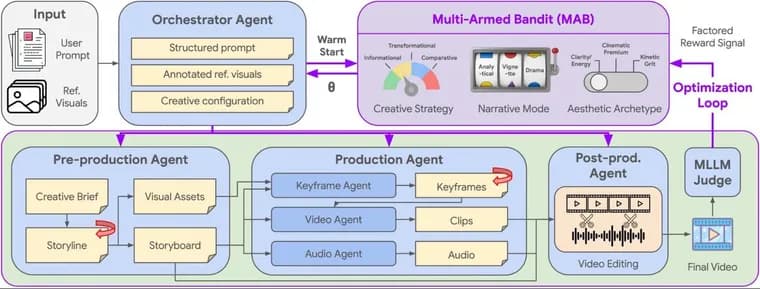
On September 24, 2026, Google Research Scientists Yale Song and Yiwen Song published a blog post introducing a unified multi-agent framework for producing coherent, long-form AI video. It is built as an orchestration layer on top of Google's Gemini and Veo models and targets two recurring failures of existing agentic video pipelines: semantic drift, where character attire or scenery subtly shifts across shots, and cascading failures, where an early artifact in one generated asset corrupts everything generated downstream. The authors trace this to independent, handcrafted prompting for each shot, which makes it hard to trace a terminal failure back to the prompt that caused it, plus related problems of feature drift and content collapse, where a narrative stalls rather than progresses.
The work is organized into four components. AI video co-director is a hierarchical system that treats long-form storytelling as a global optimization problem: a multi-armed bandit picks a creative configuration across three dimensions (creative strategy, narrative mode, and aesthetic archetype), an Orchestrator Agent and Pre-Production Agent turn that into a storyboard, a Production Agent generates keyframes, video and audio through specialized sub-agents, and a multimodal LLM judge scores the result and feeds that reward back into the bandit. This component is scheduled to appear at COLM 2026 and reaches a peak quality score of 81.4 on the GenAD-Bench benchmark, with additional gains reported on ViStoryBench.
CANVAS (Continuity-Aware Narratives via Visual Agentic Storyboarding), set to appear at EMNLP 2026, sits on top of Gemini and keeps a persistent visual memory of characters, locations and objects so that scenes remain consistent when the story returns to them. In a demonstration museum-heist sequence, Google compares CANVAS with plain Gemini-3.1-Pro generation and with a rival multi-agent system called AutoStudio; both baselines showed prop and background drift and a disappearing costume detail, while CANVAS kept the thief, the exhibit hall and the gemstone visually consistent across cuts. CANVAS is reported to yield gains on the ST-Bench and HardContinuityBench benchmarks.
A²RD, an agentic autoregressive video generation architecture, builds the actual footage segment by segment, guided by a multimodal video memory that tracks each segment's context. For every segment it runs a retrieve-synthesize-refine-update loop and switches between extrapolation, to push the story into new narrative territory, and interpolation, to anchor recurring characters and settings to their established look. Google demonstrated the approach with a ten-minute generated film intended to show character identity, costume and scene geometry held constant from the opening shot to the last; it reports gains on the VBench-Long and LVBench-C benchmarks.
VQQA (Video Quality Question Answering) generates targeted visual questions about a clip and uses a vision-language model's answers as natural-language feedback, described as a 'semantic gradient,' to iteratively rewrite the generation prompt rather than edit pixels directly. A Global Selection mechanism then scores every video produced across the whole refinement run against the original prompt, rather than automatically keeping the last iteration, so a late fix cannot silently break something correct earlier in the sequence. The post gives two examples: VQQA correcting a balloon rendered with the wrong surface texture on a cuboid object, and fixing a scene where a violinist and pianist were shown swapping instruments mid-performance. VQQA is reported to improve results on T2V-CompBench, VBench2 and VBench-I2V.
Because the whole system is built on top of Gemini and Veo, Google says it natively inherits those models' safety mechanisms, including SynthID watermarking, and that additional safety classifiers can be run across the finished, compiled video to catch unintended interactions between clips that were each individually judged safe. The post states that, across its evaluations, the framework shows substantial gains in multi-shot narrative consistency and character persistence while generating minutes-long video and limiting drift and error propagation. The post does not give a release date or availability for any of the four components outside the associated research papers, and it gives specific benchmark scores only for AI video co-director; the other three components' benchmark results are described qualitatively.
Key facts
- Google Research Scientists Yale Song and Yiwen Song published the framework on September 24, 2026, as an orchestration layer built on top of Gemini and Veo
- The system has four components, AI video co-director, CANVAS, A²RD and VQQA, each targeting a different cause of drift or error in long-form AI video
- AI video co-director reaches a peak quality score of 81.4 on the GenAD-Bench benchmark; its paper is set to appear at COLM 2026, and CANVAS's at EMNLP 2026
- A²RD was demonstrated on a ten-minute generated film meant to hold character identity, costume and scene geometry consistent throughout
- Because the framework orchestrates Gemini and Veo, it inherits SynthID watermarking, and Google says additional safety classifiers can be run across the finished video
Why it matters
Long-form AI video today is usually stitched together from separately generated, independently prompted shots, which causes characters and settings to visibly drift and lets a single bad asset corrupt everything generated after it. Google's framework instead treats an entire video as one global optimization and world-state tracking problem, which the researchers say produces substantial gains in narrative consistency and character persistence when generating minutes-long output.
Who it affects
It is aimed at researchers and engineers building agentic video-generation pipelines on top of foundation models like Gemini and Veo, and by extension at anyone who might eventually use such tools to produce longer AI-generated narrative video rather than isolated short clips.
How to use it
This is research, not a shipped product: the post gives no release date or public availability for any of the four components. Two of the associated papers have publication venues, AI video co-director at COLM 2026 and CANVAS at EMNLP 2026. The architecture is described as model-agnostic, meaning it could in principle sit on top of other foundation video models, though the current implementation orchestrates Gemini and Veo specifically.
How solid is it
The account comes directly from Google Research's own blog and is not an independent evaluation. Only AI video co-director is given a specific benchmark figure, a peak score of 81.4 on GenAD-Bench; CANVAS, A²RD and VQQA are said to improve on benchmarks including ST-Bench, HardContinuityBench, VBench-Long, LVBench-C, T2V-CompBench, VBench2 and VBench-I2V, but the post states these as qualitative gains rather than reporting the numbers, and points readers to the individual papers for full architecture and evaluation details.
Risks and caveats
Beyond AI video co-director's single reported figure, the improvements claimed for CANVAS, A²RD and VQQA are qualitative rather than quantified in the post, and no benchmark construction details or sample sizes are given. No timeline or availability is stated for turning any of the four components into a usable tool outside the research papers.
“Across comprehensive evaluations, our framework demonstrates substantial gains in multi-shot narrative consistency and character persistence, successfully generating minutes-long videos while mitigating visual drift and pipeline error propagation.”
— Yale Song and Yiwen Song, Research Scientists, Google