Google ships TimesFM-3, a multivariate forecasting model
Google Research introduced TimesFM-3 on August 31, 2026, in a blog post by Research Scientists Ayush Jain and Rajat Sen, with additional credit to Yichen Zhou, Petros Mol, Abhimanyu Das and Samet Oymak as joint project collaborators. TimesFM-3 is the latest generation of Google's TimesFM family of zero-shot time series foundation models, first launched in 2024. It has 330 million parameters and is pre-trained on a real-world and synthetic time-series corpus of more than 1 trillion time points.
The headline change is multivariate forecasting. Every TimesFM release up to TimesFM-2.5, released in September 2025, was limited to univariate forecasting: predicting a series from its own history alone. TimesFM-3 is natively pre-trained to jointly predict multiple coevolving time series and to use auxiliary external features, without task-specific fine-tuning. Google illustrates this with a retail example: forecasting ice cream sales from past sales alone misses the story, while a model that also sees sales of related products, foot traffic, and known future events such as promotions and holidays can anticipate the effect of those events. In the example given, feeding a planned promotion schedule into the model as a covariate lets it anticipate a roughly 20% sales bump on each promotion day, a pattern a univariate model does not catch because it has no visibility into the promotion calendar.
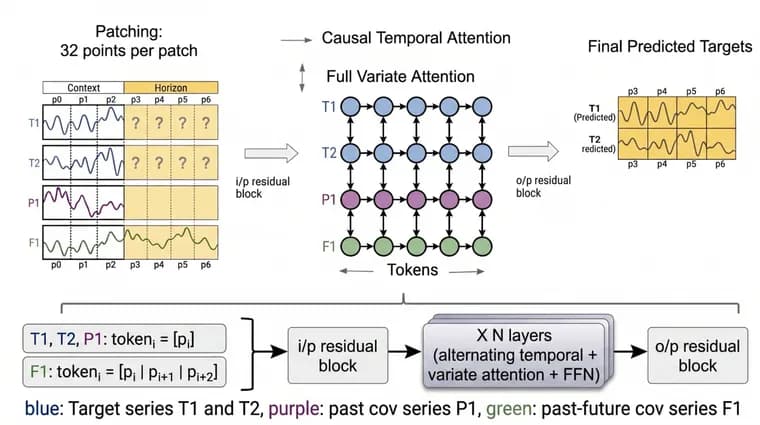
Architecturally, TimesFM-3 keeps the decoder-only transformer design of earlier versions and groups contiguous data points into patches of 32 time steps, normalizing per time series as TimesFM-2.5 did. Target and past-covariate series are each turned into one token per patch. Past-future covariates, meaning known future signals, use what Google calls a lookahead strategy: each token concatenates the current patch with future patches so the model can see upcoming known information ahead of time. The tokens then pass through an input residual block into a transformer stack that operates as a 2D grid, alternating attention across time and attention across series so temporal patterns and cross-series relationships are blended over several layers.
For generation, TimesFM-3 replaces the one-patch-at-a-time approach of earlier versions, which added latency, compounding error and computational cost, with a technique Google calls Contiguous Patch Masking. Masked placeholder tokens are appended for the entire future horizon alongside the observed context; target and past-covariate series are masked in that horizon while past-future covariates stay visible. The alternating attention layers fill in all masked horizon patches at once, in a single forward pass, with no iterative loop. For each target series, the model outputs 9 quantiles per horizon step, spanning the 10th to the 90th percentile, giving a full probabilistic view of forecast uncertainty rather than a single point estimate.
Google evaluated TimesFM-3 against recent multivariate-capable foundation models, including Chronos-2 and the Toto 2.0 family, as well as its own predecessor TimesFM-2.5, on three public benchmarks: Gift-Eval, FEV-Bench and Time. On all three, TimesFM-3 is the top-ranked pretrained foundation model on both point and probabilistic forecasting metrics, measured by average rank across tasks (the source describes this with rank plots rather than tabulated numeric scores). Even run in a univariate-only mode, with no covariate or cross-series information, TimesFM-3 already matches or beats competing models; switching on the full multivariate mode pushes it to the best average rank overall.
TimesFM-3 is available now on GitHub and Hugging Face, with BigQuery integration described as landing in the coming weeks, no exact date given. In the meantime, Google points users to TimesFM-2.5, already usable on univariate tasks through BigQuery's AI.FORECAST command.
Key facts
- TimesFM-3 has 330 million parameters and is pre-trained on more than 1 trillion time points from a real-world and synthetic corpus.
- Unlike TimesFM-2.5 (released September 2025), which was univariate only, TimesFM-3 is natively pre-trained for multivariate forecasting, jointly using multiple time series and covariates such as promotions or weather.
- In Google's ice cream sales example, feeding a promotion schedule as a covariate lets the multivariate model anticipate a roughly 20% sales bump on promotion days that a univariate model misses.
- Using a technique called Contiguous Patch Masking, TimesFM-3 generates the entire forecast horizon in a single forward pass and outputs 9 quantiles, from the 10th to the 90th percentile, per target series at every step.
- On three public benchmarks, Gift-Eval, FEV-Bench and Time, TimesFM-3 ranked top among pretrained foundation models on both point and probabilistic forecasting, ahead of models including Chronos-2 and the Toto 2.0 family.
Why it matters
TimesFM-3 closes a gap Google itself names: every TimesFM model through 2.5 could only forecast a series from its own past, while most real forecasting problems, from retail demand to observability, depend on related series and known future events like promotions or holidays. Making multivariate forecasting zero-shot, meaning it works without task-specific fine-tuning, and generating a full horizon in one forward pass instead of one patch at a time also cuts the latency and compounding error that iterative generation carried in earlier versions.
Who it affects
The source names retail, finance, observability, manufacturing, healthcare and natural sciences as domains generally adopting time-series foundation models, without citing specific customers or deployments. In practice this reaches teams building forecasting pipelines, such as demand or revenue forecasting that needs to account for promotions, pricing, weather or scheduled events, and Google Cloud users who already work through BigQuery's forecasting tools.
How to use it
TimesFM-3 is available now on GitHub and Hugging Face. BigQuery integration is described only as coming in the following weeks, with no specific date given, and the source states no pricing or licensing terms. Until the BigQuery integration ships, Google points users toward TimesFM-2.5, which already works for univariate tasks through BigQuery's AI.FORECAST command.
How solid is it
Google reports TimesFM-3 as the top-ranked pretrained foundation model on three public benchmarks, Gift-Eval, FEV-Bench and Time, for both point and probabilistic forecasting, measured against models including Chronos-2, the Toto 2.0 family and TimesFM-2.5. It also reports that TimesFM-3 matches or beats those models even run in univariate-only mode. These are Google's own results, presented as average-rank comparisons across tasks rather than as tabulated numeric scores, so no specific margin of improvement over any rival model is given.
Risks and caveats
The benchmark claims come from Google's own blog post, evaluating its own model, with no independent scores published: the plots show relative rank, not the underlying accuracy numbers. No pricing or licensing terms are disclosed, no exact date is given for BigQuery availability, and no named customer deployments back up the domains listed as adopters.