Google unveils GlucoFM, a dual-stream foundation model for glucose monitoring
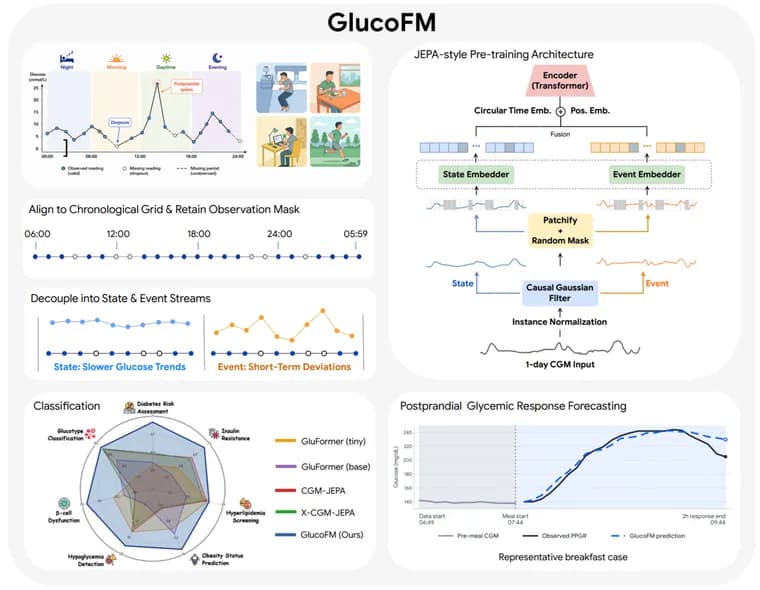
Google Research published GlucoFM on August 26, 2026, a lightweight self-supervised foundation model for continuous glucose monitor (CGM) data. The blog post is co-authored by Ahmed A. Metwally (Staff Research Scientist) and Zechen Li (Student Researcher), with contributions from a wider team including Flora D. Salim of the University of New South Wales. Prior CGM foundation models the post names, CGMformer, GluFormer, and CGM-JEPA, process glucose readings through a single representation stream. GlucoFM instead uses a dual-stream design: one stream models slower baseline glycemic trends, the other captures short-term deviations that can come from meals, activity, or sensor artifacts, while the model preserves time-of-day information and explicitly marks missing readings rather than discarding them.
GlucoFM was pre-trained on 109,066 hours of unlabeled CGM data from the Wear-CGM studies. Each recording is aligned to a 24-hour, five-minute grid with an observation mask for gaps. Rather than reconstructing exact raw glucose values, which can be distorted by measurement noise, the model is trained with latent-prediction objectives, and CGM-aware augmentations (baseline drift, compression-like drops, sparser sampling, short disconnections) expose it to the kind of missingness real CGM recordings contain.
The evaluation covered four cohorts (CGMacros, Stanford, Hall, and ShanghaiT2DM) and seven clinical prediction tasks: diabetes risk, insulin resistance, beta-cell dysfunction, hyperlipidemia, hypoglycemia, obesity, and glucotype, for 14 cohort-task combinations in total. Using subject-disjoint linear probing on the frozen encoder, GlucoFM raised average PR-AUC from 54.7, the score of the strongest CGM-specific baseline retrained on the same data, to 58.8, an absolute gain of 4.1 points, or about 7.5% relative to that baseline. It led every diabetes-risk and beta-cell-dysfunction evaluation and three of four insulin-resistance evaluations. Measured specifically against GluFormer, with both models pre-trained on the same corpus, GlucoFM's PR-AUC was 5.8 percentage points higher on average.
On a separate forecasting task, predicting the two-hour postprandial glucose-change trajectory from 874 paired meal events across 34 participants (Dexcom and Libre devices evaluated separately), GlucoFM reached the lowest mean absolute error when given the full context of one hour of pre-meal CGM, meal nutrition, and participant data: 21.88 mg/dL, against 22.90 mg/dL for the best baseline and 27.69 mg/dL for a train-fold-mean baseline.
Combining representations from multiple days, rather than a single 24-hour trace, improved PR-AUC in most settings, including a 9.6-point gain on Stanford beta-cell dysfunction and a 14.0-point gain on Hall diabetes prediction; ShanghaiT2DM insulin resistance was the main exception. In cross-dataset transfer testing, GlucoFM outperformed the strongest competing method in 11 of 12 evaluations, by 0.5 to 8.6 PR-AUC points, and trailed once by 0.6 points, with absolute PR-AUC ranging from 61.6% (both Stanford-to-Hall tasks) to 90.0% (Hall-to-CGMacros insulin resistance). In few-shot tests that varied the number of labeled participants or the fraction of observations available, GlucoFM stayed ahead of alternatives at every data budget tested, including as little as one labeled participant per class or 1% of observations.
An ablation study comparing the dual-stream design against simpler alternatives, a raw-input model, a slow-trend-only model, and a deviations-only model, found the deviations-only version weakest, while the dual-stream model consistently came out on top, supporting the choice to model the two dynamics separately before combining them.
The authors describe the current pre-training population as modest given how much metabolic responses vary across people, cohorts, and sensor devices. They say next steps are training on larger, more diverse populations and extending GlucoFM beyond independently processed 24-hour windows toward native multi-day modeling and real-time changes, without giving a timeline. The post does not name a publication venue, paper, or link for the underlying research, does not disclose model size or compute cost, and makes no claim of clinical deployment or regulatory review; all reported results are evaluations against existing research cohort datasets.
Key facts
- GlucoFM was pre-trained on 109,066 hours of unlabeled CGM data from Wear-CGM, using a dual-stream encoder that separates slow glycemic trends from short-term deviations, unlike prior single-stream CGM models such as CGMformer, GluFormer, and CGM-JEPA.
- Across 14 cohort-task evaluations spanning four cohorts, GlucoFM raised average PR-AUC from 54.7 to 58.8 (a 4.1-point absolute, about 7.5% relative gain) over the best retrained CGM-specific baseline, and beat GluFormer by 5.8 percentage points PR-AUC on average.
- For postprandial glucose-change forecasting on 874 meal events from 34 participants, GlucoFM reached the lowest mean absolute error, 21.88 mg/dL, against 22.90 mg/dL for the best baseline.
- In cross-dataset transfer testing, GlucoFM beat the strongest competing method in 11 of 12 evaluations, by 0.5 to 8.6 PR-AUC points, and stayed ahead in few-shot settings down to one labeled participant per class.
- The authors call the current pre-training population modest and plan to scale to larger, more diverse populations and native multi-day modeling, without giving a timeline.
Why it matters
CGM traces are hard to interpret because high-quality clinical labels are sparse and costly, so a model that learns useful patterns from unlabeled data alone is valuable. GlucoFM's departure from prior CGM foundation models is structural: instead of one stream for the whole signal, it separates slow baseline trends from short-term deviations, and the paper's own ablation shows this split materially outperforms single-stream alternatives.
Who it affects
The direct audience is researchers building diabetes-risk, insulin-resistance, and other metabolic prediction tools from wearable CGM data. Device makers whose sensors were used in the evaluation, Dexcom and Libre, and clinicians working with CGM data are potential downstream beneficiaries, but the post describes a research evaluation, not a shipped tool.
How to use it
No product, API, price, or license is described. This is a Google Research blog post reporting benchmark results, not a released model or service.
How solid is it
GlucoFM was tested across four independent cohorts (CGMacros, Stanford, Hall, ShanghaiT2DM), seven clinical tasks, and 14 cohort-task combinations, with consistent gains over both a retrained same-data baseline and GluFormer, plus cross-dataset transfer and few-shot experiments and a dual-stream ablation. The post does not name a publication venue, paper title, or link, and gives no model size or compute-cost figures.
Risks and caveats
The authors themselves describe the pre-training population as modest relative to how much metabolic responses vary across people, cohorts, and sensor devices, and give no timeline for scaling up or moving to multi-day modeling. The post makes no claim of clinical deployment or regulatory review, and of the other named prior CGM foundation models, only GluFormer receives a direct numeric comparison; CGMformer and CGM-JEPA are named but not benchmarked.