GPT 6.1 nearly triples a score by managing its own context
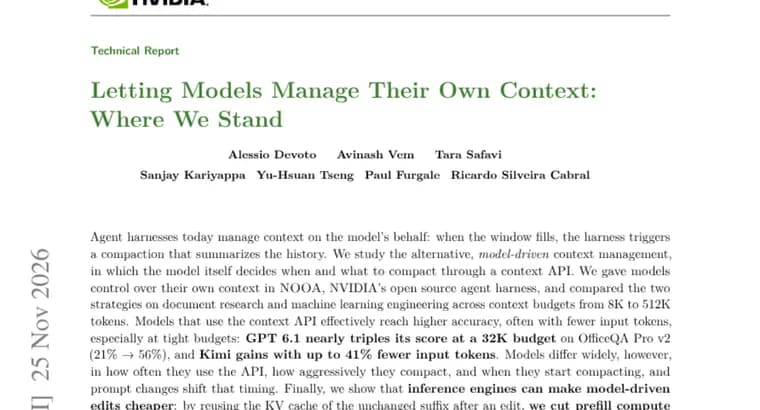
A paper titled "Letting Models Manage Their Own Context: Where We Stand" examines who should decide what stays in a model's context window. In today's agent harnesses, the authors write, that job is done on the model's behalf: when the window fills, the harness triggers a compaction that summarizes the history. The alternative they study is model-driven context management, in which the model itself decides when and what to compact through a context API.
The authors gave models control over their own context in nooa, NVIDIA's open source agent harness. They then compared the two strategies on document research and machine learning engineering, across context budgets from 8K to 512K tokens.
Models that use the context API effectively reach higher accuracy, often with fewer input tokens, and especially at tight budgets. In one example, GPT 6.1 nearly triples its score on OfficeQA Pro v2 at a 32K budget, from 21% to 56%. Kimi also gains, using up to 41% fewer input tokens.
Behaviour varies widely between models. They differ in how often they call the API, how aggressively they compact and when they start compacting. Changes to the prompt shift that timing.
The last result concerns serving cost. Inference engines can make model-driven edits cheaper by reusing the KV cache of the unchanged suffix after an edit. This cut prefill compute by up to 15% per request, with no measurable change in accuracy.
The authors conclude that the results point to a new co-design frontier: models trained to manage their own context, served by inference engines that support KV cache editing.
Key facts
- The study compares harness-triggered compaction with model-driven context management, where the model decides when and what to compact through a context API.
- Tests ran in NVIDIA's open source nooa harness on document research and machine learning engineering, with context budgets from 8K to 512K tokens.
- GPT 6.1 went from 21% to 56% on OfficeQA Pro v2 at a 32K budget; Kimi gained while using up to 41% fewer input tokens.
- Models differ widely in how often they use the API, how hard they compact and when they start, and prompt changes shift the timing.
- Reusing the KV cache of the unchanged suffix after an edit cut prefill compute by up to 15% per request with no measurable change in accuracy.
Why it matters
The study questions a default in current agent harnesses, where the harness decides that the window is full and summarizes the history. Handing that decision to the model raised accuracy for models that used the context API well, often while consuming fewer input tokens. The effect showed up especially at tight budgets, as in the GPT 6.1 result at 32K. The authors see a co-design problem here that links how models are trained with how they are served.
Who it affects
Developers of agent harnesses are the most direct audience, since the work compares their current compaction approach with an alternative. Teams running agents under tight context budgets have a reason to look at the accuracy and token results. Builders of inference engines are addressed too: the authors argue that support for KV cache editing can make model-driven edits cheaper.
How to use it
The experiments used nooa, NVIDIA's open source agent harness, where models control their context through a context API. Anyone trying the approach should check how a given model actually behaves, because usage, compaction aggressiveness and starting point differ widely. Prompt wording is one lever: changing it shifts when compaction begins. On the serving side, the technique is to reuse the KV cache of the unchanged suffix after an edit.
How solid is it
These are the authors' own results, and this account rests on the paper's abstract. The headline figure is a single example: one model, GPT 6.1, on OfficeQA Pro v2 at a 32K budget. No Kimi version is named, and the benchmark and budget behind the 41% input-token figure are not stated. No scores are given for the machine learning engineering tasks.
Risks and caveats
The accuracy gains are stated for models that use the context API effectively, so they should not be read as applying to every model. Fewer input tokens came often, which is not the same as always. The 41% and 15% figures are maximums. The 15% refers to prefill compute per request. Models trained to manage their own context are described as part of a frontier the results point to.
“Together, these results point to a new co-design frontier: models trained to manage their own context, served by inference engines that support KV cache editing.”
— The paper's authors, in the abstract