GPT-6-Astra report: robot competence across 12 benchmarks, not yet practical embodied intelligence
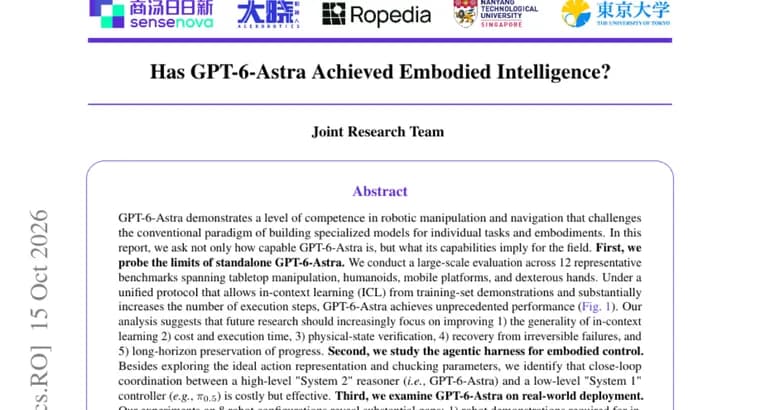
A report listed on Hugging Face papers asks what GPT-6-Astra's abilities in robotic manipulation and navigation mean for the field. Its opening claim is that the model's competence challenges the conventional paradigm of building specialized models for individual tasks and embodiments. The report is organised in four parts.
First, the authors probe the limits of the standalone model. They run a large-scale evaluation across 12 representative benchmarks spanning tabletop manipulation, humanoids, mobile platforms and dexterous hands. The protocol is unified: it allows in-context learning (ICL) from training-set demonstrations and substantially increases the number of execution steps. Under it, the authors say GPT-6-Astra achieves "unprecedented performance" (their Fig. 1). They list five areas for future research: the generality of ICL, cost and execution time, physical-state verification, recovery from irreversible failures, and long-horizon preservation of progress.
Second, they study an agentic harness for embodied control, in which GPT-6-Astra acts as a high-level "System 2" reasoner and a low-level "System 1" controller (π0.5 is given as an example) handles execution. They find that this close-loop coordination is costly but effective.
Third, they test the model in real-world deployment on 8 robot configurations and report substantial gaps. Robot demonstrations needed for ICL are expensive to collect, and it is implausible to trade longer execution for higher success rates once physical constraints apply.
Fourth, they sketch the next generation of embodied benchmarks and build a prototype. Its tasks come from real-world needs, it gives no in-domain demonstrations, and it judges agents on a world clock that keeps running while they deliberate.
Taken together, the authors write that their results suggest GPT-6-Astra has largely crossed the threshold of embodied competence, but not yet that of practical embodied intelligence. The text gives no success rates, scores or per-benchmark figures, and does not name the benchmarks or the robot configurations.
Key facts
- The report evaluates GPT-6-Astra on 12 representative benchmarks covering tabletop manipulation, humanoids, mobile platforms and dexterous hands.
- The unified protocol allows in-context learning from training-set demonstrations and raises the number of execution steps substantially; the authors call the resulting performance "unprecedented".
- Pairing GPT-6-Astra as a "System 2" reasoner with a low-level "System 1" controller (e.g., π0.5) is described as costly but effective.
- Tests on 8 real robot configurations show substantial gaps: demonstrations for ICL are expensive to collect, and trading longer execution for higher success rates is implausible under physical constraints.
- The authors' verdict: the model has largely crossed the threshold of embodied competence, but not yet that of practical embodied intelligence.
Why it matters
The report's central claim is that one general model handling manipulation and navigation across very different robots challenges the habit of building a specialized model for each task and embodiment. The authors do not stop at benchmark scores. They name what still blocks practical use: cost, execution time, physical-state verification, recovery from irreversible failures and keeping progress over long horizons. They also propose a benchmark prototype in which the clock keeps running while the agent thinks and no in-domain demonstrations are given.
Who it affects
The findings are aimed at robotics researchers and teams building embodied agents, especially those weighing a general model against task-specific ones. Anyone designing embodied benchmarks is addressed directly by the fourth part of the report. The text also points to the cost of collecting robot demonstrations, which falls on teams that want to rely on in-context learning.
How to use it
The text offers no code, release or access details, so there is nothing to run. What can be taken from it is a set of design hints: the high-level reasoner plus low-level controller setup is reported to work but at a cost; ICL depends on demonstrations that are expensive to gather; and extra execution time cannot simply be traded for success rate on real hardware. The five listed research directions double as a checklist for evaluating similar systems.
How solid is it
This is a report by the evaluators themselves, and the headline results are the authors' own reading. The text names no authors or institutions and does not say who developed GPT-6-Astra. It gives no success rates, scores or per-benchmark figures, so "unprecedented" is not quantified and no baseline or competing model is named for comparison. The 12 benchmarks and 8 robot configurations are not named, and no peer review status is stated. The conclusion itself is hedged: "largely crossed" competence, "not yet" practical embodied intelligence.
Risks and caveats
The evaluation protocol favours the model: it allows in-context learning from training-set demonstrations and substantially more execution steps, and the authors themselves show that this does not carry over cleanly to real robots. Real-world tests exposed "substantial gaps", with no figures given. The title question is not answered with a plain yes or no. No numbers are given for cost, execution time, steps or demonstrations, so the size of the practical obstacles cannot be judged from the text.
“our results suggest that GPT-6-Astra has largely crossed the threshold of embodied competence, but not yet that of practical embodied intelligence.”
— The report's authors, Hugging Face papers listing