Green Mountain Power's home batteries become Vermont's largest power source
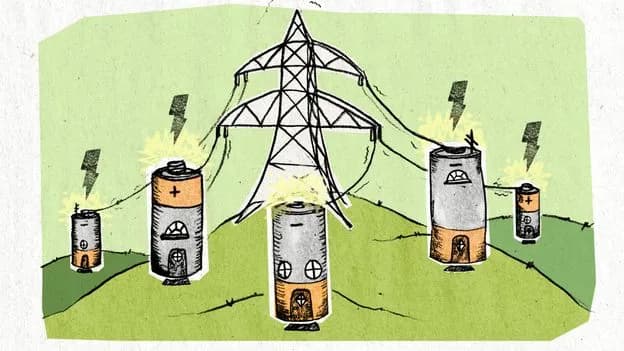
A BBC Future feature looks at Green Mountain Power (GMP), Vermont's largest utility, which serves over 75% of the state. GMP has built a virtual power plant out of batteries in customers' homes. The article says the programme now provides some 110MW, about the same as a small-to-average-sized natural gas plant, and is the largest power source in the state.
The human story is Pollyanna Bladyka of Springfield, in eastern Vermont. Storms used to knock out her power a dozen times a year, often for several hours. In 2024 she was about to buy a $12,000 (£9,000) gas generator, as many neighbours had. The electrician she hired told her about GMP's scheme instead: two batteries installed in the home for $55 (£41) a month over a 10-year lease. She and her husband took it, and have not lost power since the system went in during 2024. Her battery should run the house for two days if use of things like dishwashing and laundry is kept to a minimum. She says she did it "for myself" rather than the environment. Megan Browning, in northern Vermont, has two GMP batteries plus rooftop solar; when a windstorm downed a nearby line, she says, she "didn't even notice a flicker".
More than 5,500 people in Vermont have similar home battery systems, and GMP says over 2,500 have enrolled in the lease programme since 2023, when state regulators lifted a cap on it. The programme began as a pilot in 2017. Kate Peters of the Brattle Group, a consultancy, says it may be one of the largest battery programmes in the US. GMP can draw on the batteries whenever needed, though the customer always keeps some reserve power, especially during outages. It also links in EV batteries, commercial demand response and a handful of utility-scale batteries. Around 50% of participating homes with batteries also have solar panels, GMP says. The virtual plant itself produces no power; software manages and conserves energy so existing supply goes further when the grid needs it most.
The main grid-side payoff is peak demand. Utilities traditionally build peaker plants, often expensive and polluting, for the few days a year when use peaks. GMP used to rely on oil, diesel and natural gas peakers. CEO Mari McClure says the virtual power plant has effectively replaced them, and the company has decommissioned them as they reached end of life. Four peaking plants still run very occasionally if the regional New England grid operator calls on them, and GMP hopes to close them all soon. Rocky Mountain Power in Utah has done something similar on a smaller scale. GMP says its virtual power plant saved customers $11m (£8m) last year.
The backdrop is weather: seven of GMP's 10 most damaging storms have come in the last decade, causing more than $225m (£168m) in damages, the company says. GMP has a goal of eliminating all outages by 2030, with batteries alongside measures like undergrounding lines. In some rural, outage-prone areas it has proposed giving thousands of customers batteries at no cost, and has done so on a small scale in pilots. It aims to offer storage to all its almost 300,000 customers who want it, and to more than double the size of the virtual power plant by 2034. It also hopes to add Vermont's EV batteries (vehicle-to-grid). McClure says she once powered her rural home for five days from her Ford F-150 Lightning during an outage.
Nationally, the US has over 40GW of virtual power plant capacity, per internal Wood Mackenzie analysis, against roughly 600GW of natural gas and 200GW of coal. A 2025 US Department of Energy report says 160GW could be unlocked by 2030, equal to some 20% of expected peak demand, and that these plants could save the US over $10bn (£7.4bn) annually by 2030. Jen Downing, a former DOE official and lead author of its 2023 virtual power plant report, names the biggest barrier as a "backwards financial incentive structure": utilities make more money if they build things. She adds that this is not true of every utility. Other hurdles include the cost of enrolling customers and integrating into wholesale markets. Massachusetts, Illinois and New Jersey are pushing utilities to procure capacity from virtual power plants, and states and tech companies see them as a way to make room on the grid for data centres.
Key facts
- Green Mountain Power's programme installs two home batteries for $55 a month over a 10-year lease; more than 5,500 people in Vermont have similar systems.
- The virtual power plant provides some 110MW, per the article the largest power source in Vermont, and has effectively replaced GMP's oil, diesel and gas peaker plants; four peakers still run very occasionally.
- GMP says the programme saved customers $11m last year and aims to offer storage to all its almost 300,000 customers, more than doubling the plant by 2034.
- Seven of GMP's 10 most damaging storms came in the last decade, causing more than $225m in damages; GMP targets zero outages by 2030.
- Nationally the US has over 40GW of virtual power plant capacity (Wood Mackenzie); a 2025 DOE report sees 160GW unlockable by 2030, but utility incentives remain a barrier.
Why it matters
This is a working example of a utility replacing peaker plants with software-coordinated home batteries, rather than a pilot or forecast. The article says GMP's virtual power plant has effectively replaced its oil, diesel and gas peakers, which are expensive and often highly polluting, and is now the largest power source in Vermont at some 110MW. The scale is still small against the US fleet: over 40GW of virtual power plant capacity today versus roughly 600GW of natural gas and 200GW of coal. A 2025 Department of Energy report puts the potential at 160GW by 2030, equal to some 20% of expected peak demand. States and tech companies are also eyeing these systems as a way to make room on the grid for data centres.
Who it affects
Vermont households in GMP territory are the direct users: the utility serves over 75% of the state, and over 2,500 people have enrolled since 2023. Rural, outage-prone customers may get batteries at no cost, since GMP has proposed that for thousands of customers. Utilities elsewhere face the same peak-demand question, and Massachusetts, Illinois and New Jersey are pushing them to buy virtual power plant capacity. Regulators matter too: Vermont's enrolment surge followed regulators lifting a cap in 2023. Electric vehicle owners are a possible next group if vehicle-to-grid takes off.
How to use it
In Vermont, a GMP customer can get two batteries installed at home for $55 (£41) a month over a 10-year lease. Bladyka was pointed to the scheme by an electrician she had hired to install a generator. GMP can draw on the batteries whenever needed, but the customer always keeps some reserve power, especially during outages. About half of participating homes with batteries also have solar. A battery like Bladyka's can power a house for two days if usage is kept to a minimum. Outside GMP's area, the article gives no purchase or enrolment details.
How solid is it
The feature is a BBC Future report with on-site interviews in May 2026 and named sources, including the GMP chief executive, a Brattle Group expert, the president of the New Jersey Board of Public Utilities and a former DOE official. Most of the programme numbers come from GMP itself: the 110MW figure, the $11m savings, the storm damage and the roughly 50% solar share. The article gives no independent evaluation of whether GMP will meet its 2030 goal of eliminating all outages. The 160GW and $10bn figures are US-wide Department of Energy projections, not Vermont figures. The Wood Mackenzie capacity figure is from internal analysis.
Risks and caveats
Downing calls a backwards financial incentive structure the most significant barrier: utilities make more money if they build things, though she says this is not the case for every utility. Other hindrances include the cost of enrolling customers and difficulty integrating virtual power plants into wholesale electricity markets. The article gives no overall cost of the programme to GMP or ratepayers, only the $55 monthly lease price and the $11m savings GMP claims. Vehicle-to-grid is unproven: Downing says EV storage is enormous but not really cost-effective today for most consumer EVs, and it remains to be seen whether it becomes a gamechanger. GMP still keeps four peaking plants that run very occasionally, and gives no closing date.
“We believe in a two-way grid”
— Mari McClure, chief executive of Green Mountain Power